


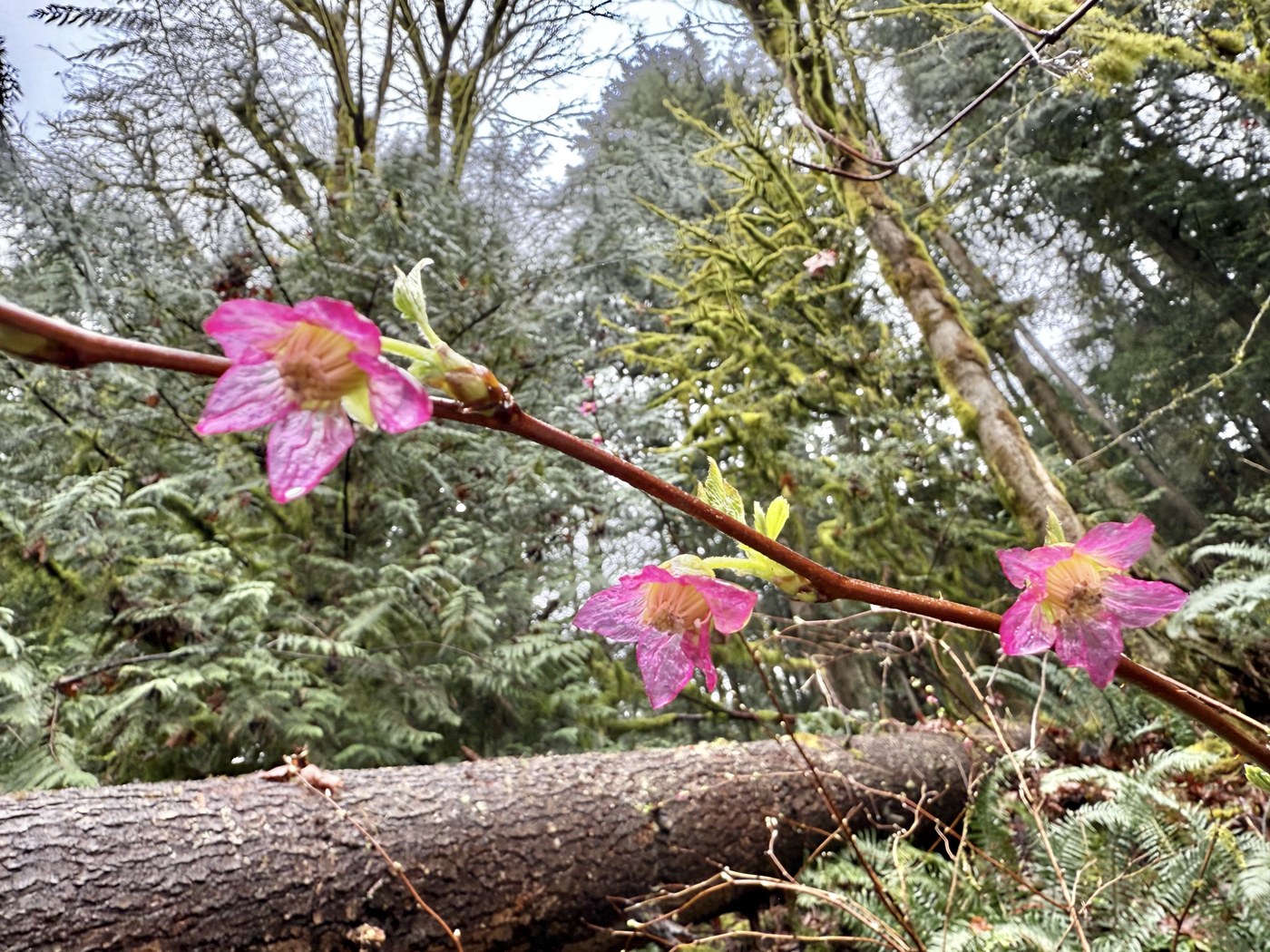
Update: I’ve given this info to WA Dep of Ecology, DNR ecologist, and DNR regional contact. Unlike the mines on Cougar Mountain, this area is not listed as a cleanup site. This is water that passes through neighborhoods and feeds into Issaquah Creek, so hopefully they’ll respond.
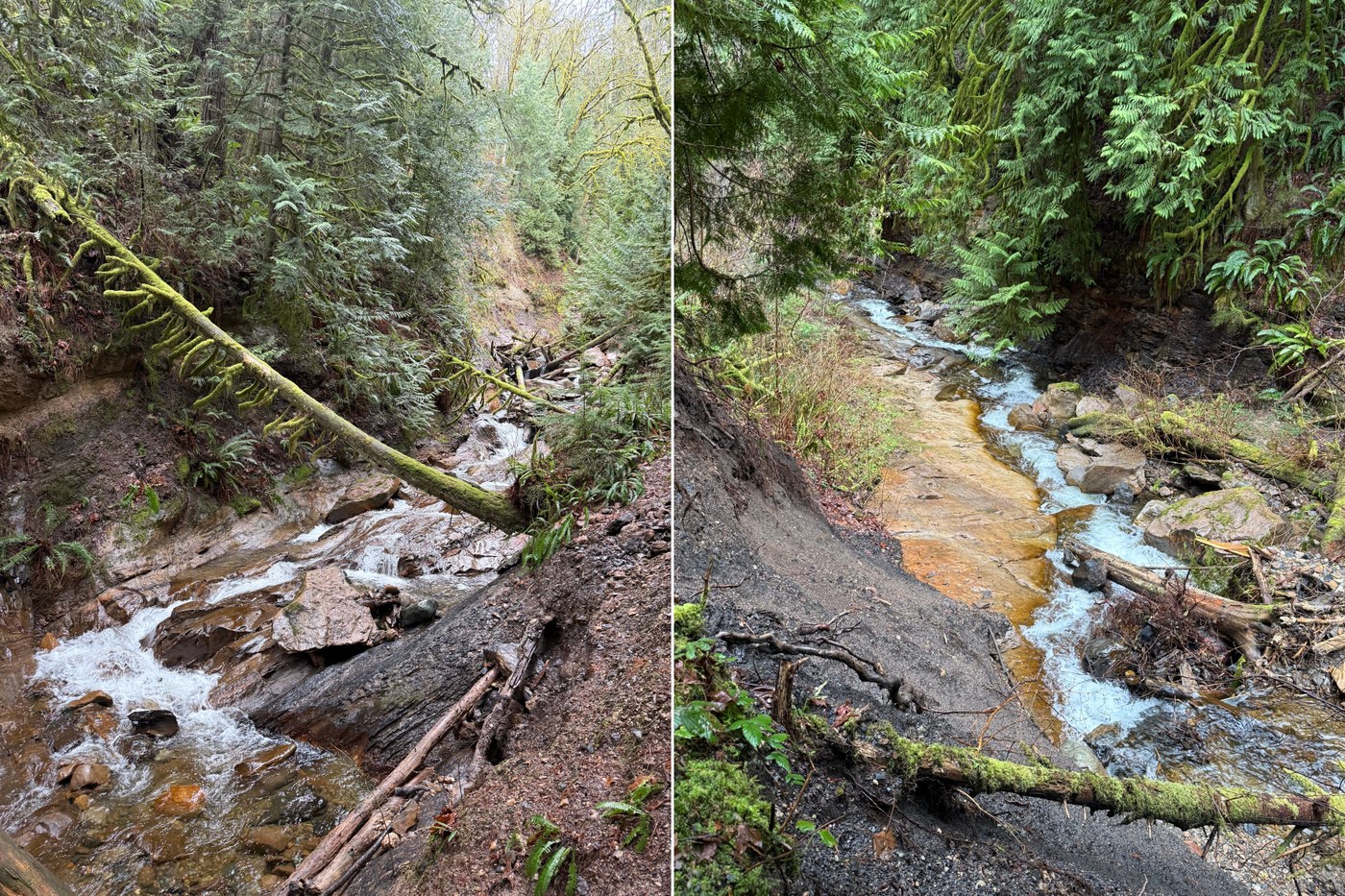
Original March 4 report: So this trail is a bit of mystery and concern. If anyone out there can help shed some light, would really appreciate it. First, I’m really confused as to why such a developed trail has access cut off by a closed gate. Second, is it safe to actually hike here with the orange drainage coming from the abandoned mine?
I’m a day late writing this report because I really needed to mull it over and look into a few things. I actually might reach out to the Washington DNR.
With the first issue, this trail is full of history and has informational signs. It was a beautiful hike and the trail itself was in really great shape and even looked groomed. I saw in a trip report from 2010 that this was at one time considered a wheelchair accessible trail. I also read somewhere that the metal bridges that have been brought in sometime over the last few years were probably done so with a helicopter. So how does a trail like this become one where direct access is cut off? My friend and I were able to find a public road nearby on which we could park, but we felt very uncomfortable doing so knowing that we were parking on a neighborhood road. We did our best to avoid blocking driveways and garbage receptacles in case it was a pick up day. And we could imagine that if this is one of the few places to park, it must be very annoying to those who live on that street.
As for the second issue, I absolutely thought it was cool to see a sealed mine as part of the hike. I’d actually not seen one like this before with what I think is called a bat gate. And I didn’t realize how much coal mining history this particular location had until after I’d visited. It turned out to be much more than just seeing a creek running through the Grand Canyon of Tiger Mountain. However, I learned afterwards that the orange colored drainage coming from the mine is not a wonderful thing to see. I learned there’s a reason why all these coal mines tend to be near a creek (Fifteenmile, Coal Creek, etc.) and that the drainage is potentially not an environmentally friendly thing to see. And very concerning considering how many of us hike here with our dogs that may drink nearby water. Or people who go down into the water.
If the first issue is being caused by the second issue, it would be great for word to get out. Otherwise, beautiful hike and just recommend avoiding the water to be on the safe side. And hopefully wheelchair access will return to this trail as it seemed made to be an accessible one…but perhaps doesn’t meet new guidelines?


Comments
That rusty red coal mine discharge is almost certainly acidic and heavy metal rich. The color is from the iron which precipitates out and tints the water running through the mines. It is toxic and can render streams lifeless. Welcome to a historical coal mining district.
Posted by:
wafflesnfalafel on Mar 05, 2026 09:12 PM
Yeah…and all uphill from the Fifteenmile Creek 😳
Posted by:
youcandoit on Mar 05, 2026 10:47 PM
The Department of Ecology has responded. As I’m preparing to send them more photos, I’m actually wondering now if that runoff could be from the rusty bat gate! I’m pretty sure it was metal. Either way, I do hope they check it out to be on the safe side.
Posted by:
youcandoit on Mar 07, 2026 10:02 AM
Longwell's Guide to the Trails of Tiger Mountain (I have the 1985 edition) identifies the slimy rust-colored discharge from the old mine shaft as being algae.
Posted by:
Lone Cedar on Mar 08, 2026 08:06 AM
Here is a link to an older webpage that has lots of info. I have no personal connection to page, just thought you might find it interesting. I have lived in Issaquah a long time and recall there was a horse camp near that location and that was part of the reason for access from the gate. Now that the camp is gone, only loggers, tower workers and people on their way up to do para sailing use the gate. Hikers have multiple parking lots in other areas, but none nearby, which is a shame.
Caroline Coal Mine aka Tiger Mtn Mine – Crows of Arroyos
https://batgurrl.net/2021/06/01/caroline-coal-mine-aka-tiger-mtn-mine/
Posted by:
I ❤️ Trees on Mar 05, 2026 09:36 PM
Batgurrl’s blog is one I found after visiting the area. I meant to include that website so thank you for putting it here and for the extra info!
Posted by:
youcandoit on Mar 05, 2026 10:51 PM
That web site has a number of errors in that it misreads the scale of the historic maps. The maps of the Caroline Mine show only what is now the area around today's waterfalls overlook. These maps do not show the tributary creek because it shows the area upstream of the tributary (i.e., beyond the second bridge along the trail). Where the trail crosses the main tributary creek (on a relatively new bridge; i.e., this is the second bridge as you hike toward the falls) was the site of mining buildings, and these buildings (including bunkers) continued along the trail until the trail turns and heads toward the falls. After this turn in the trails, when the trail heads in a straight line, does one enter the area displayed in the maps. The maps are totally accurate - Fifteen Mile Creek (and the trail) are straight lines in the area depicted on the maps.
The site also talks about "an original mine from the 1920s on a 1935 map. It sits atop a hill that is to the right in the above photo. It mentions both old bunkers and the incline/bunker." These mines are above the second bridge, not above the trail head (and this not "to the right in the above photo").
Posted by:
Lone Cedar on Mar 06, 2026 09:58 AM
I do like the website though for its “historical” photos from less than five years ago showing the trail in disrepair with washouts and dilapidated wood bridges. Totally not what my friend and I saw currently as it was a very well taken care of trail with sturdy metal bridges. The location is worth the love IMHO. The website also has a much better photo of the info sign by the mine (the one that I noted that I should’ve probably tried to clean) to read better. It also provides photos of the washery foundation which we did not try to go see as there was a sign posted that the trail to it was no longer maintained and closed. Lastly, it brought to my attention that there was more out there than I was aware of. Thank you for all your insights though related to this trip report and comments!
Posted by:
youcandoit on Mar 08, 2026 01:15 PM
Completely agree that the batgurrl website has done a great job of collecting old photogtaphs of the mine.
If the sign you saw that said that the trail was illegal and thus not maintained and closed was just after you crossed the first bridge, that trail does not go to the washery foundation - that trail was built by the hang gliders to bypass the bridge on West Side Road just north of the Grand Canyon Trailhead. The DNR replaced that bridge last year (or was it two years ago?), and while it was being replaced one could not cross the creek using the road. To reach Poo Poo Point, the hang gliders would walk the Grand Canyon trail past the first bridge and then took that trail to a truck they kept on the road beyond the bridge. Just beyond the sign ("You Are Here" close to the washery) there is a faint trail off to the left that leads to the washery ruins; this trail is farther down the trail than the hang glider bypass trail. It can be hard to follow since it's not maintained.
I would suggest looking at a copy of Longwell's Guide to the Trails Of Tiger Mountain since it provides more information about the history of the mining along the trail. The Guide states that (back when the Guide was written) one could walk 0.4 miles beyond the Caroline Coal Mine entrance (with the rust-colored algae) on the old road (no longer discernible as a road, just a foot path) to where it crossed the creek to the Bear Creek Yards mines. Like batgurrl I tried (years ago) to follow the trail past the Caroline Mine entrance but gave up before I got very far.
Posted by:
Lone Cedar on Mar 08, 2026 03:30 PM
The little posted sign about the trail no longer being maintained and closed was in the ground in between the first information sign and where the washery foundation would be. And that area was pretty overgrown compared to the main trail
Posted by:
youcandoit on Mar 08, 2026 03:54 PM
https://www.nwhikers.net/forums/viewtopic.php?t=8040292&highlight=fifteen
Posted by:
fourteen410 on Mar 05, 2026 10:25 PM
Thanks. Good info regarding the gate situation. If I contact WA DNR, I’ll focus on the other concern
Posted by:
youcandoit on Mar 05, 2026 11:17 PM
Actually if you are frustrated by the parking situation, please let them know. The more voices they hear this from, the better. Parking should be available in that lot but the DNR caved to pressure from neighboring landowners and the paragliding business to limit access.
Posted by:
fourteen410 on Mar 06, 2026 01:07 AM
I wondered if the parapenting business had something to do with the "No Parking" situation at the gate. I can understand, given how a subset of people park at trailheads, that they might have been concerned with West Side Rd access being blocked. If you've got a busload of paying customers, that's not a good situation.
Posted by:
kascadia on Mar 06, 2026 08:29 PM
The nwhikers site states "the forest road network on Tiger Mountain was historically open to the public until approximately the mid-1990s. The Grand Canyon Trail and its adjacent parking area, as well as several other interior trailheads, were built during this time, which is to say the public was once able to drive directly to the beginning of the Grand Canyon Trail." This was when the rest rooms were built at Poo Poo Point. The intent was to open the road network from the Highway 18 summit all they way to Poo Point. Unfortunately, after they had graded the road and built the trail heads, the road suffered catastrophic wash outs at several places. It took several years for the DNR to find the funding and to rebuild the bridges and make the necessary road repairs. The DNR realized that they could not afford to maintain the road, and thus the trail heads were abandoned. The segment of road that connects Tiger Mtn Road to the logging road (through the yellow gate) is located on what was privately owned land; it's been only recently that the state was able to buy that strip of land.
Posted by:
Lone Cedar on Mar 06, 2026 09:43 AM
This is all very interesting. And as long as we are on the subject of Tiger Mountain history, does anyone know where Irving Pettitte's house was?
https://special.seattletimes.com/o/special/centennial/september/photo/petite.html
I read his book 'Life on Tiger Mountain'. I gathered that he lived on the south side of the mountain but I am not sure quite where. The exact location might be lost to history but it sure would be interesting to see if it is possible to find out where his house was and see what it looks like today.
Posted by:
Joel_Grant on Mar 06, 2026 08:02 PM
Don’t know about remains of his Tiger Mt homestead but thanks for introducing me to his name. First time hearing about this writer who raised a bear cub and this bit of Issaquah history.
Posted by:
youcandoit on Mar 07, 2026 10:15 AM
Irving Petite, along with a partner, bought 165 acres on the "base of Tiger Mountain" in 1941 and built his cabin there. He lived there until selling his land in 1984 and moving away. In his book Life on Tiger Mountain (available on Internet Archive) he talks about coasting his vehicle one mile from his drive way to Hobart Road (now called Issaquah-Hobart Road). He lived close to Issaquah-Hobart Road since in his book he speaks of a neighbor who lived on Hobart Road. When he sold his land, it was presumably developed. I searched Google (perhaps not the best method to search for houses) to see where houses were built in 1984 in the Tiger Mountain area and found only one, which is around 253rd Ave SE. There were a number of houses built in that area (252nd to 254th Ave SE) in 1985. To those familiar with Tiger Mountain Road, this area is just below (to the north) of the S-curves. In a 2009 Issaquah Reporter article, Irving's niece recounts hiking up the creek in/by his property (presumably 15 Mile Creek) with him up to what they called the Big Falls, which may be the Grand Canyon Falls since the falls is less than a mile upstream of where his land was. I doubt that anything remains of his one room cabin given all the development in that area since 1984.
Posted by:
Lone Cedar on Mar 08, 2026 12:39 PM
Excellent information, thanks! I will try to check out the location. I am sure there is nothing left of the cabin, but it would be great just to see what it looks like in the area. I thought his book was wonderful; it gave me the impression that he was an interesting person.
Posted by:
Joel_Grant on Mar 08, 2026 12:46 PM