


Trip Report
Mount St. Helens - Worm Flows Route — Saturday, Jan. 22, 2011
 South Cascades > Mount St. Helens
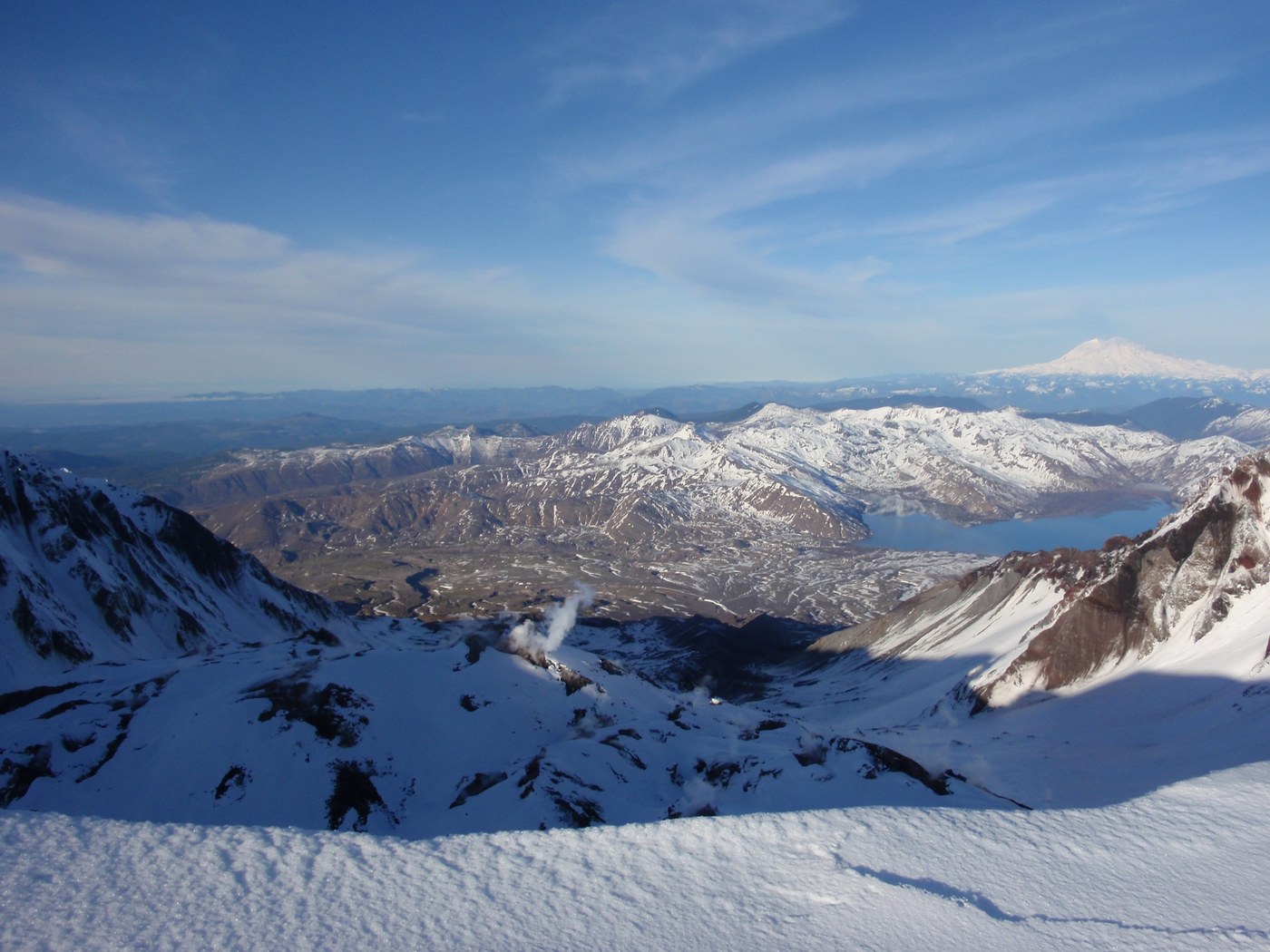
As I pushed the spike of my ice axe into the hard ice, I knew there was nowhere else to go. In every direction the crust yielded barely an inch, hardly enough for me to lean on the axe to rest, let alone take my weight in case of a slip. My legs and back were tired from the awkward contrapposto of cutting steps through ice below me and pounding with my feet to gain purchase. My headlamp lit the ridge and gully and I traced a path through the dark but could not see an end to a fall that had grown from potential to inevitable in the last few hours. As my feet gave out and I rolled on my belly and the ice rejected the pick of my axe and I lost my grip on it, the world accelerated around me.
I was on the road by 3:15am, hoping to get to the Marble Mountain Sno-Park a little before sunset. Climbing Mt. St. Helens had been a bee in my bonnet since last November, and after more than a year of wavering and excuses and waiting for the right weather and avalanche conditions, I was finally on my way. The excitement made the 4-hour drive bearable.
According to the wta.org site, the snowshoe route is an 8-mile round trip with an elevation gain of 5700'. According to the sign at the Sno-Park , the route is 16 miles and 6200'. I am not entirely sure which is correct. The trip up certainly did not feel as short as 4 miles, but also not as long as 8. According to another site, it is a 12-mile round trip, which seems a bit more reasonable.
The elevation gain on the lower trail was gentle and it was well-marked with blue diamonds in the forest and posts in the clearing. Even without the footprints the path would have been easy to follow. At the Swift Creek crossing, the south face of the mountain emerged from the fog and the ridge scramble to the top became clear.
After post-holing a few times down on the ski trail, I put on my snowshoes and wore them until I needed to cross the exposed rocks of the ridge. I switched into MICROspikes because the snow had become more compact and because they provide better traction with mixed terrain. At the ridge, strong winds began and continued with a few intermittent breaks until the top.
Distances on the mountain were very difficult to judge, and after passing a few other hikers, I sat down for lunch on any area that was not too steep, believing I could reach the summit in the next hour. It is good that I ate because the climbing afterwards became more difficult and there were no flat areas where I could have taken such a relaxing break.
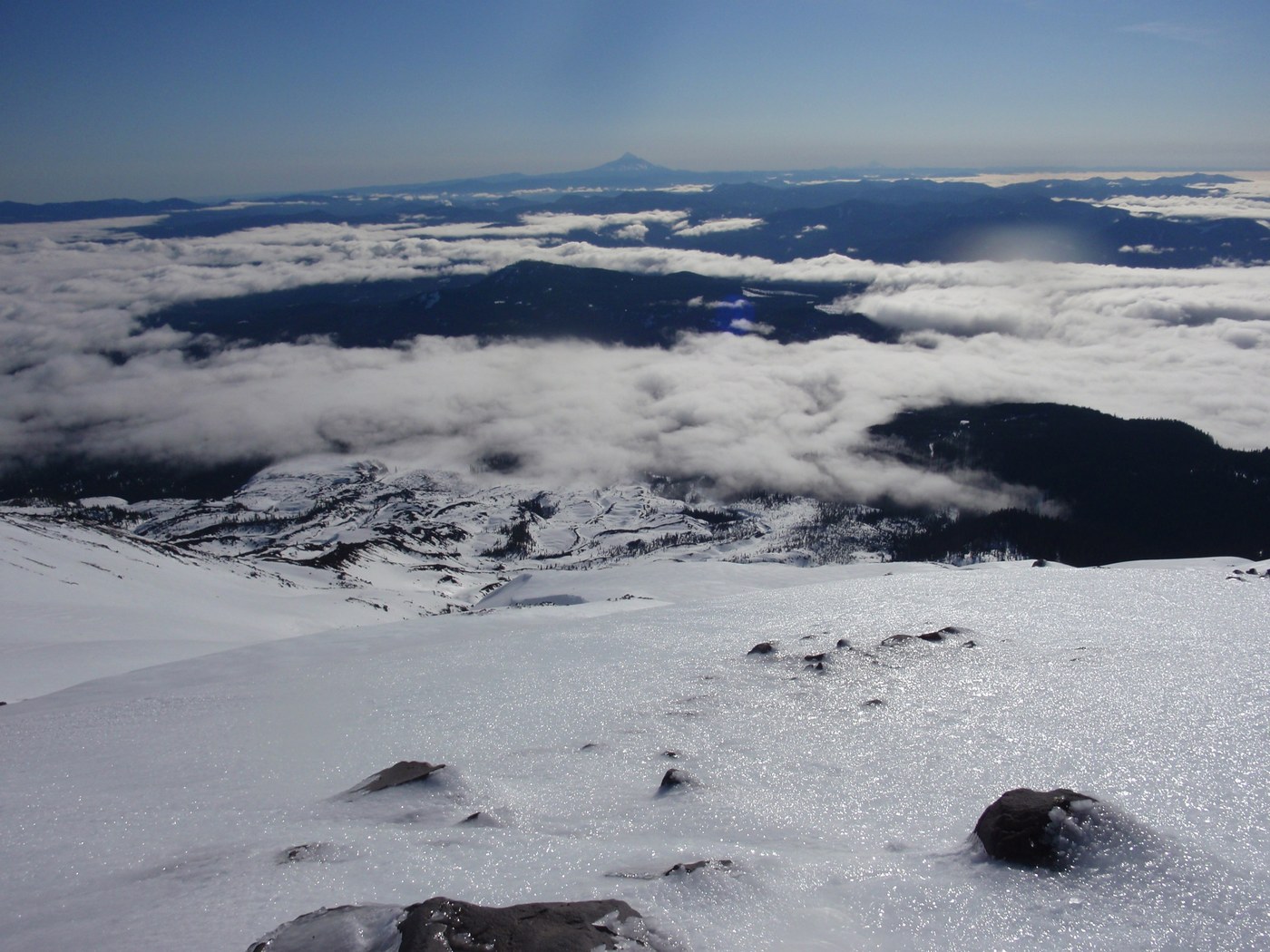
There were 4 other hikers on the mountain, all wearing crampons. We had also met 2 skiers who turned back when they hit hard ice. Because I had worn MICROspikes on ice before and because the sun had started warming the slopes, I felt comfortable enough to continue. As I climbed higher, though, I realized I had never seen ice quite like this before. Under the thin crust, a luminescent aqua color glowed in the sun. I could barely chip away at it with my trekking poles and it was getting more and more difficult to kick steps. Eventually, the front rubber ring on one of my MICROspikes broke. There was no place to re-adjust it, I did not have my axe out and could not take it off my bag to switch it for a pole, and the summit did not look too much further, so I decided to continue up until I reached a point where I could put down my bag and switch equipment. The snow on the last push up the ridge had become softer and I hoped the warming air had started melting some of the ice below for the climb back.
At the crater rim, I ate again and took pictures and rested with 2 others. I prepared my axe and re-adjusted my footwear for what I knew would be a slow trip down. By 3pm I was heading down in fine snow that felt secure underfoot despite a lack of traction on the front of my right boot.
Eventually, I reached the hard ice again, which had not softened during the afternoon. I chopped steps down and pounded in with the sides and heels of my boots, as if I were beating out all my frustrations and fatigue into the mountain. I reached rocks that were mostly covered and cut slabs of ice down to ash to sit and drink water and to consider an overnight bivouac but decided that would only leave me more exhausted, and a night, no matter how warm the breeze now coming down the south slope, would not make the ice go away by morning.
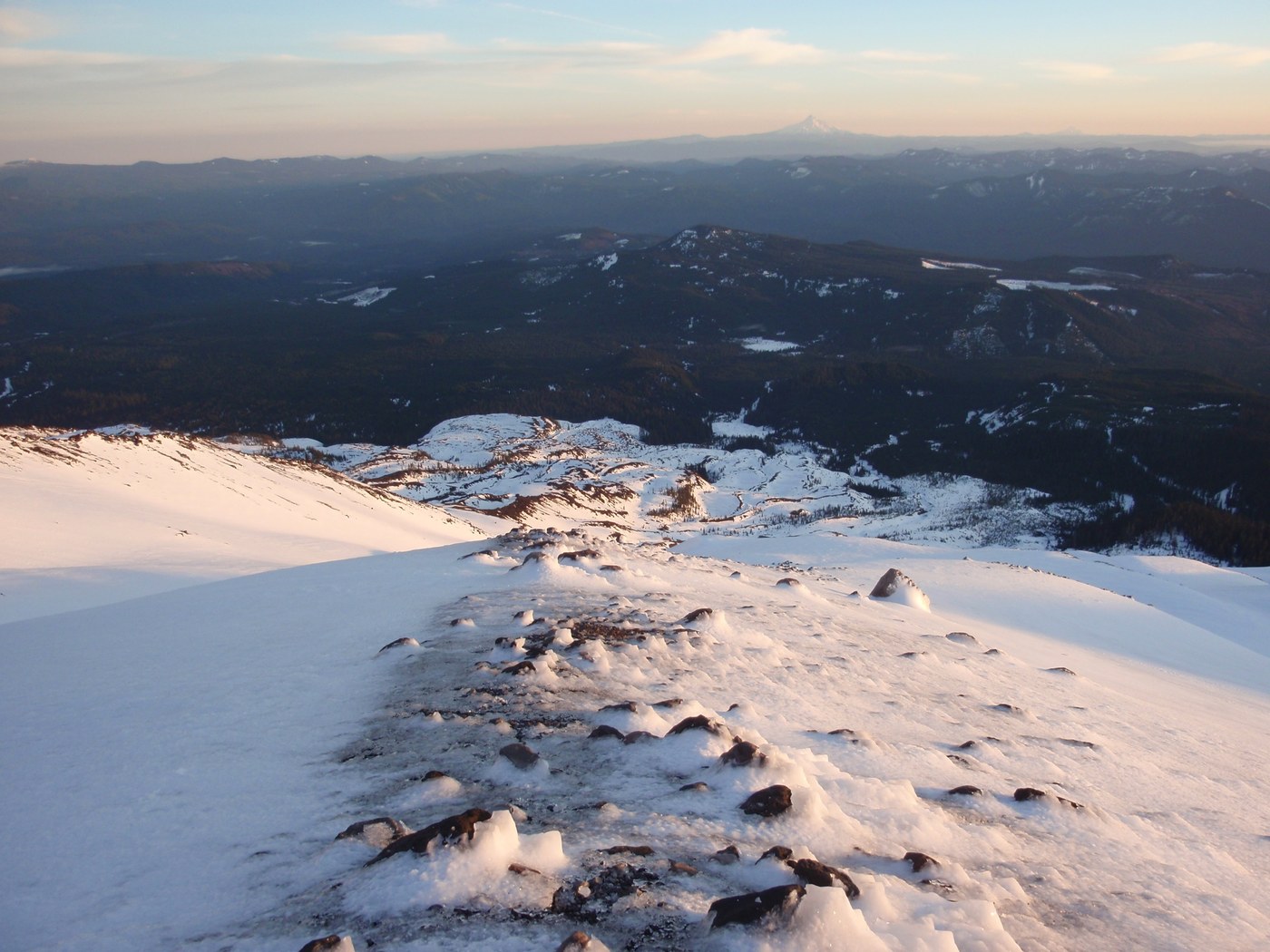
The setting sun pinked Mounts Adams and Hood and exposed Mount Bachelor, which had hidden all day, beyond. Coyotes howled at the rising moon behind the clouds at the summit of Adams.
The slide eventually took me beyond the hard ice, and I stopped on firmer crust in the chute west of the ridge. I cradled my right arm, which was tingling up to the fourth and fifth fingers, sat up and gathered my gear. Today I had broken 1 MICROspike, lost 2 snowbaskets and lost 1 snowshoe, but all my limbs were intact -- contused and abraded, but intact.
For the remainder of the hike down, I tested each step carefully, rested frequently and cut steps when I felt at all uncertain. By 11:30pm I was back at the car and lucky to be driving home.
Comments
Posted by:
"Wise Mule" on Jun 23, 2011 02:21 PM