


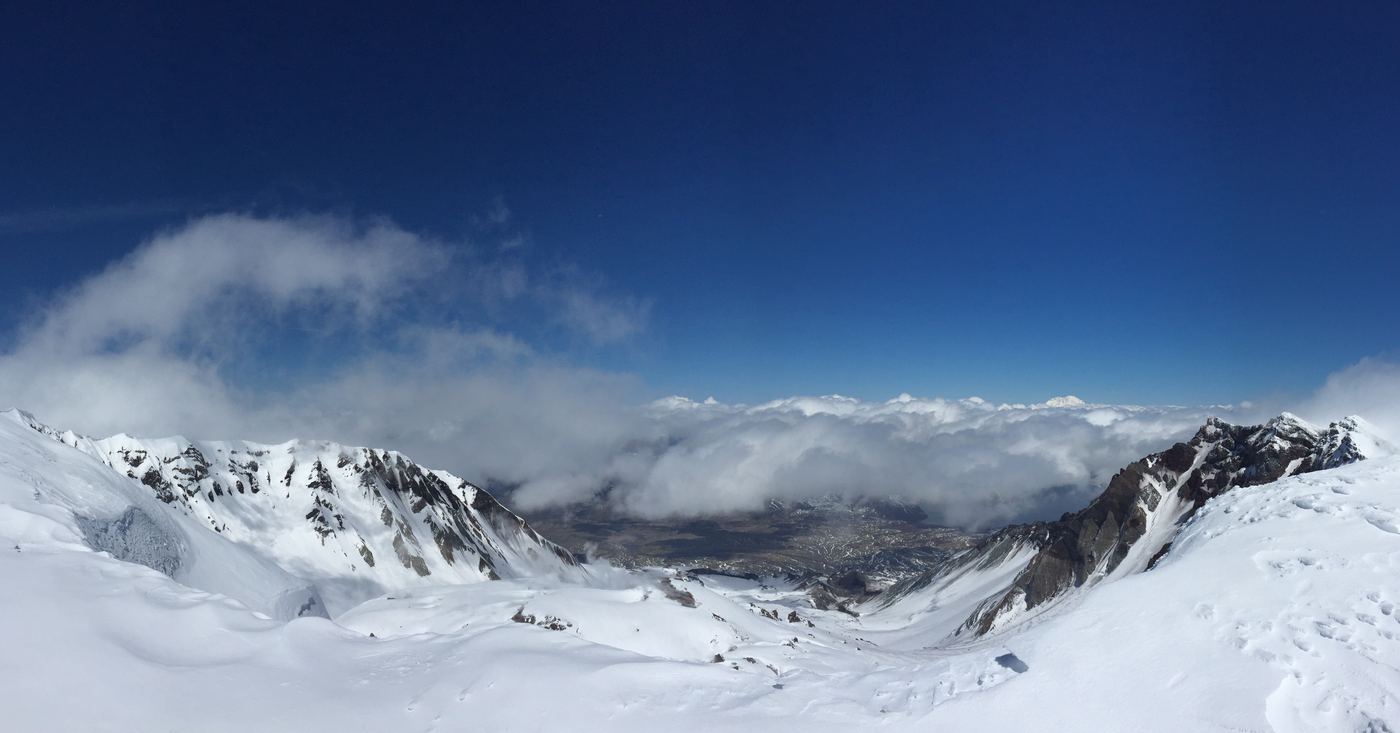
A beautiful day!!!!
Weather
Early spring hikes are tricky in terms of rain, snow and avalanche condition. Make sure you keep track of the weather and avalanche forecast from the preceding week, as it helps you predict how much snow has accumulated recently and the resulted snow condition (firm / powdery / icy ?). Knowing that there was moderate-heavy snow for 2 days in a row 4 days before my hike, I expected deep and powdery snow and packed snowshoes. The forecast is constantly changing and probably not accurate until 1-2 days before. But don't wait until the day before the hike to check it. In my case, just knowing about the snow shower on my day of hike, I wouldn't be prepared with snowshoes. Also, check weather at all the elevation levels.
You best bet is still to bring your full mountaineering gear, including all types of traction gear (microspikes, crampon and snowshoes), ice axe and helmet. These gear are heavy and bulky, but definitely worth their weight and space in your backpack, and critical to your and your group's safety. "Better to have and not need, than to need and not have." Keep in mind that you are exposed to a high altitude where weather condition is constantly changing.
Weather: https://www.mountain-forecast.com/peaks/Mount-Saint-Helens/forecasts/2549
Avalanche: https://www.nwac.us/
---------------------------------------------------------------------------------------------
Driving
Arrived at the parking lot (Marble Mountain sno park) 8:30pm the day before. Just in time to take out the headlamp. There were already 20+ cars there and a few tents set up. Road was clear of snow, until the last 1.5mi where there were patches on the side. Slow down and be prepared to yield to the incoming traffic. Passable for all vehicles.
A sno-park permit is required Dec 1 - Mar 31. Purchase at http://parks.state.wa.us/130/Winter-Recreation. A few websites mention different timeframe. Better call the ranger station to confirm.
---------------------------------------------------------------------------------------------
Gear
- Headlamp
- Mountaineering boots
- Gaiters
- Hat (with long brim and cape)
- Gloves
- Trekking poles
- Snowshoes (preferably with heel lift)
- Crampons (1)
- Ice axe with leash
- Helmet
- Microspikes
- Sunscreen and lip balm w/ SPF (2)
- Sunglasses
- The rest of 10 essentials not mentioned above
(1) Make sure it's compatible with your boots. Know how it's locked. Absolutely no glissading with it.
(2) Re-apply every hour if possible, or every 2 hrs at least. In an exposed and snow covered trail like this, sun reflected off snow gets intensify and can easily burn your skin. You can never apply too much sunscreen. Even with multiple layers of sunscreen, I still felt the burning heat on my skin as soon as sun came out. Nostrils, lips and ears are easily forgotten, and sunburn in these places are particularly unpleasant. By the time you feel it, it'll already be too late. So I'd apply sunscreen at every break, or even when I'm waiting behind a big/slow group of people (at a relatively flat area only!!).
---------------------------------------------------------------------------------------------
Timeline
5:45am start
12:10pm (false) summit
5:10pm back to car
- Didn't attempt the true summit due to 30mph gust and falling snow at the false summit.
- Took long breaks for putting on / removing snowshoes and crampons. Took a short (15 min) lunch break at the summit, due to wind starting to pick up and snow falling.
- Start as early as you are comfortable with. Preferably by 5am, and by 6am at the latest, regardless of your pace, especially in the summer. As soon as sun comes out, snow starts melting fast and becomes increasingly soft. Each step will require more effort and you're more likely to posthole.
---------------------------------------------------------------------------------------------
Hike
5:45am is not an early start at all. I woke up at 5am and there were many people walking around with headlamp.
Don't forget to self register your entire group at the trailhead (a wooden bulletin next to the bathroom). You need to write your expected return time before the hike, and your actual return time afterwards.
Many people put on snowshoes at around the Chocolate fall (shortly after you hike above the treeline), when snow felt powdery. Although it's not super steep, trekking poles could help you balance easily.
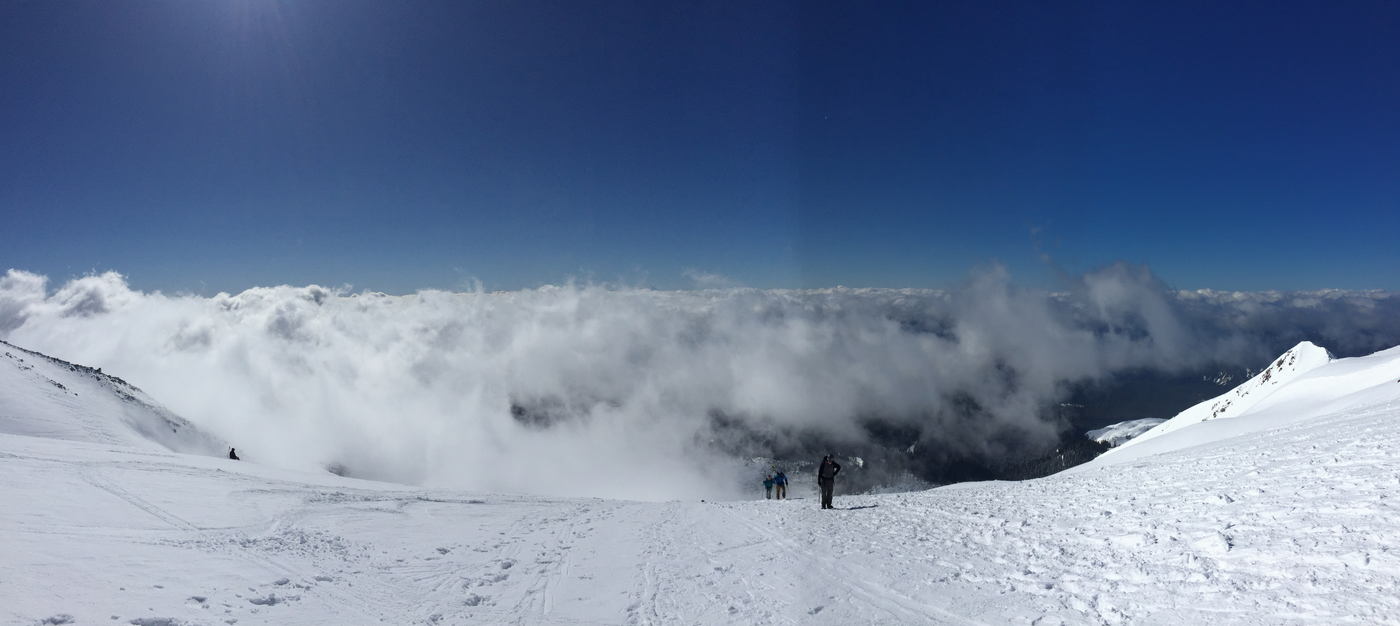
At around 4000ft, snow became icy, and I slipped with my snowshoes. We decided to switch to crampons, ice axes and helmets, and kept all these gear until we descended back to this point. Most people (except skiers) had crampons and ice axes for the remainder of ascending. There was some whiteout here, but knowing that it's forecasted to be cloudy in the lower elevation and clear at the higher elevation, we knew that if we manage to walk out of the whiteout, blue sky awaits us.
Trail was easily to follow with the deep foot path and the huge crowd of hikers. It's a busy trail today - all 500 permits were sold out and parking lot was full.
Glissading is a always a blast here. St. Helens has some gentle slopes, which make it perfect for beginners to learn to self arrest and control speed with ice axes. Probably too flat for experienced hikers, as the speed doesn't really pick up. (Camp muir is another great place to learn too. Especially if you wanna attempt Mt Adams next, because I wouldn't defer my first glissading experience to that and wait until I need it to learn it.) Just remember to remove your crampons before glissading. As you hike up, you see all these awesome glissading chutes that make you feel motivated to get to the top sooner so you can slide down.
Going down, snow became painfully soft after ~2pm. So soft that you posthole at knee level.
---------------------------------------------------------------------------------------------
Random thoughts
2 years ago, St. Helens was my first mountaineering experience. The most strenuous hike I did before was lake serene. I was never exposed to a fully snow covered mountain before, came with no waterproof gear and no sun protection (neither hat nor sunscreen), and came back completely soaked and looking like a baked potato. All the hills looked intimidating and never ending to me. But I absolutely love this mountain, and learnt to glissade (despite of falling everywhere lol). Pretty amazing to see how things have changed over 2 years and how training made a huge difference. Today I came back feeling that it's just Mt. Si x1.5 in terms of strenuous level, thinner air and more exposure and wind.
St. Helens is a great place for beginners to build mountaineering experience! You can get comfortable with walking on crampons, glissading, self arresting with an ice axe, and be exposed to high altitude / exposure / wind / slope / different snow conditions. While climbing in the gym or hiking up Mt Si helps you be conditioned, it can never replace the experience of being exposed to glaciers.
Mountaineering gear like crampons and ice axe can save you life and hurt you when used improperly. If you haven't used them before, just go with people who are experienced with them and learn it here.
Comments