


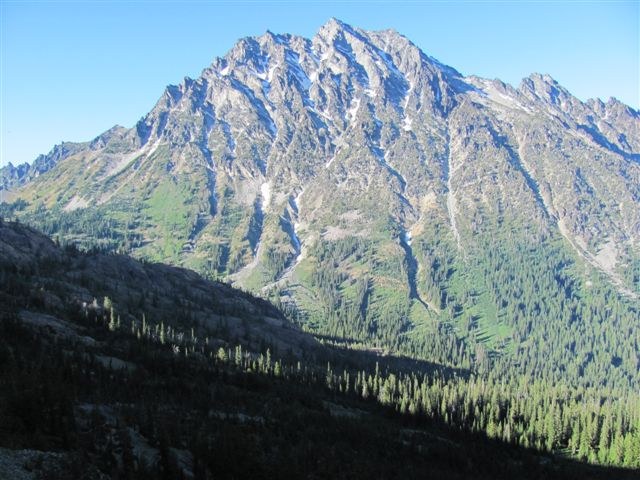
Mt. Stuart is the tallest peak in the Alpine Lakes Wilderness area. The Mt. Stuart batholith is a hotly debated topic in geologic circles. A microplate tectonic model proposes in what is called the Baja-BC hypothesis that the granite of Stuart had its origins at latitude ~31 degrees in the Baja region. The rock was driven on a subterranean plate and surfaced as an accreted terrane at it present location. The only movement of rock we experienced was the occasional rockfall in our Cascadian Couloir route. Randy Busch and Craig Beaver were my partners for this ambitious day-trip.
We drove I-90 east and turned north toward Wenatchee at Route 970. We were on this for 5 miles and turned left at the sign for Teanaway River road. At 13 1/2 miles is a road junction at 29 Pines Campground. At this "Y" take the right fork (Forest Road 9737) and drive the dirt road until it ends at the trailhead, elevation 4243 feet.
This trail also accesses Ingall's Lake but the signage is good for the turnoffs to reach Long's Pass at 6250 ft. Once at Long's Pass the descending trail toward Ingall's Creek is 50 ft to the left. It starts out with tricky footing but gets better as you descend. There is a log crossing at Ingall's Creek but it is not for the faint-hearted. You may want to bring wading shoes for the ford. We then took the Ingall's Creek trail downhill east for ~1/4 mile. The start of the trail toward the Cascadian Couloir is just past a large stream with a broken bridge at ~4900 ft. The trail is on the left and is well-used. When you get out of the trees and see the mountain the route continues up broken rock to the left of a black-rock buttress seen on your right. The route continues up and dropped us at a snowfield where we finally changed into our boots and removed our ice-axes from the packs. The snow was easy to kick steps into and our crampons remained stowed away. We crossed the ridge at ~9,000. It is important to remember the landmarks for where you crossed this ridge as it will be a challenge to locate on the downclimb. Once across the ridge we lost ~30 feet of elevation before following the cairned route to the top. There is a fair amount of traversing left and don't be tempted to gain elevation quickly or you will be on unfriendly rock. If you are on Class 4 rock then you are off-route. The true summit only grants use of one person at a time. The summit register is in an attache size box placed by the Cascadians of Yakima.
Our descent varied from the ascent route. We wanted to avoid the slabby rock and with climbers above us the risk of rockfall in the Cascadian Couloir. We took the next gully drainage to the east. Where the gully steepened through a rock course we angled right and teased our way through trees and talus to reconnect with the Cascadian Couloir trail. The sun had thankfully dropped below the ridgelines and gave us a shadowed route for the grind back up to Long's Pass. Distance travelled; 13 miles Elevation gain; 8,200 ft Car-to-car; 13 hrs


Comments