


What winter flooding will mean for towns and trails, and how hikers can help


Catastrophic flooding has hit communities hard and washed out major access routes to trails and public lands and trail towns like Stehekin, Greenwater and Marblemount. From coordinating with our partners to trail work to advocacy for access and funding, WTA and hikers stand ready to be part of the recovery.
In mid-December, a series of atmospheric rivers dumped record rains, then wind and snow on Washington and the Inland Northwest. The floods that followed have been catastrophic. Up to 100,000 people were told to evacuate and more than 100 people had to be rescued. Winds knocked out power for tens of thousands. Major routes closed, and some will remain closed for quite some time.
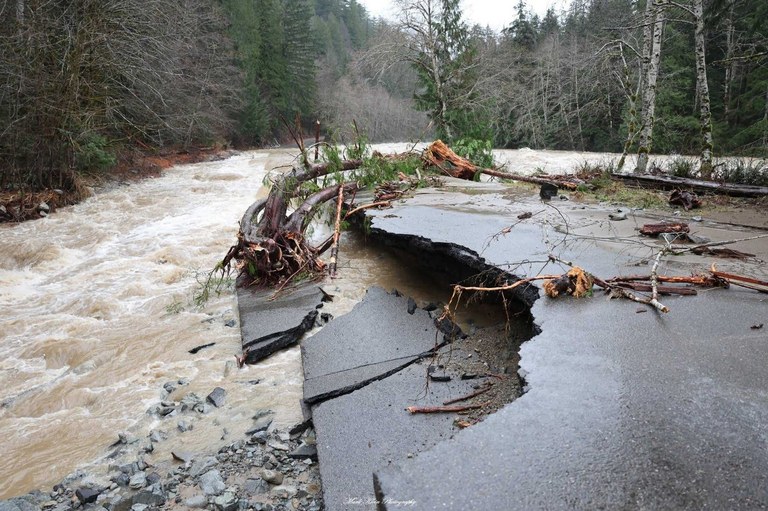
The Index-Galena Road washed out during recent flooding. The road provides access to popular hikes like Blanca Lake, as well as to private property. The road had re-opened in 2023 after a prior washout, at a different location, had been repaired. Photo by trip reporter I-like_2_hike_.
What this means for hikers right now
The response to this disaster is going to take all of us. Right now, the focus is on helping deal with the immediate aftermath of the disaster. The best thing hikers can do is to observe closure signs, avoid driving through water and help those in their community who need it.
Consider delaying any hiking plans or hike on nearby neighborhood trails, if you know they’re safe. The situation is still quite unstable. By staying close to home, you’re leaving roads clearer for those who are doing recovery work. And you’re not putting yourself at risk from falling trees or landslides.
See below for an overview of conditions around the state. See the Hiking Guide for information on specific trails.
Communities hit hard by flooding, landslides
A state of emergency has been declared, but even with that help, recovery is going to take a long time.
Communities have been hit hard. Many people who work and depend on public lands live in towns that were affected by the storms. People in Monroe, Sedro-Woolley and many other areas saw their homes flooded and they will need time and money to be able to return home.
Leavenworth and Chelan County were hit by widespread flooding and power outages. Leavenworth canceled winter festival events over the last weekend, but has since regained power and is welcoming out-of-town visitors who can reach town safely. If you have reservations, call and speak to your hosts.
Stehekin and Holden Village, both on Lake Chelan and popular stopping spots for hikers, had evacuation orders after massive slides. Holden is expected to be closed until May. Communities around Randle and Packwood were cut off by water. The residents of Greenwater and Crystal Mountain Resort, northeast of Mount Rainier, had their access limited due to major damage to Highway 410.
For trails, especially with wind and snow in the forecast, some of the impacts won’t even be known until next year, when land managers and hikers start to return to higher elevation and more remote areas. And some areas won’t be accessible at all, until roads can be repaired.
What this means for trails, and those who rely on them
Trails are more than just places to hike. They are an extension of the communities in our state. They are the places where people work, picnic or vacation with families, where they fish and forage. Trails are a driving force for local economies, and when those trails become inaccessible, that reverberates in town.
Much of the damage that was caused by these recent storms is going to take years to recover from.
The Suiattle River Road, for instance, washed out about 4.5 miles from Highway 530 — much closer to the highway than where the road washed out in 2003 and 2006. The washout leaves more than a dozen trails out of reach, and cuts off an important access point to the Pacific Crest Trail. It also cuts off Darrington from the benefit of visitors who stop in town on their way to hike. After the washouts in 2003 and 2006, the road didn’t reopen to vehicles again until 2014. And, once it was open, crews had a monumental amount of work to restore trails that hadn’t been maintained for years.
The Index-Galena Road, which leads to Blanca Lake and other popular hikes, also washed out during the recent flooding. That road had re-opened in 2023 after being closed for 17 years. (The recent washout is in a different location.) While the road was washed out, emergency access was more difficult and hikers and other recreators had to access trails via the Beckler River Road, a 40-mile mostly gravel detour. The detour bypasses Index, meaning the town doesn’t get to benefit from hikers stopping by to grab a meal. The washout is on a county road and cuts off access to private property, in addition to the many recreation opportunities.
Many more roads to trailheads and trails have been affected, and it may take months before the full damage is clear.
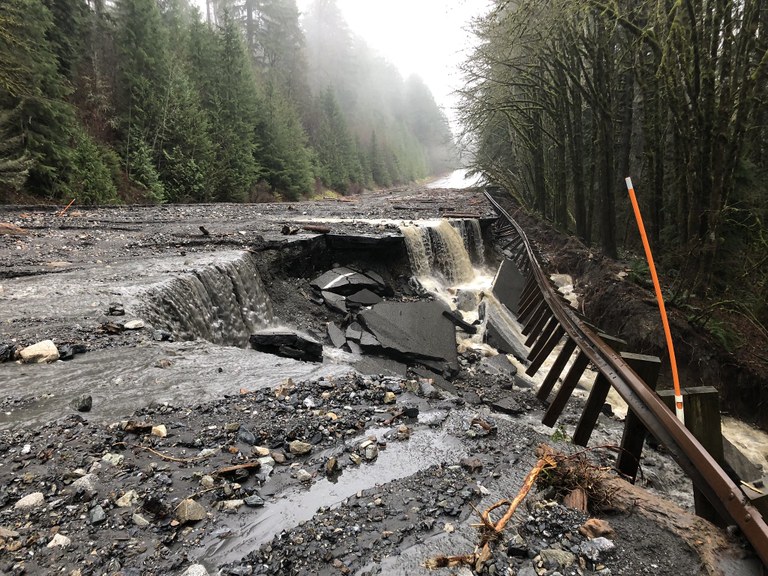
Damage to U.S. 2 near Skykomish. The roadway remains closed from near Skykomish to Leavenworth. Sections of the road have washed out in several areas. Photo courtesy Washington State Department of Transportation.
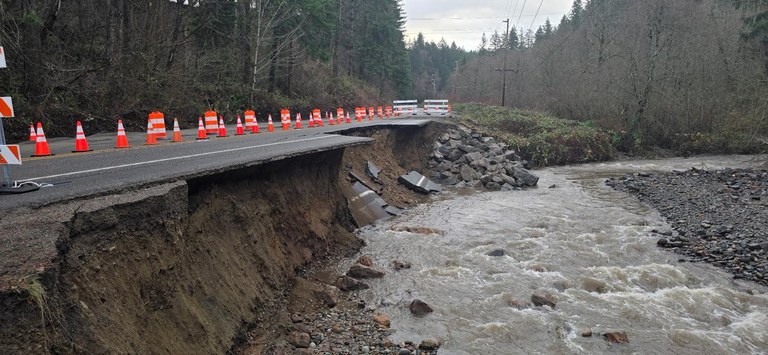
Highway 410, east of Enumclaw, washed out in recent flooding. WSDOT has since repaired the road and it is open to traffic. Photo by Enumclaw Police Department.
How you can help trails and be part of the recovery
WTA will be leading the way and coordinating with our partners across the state to advocate for funding to repair these roads and trails — and to ensure they’re better prepared for storms like this in the future. We’ll continue to ask state and federal officials to fully fund public lands, so that land managers have the resources they need to maintain roads, bridges, trails and other resources at risk.
For decades, public lands have not had the funding they need, which means maintenance and upkeep is always way behind what is needed. That means, when flooding like this hits, bridges, roads and trails are vulnerable.
In the coming months and years, we’ll be asking for your help to recover from this disaster. From volunteering on trail to talking to your lawmakers to donating to power our work, you can help restore access to the wild places we love.
We’ll keep you up-to-date on the situation on trails. Check our Hiking Guide for information on trail closures. And sign up for action alerts to be informed when you can speak up to help trails.
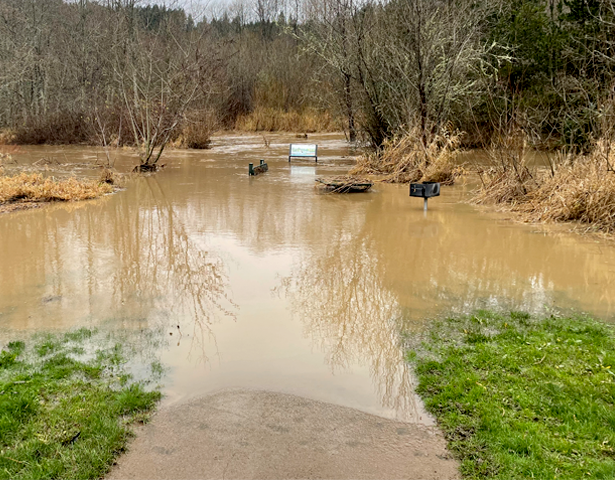
The Foothills Trail in Pierce County is closed due to flooding. Photo courtesy Pierce County.
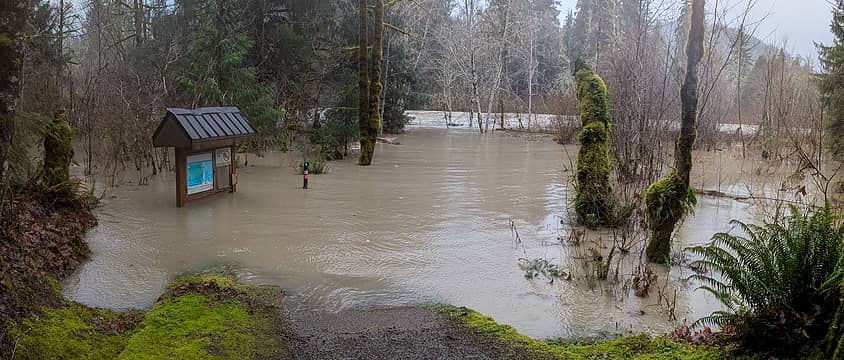 The river access to the Middle Fork of the Snoqualmie River was flooded near Big River Bridge. Photo by Monty VanderBilt.
What hikers need to know right now
While the state is still in an active disaster response, consider delaying your hiking or recreation plans and respect all closures. Saturated soils mean trees are more likely to fall, and as snow begins to fall, avalanche danger will climb in the high country.
Give responders and communities the space and time they need to address immediate needs.
As conditions stabilize, check road conditions, trip reports and our Hiking Guide before heading out. We’re keeping the Hiking Guide up to date with information on trails that are closed or inaccessible. Planning to spend time in the snow? Visit our friends at the Northwest Avalanche Center and check avalanche conditions. Stay safe out there.
Here are some of the key impacts from recent storms that hikers should know about.
(Updated Dec. 30, 2025.)
- State Route 542, the Mount Baker Highway, is open to travel from 6 a.m. to 6 p.m. through the holidays, with alternating traffic between mileposts 41 and 44. Crews will continue to assess and repair the highway.
- On the west, Highway 20, the North Cascades Highway, is closed in both directions near Beacon Creek, east of State Route 530. That cuts off hiking to trails along Highway 20, including Diablo Lake. The road is also closed for the season just past Diablo Lake.
- On the east, Highway 20 is closed between mileposts 171 and 184 (Silver Star gate to Goat Creek Road) due to multiple wash outs, debris and mud over roadway. An emergency contractor will be working on the road. For the safety of the public and crews, people are asked to stay out of the area between Silver Star (milepost 171) and Early Winters (milepost 178) until emergency repairs are complete.
- State Route 530, north of Darrington, is closed in both directions.
- The Suiattle River Road is washed out about 4.5 miles from State Route 530.
- The Mountain Loop Highway is closed due to landslide at milepost 37.5 (15.5 miles south of Darrington). That cuts off access to Forest Road 49 and several trails. The Mountain Loop had already been closed for the season between the gate at Deer Creek and the Bedal gate near the Bedal Campground.
- U.S. 2 is closed from Skykomish to Leavenworth due to rocks, trees and mud on the roadway. This means that Stevens Pass, and the trails for hiking and snowshoeing in that area, are all inaccessible. Leavenworth is accessible from other routes. Starting on Monday, Dec. 29, U.S. 2 will open from Coles Corner (milepost 85) to Stevens Pass from 6 a.m. to 6 p.m. Traffic will be alternating, with a pilot car, between Mill Creek Road (milepost 71) and Stevens Pass Resort (milepost 64). U.S. 2 at Tumwater Canyon will remain closed from east of Coles Corner (milepost 85) to Leavenworth (MP 99). That section is expected to remain closed through mid-March. There is a detour via Chumstick Highway, which is a rural county road, so expect longer travel times. U.S. 2 is expected to reopen on the west side on Sunday, Jan. 4.
- Icicle Road near Leavenworth is only open to local traffic past Eightmile Campground. That cuts off access to the hiking, climbing and snowshoeing on that road, including Eightmile and Colchuck Lake trails. Also in the Wenatchee River Ranger District, Little Wenatchee, Chiwawa, Mission Creek and Hatchery Creek roads were all severely damaged. White River Road also flooded, but was less severely damaged.
- Index-Galena Road is closed near Index. That means access to Blanca Lake or other hikes in that area require a long detour via Beckler Road. (Note that there is also a washout about a quarter mile before the Blanca Trailhead.)
- The road along the Middle Fork of the Snoqualmie River has been mostly cleared, but might still see trees coming down. Visit the Middle Fork of the Snoqualmie River area with caution.
- State Route 410 has re-opened to traffic after WSDOT repaired the storm damage to the roadway.
- The Hoh River Rainforest area in Olympic National Park is closed due to flooding.
- In the Teanaway, much of the upper Teanaway past Twentynine Pines campground is inaccessible. The Forest Service has closed NF 9701 (Jungle Creek Rd) and NF 9737 (North Fork Teanaway) above the campground and 9703 (along Stafford Creek) for assessment. DNR has also closed Teanaway Camp and 29 Pines campgrounds until spring.
Comments