


Trailwork behind the scenes: The joys of tool maintenance


Caring for the tools we use on trails is a big job. Thankfully, dedicated and skilled volunteers around the state help make this big project a lot easier.
After a busy season of trail work, most of the tools at WTA are in need of at least a little TLC. As the bulk of WTA’s trail work season comes to an end, cleaning, repairing and storing tools for the winter is a big task, but volunteers always step up to make the task easier. This month, volunteers helped with maintenance at WTA’s North Puget Sound tool cache in Arlington, the Olympia cache in Tumwater, the cache and packing facility in North Bend, and the Spokane tool cache out in Eastern Washington. There are also additional upcoming maintenance days in the Northwest and Southwest regions. This help from volunteers helps our trail work tools last longer and keeps them in great shape, making our work on trail easier.
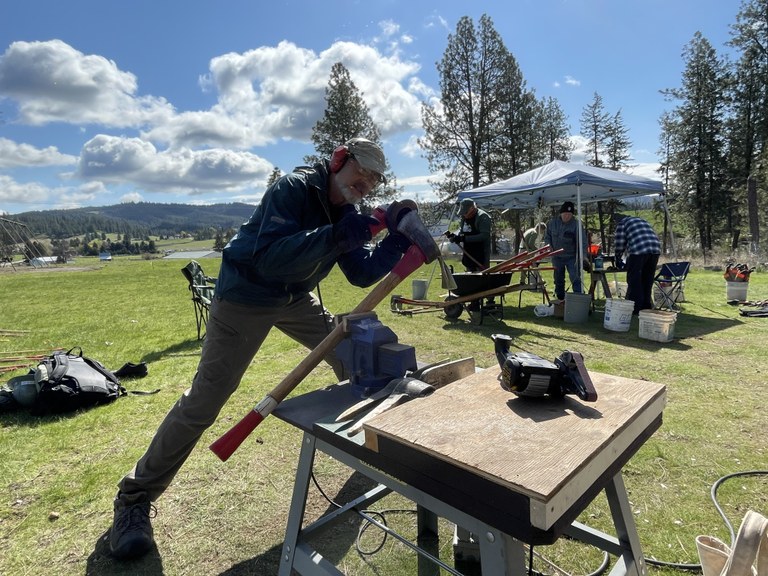
Keeping tools sharp ensures they work their best out on trail. Photo by Holly Weiler.
Many hands make light work
Cleaning, sharpening and repairing tools is a big project. In Eastern Washington, Holly Weiler, WTA's senior Eastern Washington regional coordinator, hosts biannual work parties to support the work.
“This is definitely the sort of project where, if I were to do it by myself, I think I could spend an entire 40-hour work week just doing tool maintenance. But because the volunteers are here, we can get it done in a little bit more than a half a day,” Holly said.
Inventory alone used to take Holly the better part of three days, but a crew of a dozen volunteers can get the job done in a single day. Looking at her clipboard, Holly shared some numbers from their recent maintenance work party.
Volunteers cleaned and maintained 12 shovels and 24 green grubbers. They also counted the 18 grub hoes and 18 pulaskis for the Eastern Washington tool cache. Additionally, volunteers tested 32 Corona saws to determine if any blades needed to be replaced, and which would be used on day work parties versus multi-day trips.

A group of volunteers care for tools at the Spokane tool cache on a cold, clear day. Photo by Holly Weiler.
Changing with the seasons
There is definitely a seasonality to the maintenance of Holly’s tool cache and others around the state.
In Spokane, spring is the time for sharpening and preparing tools for the upcoming trail work season. Holly starts by having her volunteers unload the 10x10 tool shed and sort all the tools into piles depending on what maintenance they need.
Some tools are dirty from being used over the winter and just need to be cleaned; other tools are clean, but need sharpening. And some tools are clean and sharp, but need a new coat of the red paint that has become a WTA hallmark. Once all the tools have been sharpened and painted as needed, each receives a coat of linseed oil to help maintain and preserve the wooden handles.
In the fall, tool cleaning and inventory becomes Holly’s main goal, along with cleaning and reorganizing the entire tool shed. Holly hosted her fall tool maintenance work day on Oct. 16 this year, and she’s still reveling in how clean the shed is.
“We get in there with a shop vac and we vacuum up all of the debris from an entire season's worth of being out on work parties. Right now everything is clean and organized and smells like linseed oil and it's fantastic,” Holly said.
Fall is also the time where any larger maintenance needs are addressed. Some tools need new handles or to have nuts and bolts tightened. And just like in the spring, everything is cleaned before the tool handles are once again wiped with linseed oil and stored away.
While maintenance schedules and tasks vary from cache to cache around the state, much of the work follows a similar cadence to Holly’s work.
Going the extra mile
In addition to work parties, there are a few volunteers Holly works with who go above and beyond to help keep WTA’s Eastern Washington tool cache in good condition.
During the spring work days, Holly’s yard transforms into a bustling outdoor workshop, with several volunteers bringing their own bench grinders to get the job done faster. Holly gave a special shoutout to Dave Drum, an assistant crew leader with professional tool maintenance experience and a talent for sharpening tools.
Marc Kiehn also played a big role in getting the region’s brush cutters working again thanks to his experience in small engine repair. During this most recent work day, he spent time repairing one, then ended up taking another home to finish the job.

A very satisfying line of green grubbers with fresh red paint. Photo by Holly Weiler.
“He actually just texted me to say he’s got it working again, and that thing hasn’t worked all season, so it’s really nice to have those volunteers who have some specialized knowledge like that,” Holly said.
George Stites came out to Eastern Washington and offered training on sharpening the Corona saws, and last winter Scott Redman, another of Holly’s regular ACL’s, took a box of handsaws home and sharpened all of them.
Tool maintenance at home
Holly recognizes that many WTA volunteers have their own tools, and she offered some advice for maintaining tools at home.
“I always recommend to people the best way to have a long lasting tool is to apply linseed oil to the handle periodically,” Holly said. “But it's also really important to keep in mind that if you're using rags to apply linseed oil to a tool, those rags should never be thrown in the trash because they can spontaneously combust.”
Holly’s solution is usually to have a bonfire during their maintenance days. “I always use cotton rags and then when we have a bonfire, we are choosing how they combust instead of allowing them to spontaneously combust in the trash.”
Another tip is to use Simple Green as a cleaning product, especially for handsaw blades that have a lot of pitch clogging the teeth. The non-toxic ingredients are good for working outdoors on the lawn without the worry of chemicals being washed into the yard. Holly also recommends natural pumice stone as the best tool for scrubbing and cleaning, along with wire brushes.
For sharpening tools at home, Holly says a small handheld angle grinder works really well, and while some people choose to use a vice and measure the exact angle, she says that eyeballing it is usually pretty straightforward.
Lastly, Holly recommends buying a higher quality axe puck — a handheld sharpening stone — for sharpening axe blades. “I've always just used the cheap axe pucks you can buy at Ace Hardware for about 10 bucks and I was like, ‘this is fine’. And then a year ago, I bought a nice one and it makes a huge difference for axes to use a higher quality axe puck.”
Comments