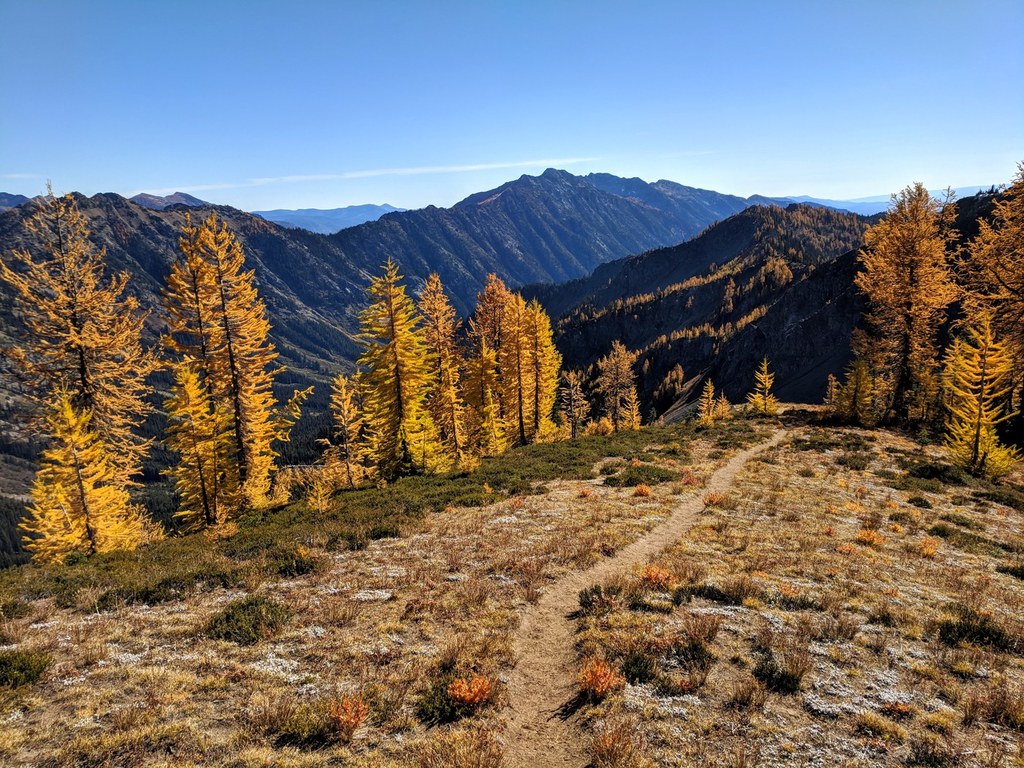
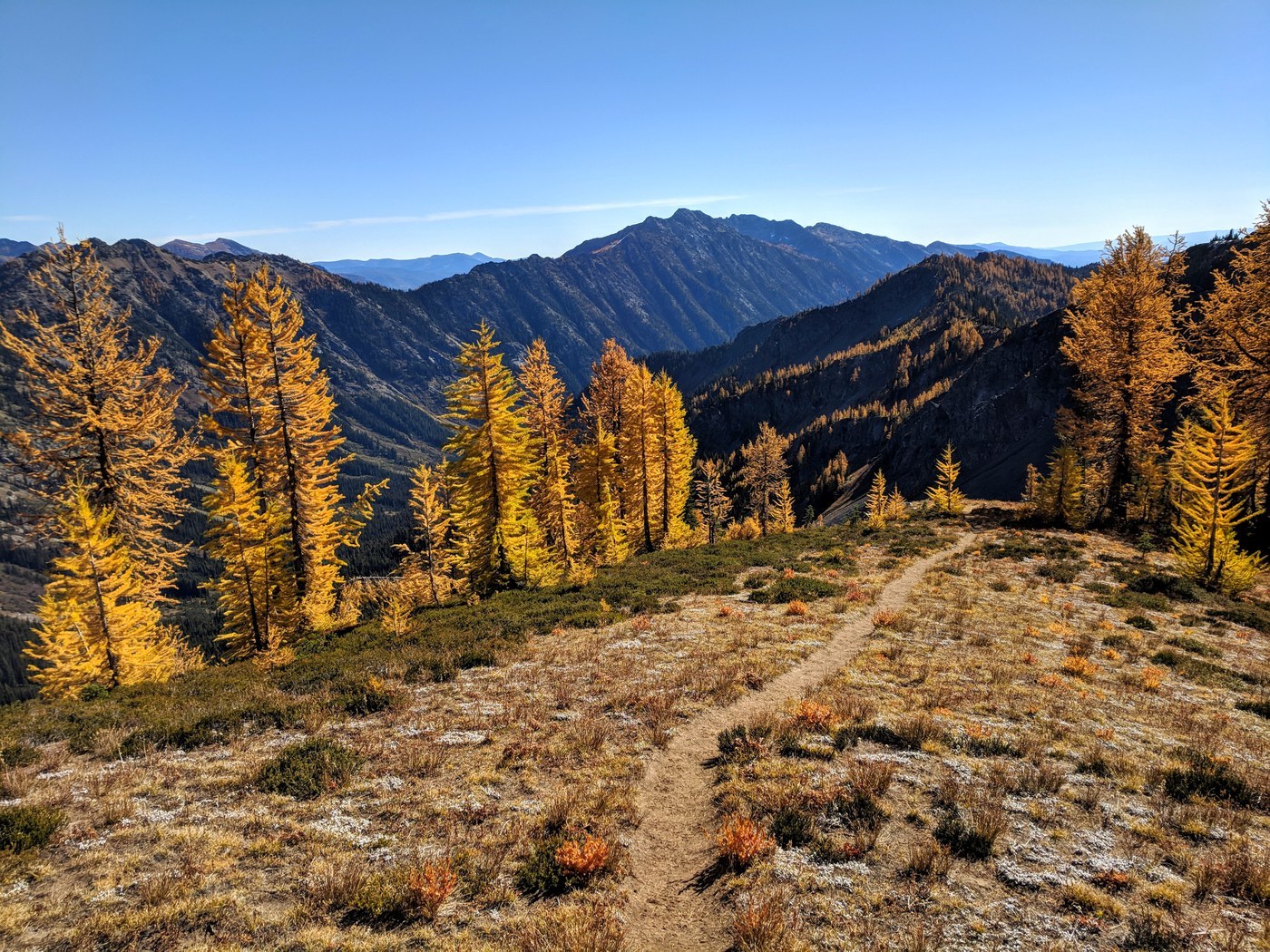
If it is fall in the Cascades, come here for the golden larches.
For those too tired or short on time for the long and usually multi-day trek to the Upper Enchantment Lakes, another well-known site for larches, Carne Mountain has fewer larches but the payoff is much more accessible. In the morning sun the larches shine yellow, and in the afternoon shade they are yellow-orange. The smell of the needles is sweet and rich.
The hike has four distinct parts: first, through the forest in the Phelps Valley; then up along a valley to the basin; then the basin itself; and finally the walk along the ridge to the summit. Once you reach the basin, just follow the foot-wide rivulet toward the middle of the three peaks - that's the site of an old lookout. The views are fabulous from this perch.
For backpackers, there are plenty of camp spots in the basin. And a good map will show several possibilities for multiple day trips.
The larches are turning and the mountains are closing down for winter. When it was clear that good weather and...
The larches are turning and the mountains are closing down for winter. When it was clear that good weather and a nearly full moon were meeting up with the larches over the weekend, Hans and I reckoned to be there too. Even though Carne Mountain had been highlighted as a place to catch the show, we gambled that it wouldn't be too busy, and weren't so keen on driving to outposts North and East. As it was, from our inconvenient location near the 45th parallel, it took seven hours to the Phelps Creek Trailhead, where we arrived about ten, with just a few convenient parking spaces to spare.
It was cold as we donned hats and scarves and gloves, and stuffed more clothes into our packs. My hiking poles apparently had other plans for the weekend, so I annexed a walking stick a quarter mile into the hike, where 1508 to Carne turns East from the trail (1511) to Spider Gap. The initial long switchbacks on the route are pretty gentle, and as the path zig-zags up, the views improve steadily to the West. As we got closer to the basin, stretches of ice and snow encroached on the trail, but footing wasn't an issue, at least on the uphill tack.
We ultimately emerged into the larch-dotted, snow-filled basin and looked for a place to tent. Our off trail explorations on the knob to the North revealed a few flat, but snow-covered sites, so we descended to the basin to eat lunch and reconnoiter. After considerable deliberation, we picked the one five by seven foot bare pre-existing campsite in the basin and set up shop. Since we had whittled away a fair amount of the afternoon, we then hurried to trace the footsteps of day-hikers up to Carne Mountain. As we trekked up through the snow, we crossed paths with a dozen or so day-hikers, and were infiltrated by the magical scenery. Buck and Clark Mountains and the snow-blanketed Chiwawa Ridge occupied the balcony above sparse groves of austere, brightly lit, pumpkin-colored larches. Once the path to Carne cuts left from the Rock Creek Trail (1509) and attains the ridgeline, the views are unencumbered: East across Rock Creek valley to Fifth of July and the Rampart Mountains; North along the Entiat Crest, with Maude and Seven Fingered Jack, the Ice Lakes basin, and hints of the Leroy High route; and then West, past Chiwawa Ridge and the White Mountains, beyond Glacier Peak to the sun sinking below the clouds. We surveyed the distant lands with the last of the day-hikers, and clicked more pictures as clusters of larches whispered among themselves.
We returned to the basin at dusk, filtered water from the snow banks of the meandering stream, and put on clothes. I counted three pairs of socks, five layers of pants, nine layers on the top, and a hat, scarf, and mittens; but Hans beat that with an additional scarf and two hats. Thus fortified, we sat down to cocktail hour, dinner, and dessert. The skies were cloudy, but the moon climbed above the pass to join us for our night time constitutionals. Eventually, stars to the North came out, telling us it was time for bed.
On Sunday morning, we lounged till nine and had a leisurely breakfast. We packed up and picked our way down through some initial icy patches, greeting a dozen day hikers along the way. We got to our car, celebrated with a beer each, and drove home with the elegy of autumn in our minds.
Little Challenging to climb to the top of the perch. Took us 2.30 hours. The best part of the trek...
Little Challenging to climb to the top of the perch. Took us 2.30 hours. The best part of the trek was the climb from the basin to the perch. The larches were flush with yellow. The basin was looking surreal. Almost dreamy. From the basin, we climbed up and we came upon a fork. We took the left fork as suggested by a few folks climbing down. This trails kind of ends at the peak but one has to turn right from there onwards to walk along the ridge to get to the perch. The 360 degree view from the perch is breathtaking, raw and wild.
After some last minute changes to the plan due to weather, and shortening the trip to three days, we set...
After some last minute changes to the plan due to weather, and shortening the trip to three days, we set out for the trailhead. We crossed our fingers leaving Seattle under drizzle, driving out into heavier rain. It ended up being just Yumi and myself for this one, Joanna dropping off at the last minute due to bad-dog related complications.
It was fairly cool and the weather far from certain when we set out along the Phelps creek trail. Near our turn off to Leroy basin we passed a large group camped beside the trail. They told us of riding out the worst rains and thunderstorms they'd ever seen the night before. We hoped we'd fare better and were constantly looking over our shoulders at every dark cloud that floated past.
We pushed on and reached Leroy basin, finding only one tent there. It was a pretty place with lots of marmots scampering around and Seven Fingered Jack hanging overhead. That was our original goal for the day but with the uncertain weather the last thing we wanted was to get caught in a storm high on the loose rock. It was also too early to pitch camp and just sit around, so we opted to have a travel day and pushed on to Ice Lakes.
Route finding was overall pretty straight forward until we hit the infamous scoured out avalanche chute. It was only 15-20 ft deep and equally wide but was a difficult obstacle. I went first, dropping down the very steep dirt and loose rock sides with some difficulty. I found myself wishing I'd brought my ice axe to sink the pick in for some kind of hand hold. Tricker still was the climb on the far side. I started up towards a cairn, following some boot prints when, about halfway up, the ground under my feet gave way. I grabbed onto some exposed rocks, hoping they'd hold, and pulled myself up rock after rock until my feet could find purchase. Not a far fall bit it would have been very painful and likely trip ending. And of course when I reached the top I spotted a nice, easy step-like way up which Yumi took advantage of.
Onward we went and after some more talus crossings we crested the ridge to look down on Ice Lakes. Off to the south and east it was beautiful blue sky but behind us we could see the black skies and rain moving in. We dropped quickly down the snowfields, myself on the rock and scree, Yumi glissading. After a quick search we found a reasonably sheltered campsite in a clump of larch on the knob south of the upper lake. It also had a good little cooking area with rock benches and a large rock for a wind break. We would really need that.
Not long after we pitched camp the clouds rolled in and the wind picked up. It did not relent the entire night. We bundled up with all our clothes, Yumi even with a down parka, but we were still shivering well before sunset. We were forced into the tents early for a second trip in a row. I stayed up awhile reading, knowing I'd have a hard time sleeping with the wind buffeting my Tarptent all night. It held strong, much better than at Lake Augusta last month, but was still incredibly noisy and cold. Dust also blew in through the mesh, sand blasting my face most of the night. There were a few bouts of small hailstones, but thankfully it didn't rain.
I awoke fairly late, taking advantage of the calm morning winds to get a little more rest. Still I was tired. The weather was a little more promising, with blue skies as we ate our breakfast, but then the snow flurries started. This is August! It's not supposed to snow in August! I dont care that we were camped at the aptly named ""Ice Lakes"", it's just not supposed to happen!
Anyway. We decided to check out the lower Ice lake while waiting for Maude to emerge from the clouds. We crossed over to the lake outlet and found we had to scramble down a 50 ft steep chimney to reach our descent route. Normally it appears one could drop down along the lake shore to reach it but currently there is a steep snow slope dropping down right into the lake preventing this. The scramble was quite steep, and a little difficult, but still fun. We dropped the rest of the way on dirt and scree slope beside the outlet waterfall, passing another pair of hikers headed up Maude.
We circled down around the little pond formed by the upper lake outflow, walking to the edge to gaze down the valley. This little bench was very cool, a wide flat area of pumice and larch. It would be beautiful in the fall I'm sure. The lower lake was even more impressive. It had a brighter blue shade than its upper neighbor and even a little island. The contrast was similar to the upper and lower Enchantment lakes. If it didn't involve the scramble and elevation loss I'd prefer to camp at the lower lake.
Circling around the lake we ascended back to the upper lake. In the rocks here a very curious marmot walked right up and stared at us, posing for photos, before we continued out of his territory. Maude was now out of the clouds so we headed back to camp to pick up more food and water. The scramble was surprisingly a little more difficult to ascend than descent but we made it back up.
From the lakes we headed due west, towards the snow-filled bench below the ridge at the end of Maude's shoulder. A low angled gully of snow and rock carried us higher before reaching a nice little boot path the rest of the way. Some very loose scree but nothing difficult. On the shoulder itself we ran into the other hikers again, saying hello as we passed by. The summit never seemed to get closer but without too much effort we were on top. Surprisingly the summit had the warmest temperatures so far! It was quite calm and nice. We stayed for about 45 minutes, signing the register and watching the billowing clouds around Jack and Fernow, before heading down.
I'd hoped for better weather the second night but was again disappointed. If anything it was much colder than before. Still, we refused to be beaten by the cold and stayed out as long as possible, resorting to wrapping ourselves in the sleeping bags like blankets. This helped immensely but even so we were again beaten and retreated to the tents not long after sunset. For consolation at least we had some great color.
The wind howled even worse than before, this time continuous blasts instead of occasional gusts, and I had even less sleep. Monday morning came with blue, beautiful, clear skies. I could have stayed in my bag much longer but forced myself out. After a quick breakfast and filtering some water we were on our way. We climbed up to the saddle overlooking the lakes, waved good bye, and turned to finally see Glacier Peak and all the other stuff hidden by the clouds the past two days. What a welcome view!
Of course immediately we lost the route. We'd spotted a path that appeared to lead over Pt8017 but believed it was simply a summit track, leading to a cliffed out area. Instead we followed a cairn and faint path downwards, below the rock cliffs, to traverse across the slope to the notch on the next ridge. Crossing this sucked almost as much as the earlier gully. In many places it was hard packed steep dirt with occasional scree. Many places to slip and go for a ride on the natural cheese-grater surface. It took over an hour to pick our way across. There must have been a better way.
Off and on we continued our battle to stay on the trail. Occasionally we'd spot a cairn, or possibly a faint boot path, only to be disappointed. We could see where we needed to go the whole time but had a hard time picking the best route. At one point in Chipmunk creek basin we ascended too high, only to be cliffed out and have to drop back down low in the basin. We could see trail on the next shoulder, brightening our spirits.
Finally past Box Creek we picked up real trail and kept it. Carne mountain was now in sight! We looped around through the last basin and began the final ascent to the ridge. Passing the Rock creek trail junction our tired legs pushed up the last bit of elevation to the ridge. We were both pretty beat and low on water now. Dropping packs here we took a quick trip up Carne to look back on our traverse. Views were fantastic! Blue and very clear skies gave up mountains in all directions. Spider meadows lay far below, surrounded by snowy cliffs.
We could also see water down below in Carne basin! We picked up our packs and began the numbing descent of all those long, low switchbacks back to the car. Pausing only in the basin to collect some more water, we continued on, ticking off the miles. At one point we figured each long switchback only shaved off 50-100 ft! What we wouldn't have given for a nice, quick, steeper descent. At last we spotted the main trail below and knew the cars were close! It felt great to finally sit down in a comfortable seat. Even better was the real food back in Monroe, after three days of trailfood.
What a great trip! In the end we didn't summit Seven Fingered Jack but we did finish the route, Carne mountain, and Maude, as well as have a leisurely exploration of the lakes themselves. 3 days, 20 miles, and 8900 ft total gain. Beautiful place, and it certainly lived up to its name this weekend! It was fricken freezing up there!
Full trip photos at: http://www.pbase.com/billcat/icelakes
US 2 to Coles Corner at SR 207. Take the Lake Wenatchee Road for 3.8 miles to a fork, take the Chiwawa Loop Road that hugs the south shore of Fish Lake and head east to Chiwawa River Road or FSR 62. Bear left now turning north. FSR 62 is rarely marked--just stay on this main road. FSR 62 is renumbered FSR 6200. Look for Phelps Creek Road 6211 at 22 miles. Continue 2.5 miles to the Phelps Creek Trailhead. The last 15 miles of the ride is dirt, gravel and rock and not in graded condition.
Location
Carne Mountain (#1508)
Central Cascades -- Stevens Pass - East
Okanogan Wenatchee National Forest
3.75 out of 5
Based on
4 votes
Roundtrip
8.0 miles
Elevation Gain
3600 ft
Highest Point
7085 ft
Features
Fall foliage
Mountain views
Summits
Guidebooks & Maps
100 Hikes in Washington's Glacier Peak Region (Spring & Manning - Mountaineers Books)