|
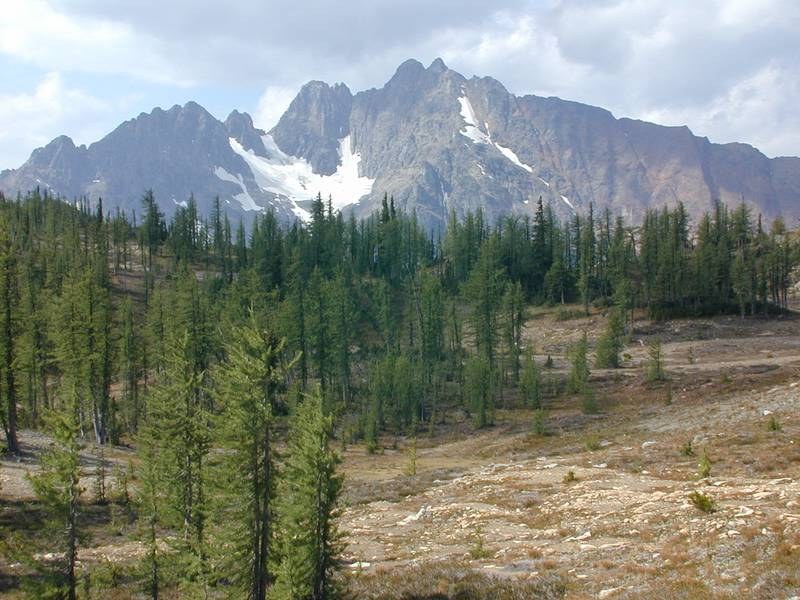
Copyright © Craig Romano/The Mountaineers Books Tatie Peak and Grasshopper Pass
Featured In:
Day Hiking: North Cascades,
by Craig Romano.
A portion of all book sales from the links above benefits WTA and helps protect and maintain our trails. Start on a Cat track on the edge of a burn that scorched thousands of acres of high-country forest surrounding Harts Pass. In two minutes reach Trail No. 2000, the Pacific Crest Trail. The trail right heads to Canada. The trail left heads to Mexico via Grasshopper Pass-take it. In no time break out of the forest into an open basin punctuated with tall larches. You may notice flagging and other disturbances below. They're remnants of the Brown Bear Mine. The region is littered with old mines, some still active, but none yielding much these days. Gently climb, rounding the open basin, views expanding with each step, and reach a ridge crest at 0.75 mile. The way is all alpine now as the trail skirts steep slopes. Gaze south into the glacially carved South Fork Trout Creek valley. Its U-shaped symmetry indicates past glaciations (V-shaped valleys signify the past work of creeks and rivers). At 2 miles (elev. 7000 ft) attain a small gap high on Tatie Peak's eastern shoulder. Marvel at the array of geological diversity at your feet. Shale, slate, sandstone, and granite-it rocks! Speaking of slate, the peak bearing that name can be seen off to the north. It's the one with the attractive fire tower gracing its summit. Hikers comfortable with off-trail travel may want to continue along the ridge crest for 0.5 mile, climbing 400 feet to Tatie Peak's 7386-foot summit. It's not overly difficult; just be aware of the drop-off along the northern slopes. Peak baggers can help themselves to a heaping of visual delights. The prominent summits of Jack, Crater, Azurite, Tower, Robinson, and Ballard can all be sampled from Tatie's wide open perch. The trail, however, forgoes those views, traversing Tatie's southern slopes to gently descend to another gap (elev. 6800 ft). Squeaky ground squirrels and whistling marmots will accompany you. Sneak a peek at the gap to impressive Mount Ballard and below to Slate Creek, where the mining community of Chancellor once bustled. From this point, the trail continues to descend, now through alpine rock gardens and a majestic stand of larches. Pass this way in October and be wooed by a golden hue. Snow patches often blotch the heather meadows, providing the only water along the way. Bottoming out at 6500 feet in a boulder field, the way once again climbs and at 5 miles reaches 7125-foot Grasshopper Pass. Don't call it quits here, however. Continue a little farther on the broad gap, leaving the trail just before it drops steeply to Glacier Pass. Locate well-defined tread heading south, and follow it for about 0.5 mile to a 7125-foot knoll. Now revel in the shadows of all 8000-plus feet of impressive Mount Ballard and Azurite Peak. Admire, too, the prominent cloud-piercing Golden Horn and Tower Peak. And don't forget to set your sights downward to the confluence of crashing creeks that create the majestic Methow River.
Driving Directions:
From Winthrop drive the North Cascades Highway (State Route 20) west for 13 miles to the Mazama turnoff just past milepost 180. From Marblemount follow SR 20 east for 73 miles. Proceed north for 0.5 mile to Mazama. Turn left (west) at the intersection, following the paved road to Harts Pass (Lost River Road). The pavement ends in 6.7 miles, and the road becomes Forest Road 54. Follow this harrowing, at times narrow road for 12 miles to Harts Pass. Turn left onto FR 54-500 (signed for Meadows Campground) and in 2 miles come to road end and trailhead (elev. 6400 ft). Recent Trip Reports
Hiked here recently?
Submit a trip report!
There are
25
trip reports for this hike.
See all trip reports for this hike.
Day hike
Features:
Wildflowers blooming
Issues:
Snow on trail
Expand report text
Hide report text
Read full report
with photos
This day hike begins along the Pacific Crest Trail at 6400’ and only gets higher. There is not a...
This day hike begins along the Pacific Crest Trail at 6400’ and only gets higher. There is not a lot of elevation gain or loss, making this a pleasant day hike. Because of 2011’s heavy snow and cool spring, there are still some snow patches and a few wildflowers.
The side trip to the top of Tatie Peak was well worth it. From the east, the scramble trail up Tatie Peak is well defined and easy to follow. Mt. Baker was partially obscured but the 360 degree view from the top was still awesome. We chose to drop down from the peak to the southwest and continue onward to Grasshopper Pass. There was not a well-defined trail on that side. It was doable, but required more caution. After a snack at Grasshopper Pass, we left the PCT again to climb Point 7125. The boot path to the top was well defined, but scratchy trees lined the narrow path. I got too careless when squeezing between two small scrubby trees and ended up with a cut on my knee from an unyielding branch. The view from the summit was different from that atop Tatie Peak and therefore also worth the effort.
Tatie Peak and Grasshopper Pass
— Jul 27, 2011
— backpacker2004
Day hike
Features:
Wildflowers blooming
Issues:
Snow on trail
Expand report text
Hide report text
Read full report
Left Winthrop about 9AM and drove to Hart's Pass then turned left toward Meadows CG for the last 2 miles...
Left Winthrop about 9AM and drove to Hart's Pass then turned left toward Meadows CG for the last 2 miles to the trailhead. No snow on the road until the last 200 yards before reaching the trailhead parking area. We parked on the road and walked up to catch the PCT south. Temperature was 45 degrees with light wind, no mosquitoes.
The first part of the trail skirting a basin has a sort of NE exposure until you round the corner in about 3/4 of a mile. There were a couple of steep snowfields to cross that made my wife ask if our wills were up to date, but with trekking poles and mini crampons we managed to escape alive. After turning the corner, the trail has a southern exposure and looked pretty much free of snow. We encountered other hikers/climbers, a group of six, who were on their way to climb Tatie Peak. As it turned out there were a few other snowy places on the trail as we headed toward the next big turn just below Tatie Peak, but nothing major. At this point the trail became completely snow covered and we could see several steep snowfields to cross up ahead, so we had lunch and headed back. There were of course plenty of wildflowers, including pasque flower, lupine, lewisia, glacier lilies, phlox, paintbrush, etc. Weather was cooperative, cloudy at first, but burning off to mostly sunny by the time we got back to the car. Once we reached Hart's Pass on the way back there was a huge dirt/rock hauling piece of equipment that had just driven up to go work on the road out towards Chancellor. The thing was 11 feet wide and I was so glad we didn't meet it on the way down. Day hike
Features:
Fall foliage
Expand report text
Hide report text
Read full report
with photos
We spent the night at Meadows Campground very near Harts Pass so we could hike Grasshopper Pass on Saturday and...
We spent the night at Meadows Campground very near Harts Pass so we could hike Grasshopper Pass on Saturday and Windy Pass on Sunday. We came to see the larch trees and were not disappointed. They are at their peak and some near Grasshopper Pass are already past their peak with their needles on the ground. The trail is on the PCT so a very gentle grade. Hiked up Tatie Peak for a better view and took a snooze at Grasshopper. Perfect day.
Tatie Peak and Grasshopper Pass
— Sep 26, 2010
— wolfwoman
Multi-night backpack
Expand report text
Hide report text
Read full report
This was the annual larch trip for our gang of friends which included Blissman, Greg, Maria, Jimbo, Cathy, and Cedar....
This was the annual larch trip for our gang of friends which included Blissman, Greg, Maria, Jimbo, Cathy, and Cedar. I'd planned to begin this hike at Hart's Pass, but given the questionable weather, we started at the trailhead beyond Meadows Campground which cut off about two miles of hiking. It just seemed like a good idea to set up tents as early as possible and hope for better weather on Saturday. We had some on and off sprinkles and cold temperatures, but it went just fine and we camped at the basin about 3/4 miles north of Grasshopper Pass. I'd read several reports that indicated that there was no water in this area, but I knew differently having camped there before. For anyone looking for water, just keep an eye out once you've left Grasshopper Pass and swung around into the next open basin where your views change and you leave Azurite Peak behind. There is a nice green basin below here and a camp complete with fire ring next to the trail. From here find at least three trails descending a short way into the basin and there is lots of water here. Maybe from a spring? Great camps too. After setting up camp, we hiked up to Grasshopper Pass and north to peak 7528. The wind was blowing and the clouds were swirling! It was cold and we tried to keep moving. We arrived back in camp to a hurried dinner and the lowering of clouds and darkness. Still, we were in high spirits hoping for better weather in the morning. Saturday was sunny and clear! We headed back to Grasshopper Meadows to check out Peak 7125. This is a very easy and spectacular peak with a trail the whole way up. After some lunch and lazy basking, we split up the group. Some of us needed water and others had planned better. The planners, Blissman and Greg, went back up peak 7528 to run the ridge over to Tatie Peak. The report was that it was great fun. The rest of us went back to camp to fill our water bottles and head toward Tatie Peak from the PCT. Tatie is fun and dramatic following eroded ridge and looking down into the basin below. Blissman and Greg showed up while we were loafing on the summit. After a short time we started back down as the wind was picking up and the clouds were coming in. Saturday night rained practically the entire time, but eased off a bit during breakfast and the trip out. Peakbagger extraordinairre, Greg, polished off his weekend with a scramble up Peak 7405 on the way out. The larch are near peak, but the needles are starting to blow off with the wind. The huckleberry is red as can be. We saw a lone elk in the basin below Tatie, and lots of pica in camp. Good times were had by all, but dinner at the Duck Brand in Winthrop left something to be desired!
Tatie Peak and Grasshopper Pass, Pacific Crest Trail (PCT) Section L - Rainy Pass to Manning Park, West Fork Methow River
— Aug 22, 2010
— DestinationUp
Multi-night backpack
Features:
Wildflowers blooming | Ripe berries
Issues:
Overgrown
Expand report text
Hide report text
Read full report
On 8/22, our group of five Boy Scouts, plus adult leaders J and I, went to Meadows Campground, near the...
On 8/22, our group of five Boy Scouts, plus adult leaders J and I, went to Meadows Campground, near the top of Harts Pass. Our plan was an open loop trip down to River Bend Campground, and the TH of the West Fork of the Methow Trail.
Harts Pass Road (5400) is in good shape; 12.4 miles, but plan for about a 40+ minute drive time. It is one lane, and has its share of washboarding and potholes, but can be handled by cars with reasonable clearance and decent suspension. Be cautious of the blind curves, and be ready to stop and pull off into one of the many wide spots for a slow speed pass. The area around Dead Horse Point is signed as rough and hazardous, 10 mph. Obey the sign, and life will be good. According to the calendar, it was August, but when the guys stepped out of the trucks, they were hit by a twenty-plus mph wind, and temps in the thirties. The campground (and some of the subsequent trip) is located in the region of the Needles Fire of 2002. Burned out trees were everywhere, and the howling wind through the trees sounded positively eerie. We were even greeted by a brief burst of snow. Such is summer in the North Cascades. The wind eventually blew itself out, and Monday morning dawned calm and clear; temps would be in the mid-upper 70s for the rest of the trip. After a quick breakfast, and breaking camp, the two chauffeurs headed back down the mountain to leave a truck at River Bend Campground, where the open-loop trip would end. Finally, the troop headed to the road up to the trailhead, and after a quick picture, took off south down the Pacific Crest Trail. The trail gradually climbs around an open basin, and makes its way along steep slopes near the ridgeline. Unfortunately, my camera was on the fritz, so I don't have pictures of the views, or the many flowers I'd never seen before (see Riri's report from 8/14 for a description and lots of great shots). At two miles and 7000 feet of elevation, at the saddle next to Tatie Peak, the troop called a halt for lunch among the heather and the views. There were virtually no bugs, and it was utterly pleasant. The trail descends gradually to 6500 feet, but not before traversing several boulder fields. It was awesome to see the Slate Creek valley far below us, and the huge boulders that were scattered all around; they must have rolled hundreds of feet as they crashed down the slope. Finally, we hit the last ascent, and at five miles and 7125 feet, we reached Grasshopper Pass. Mt. Ballard and Azurite Peak almost hit us in the face, they seemed so close. Gorgeous. And now for the water. The source we had been expecting a couple of miles back had apparently dried up. We met a couple of northbound thru-hikers, who told us that the last water they’d seen was far ahead of us. So we shouldered our packs, and headed down the far side of Grasshopper Pass. This is an extremely steep slope, with long switchbacks, and it took a while to make it down. But the trail was in fine shape, so we had no problem. We passed Glacier Pass at 5200 feet, and headed southwest along Brush Creek, which was within earshot, but tantalizingly out of reach. At 8.6 miles, we reached the junction with the West Fork of the Methow River Trail. The river, too, remained in earshot, as we travelled almost due east down the 8 mile trail. It would be another two miles before we reached a campsite where water was accessible. Dusk was falling as we began to set up camp, and by the time water had been filtered, tents pitched, and dinner prepared, it was dark. Nobody minded turning in at 10:30, and I daresay everyone slept well. Tuesday morning was a carbon copy of Monday, except a couple of thousand feet lower, and with the sound of the river in our ears. We slept in, after the late night, and hit the trail a little before eleven. The first thing that hit us, literally, was the brush. Slide chute brush was everywhere, and I do mean everywhere. Today’s challenge was to make our way through. The trail was easy enough to follow, but as I looked up from the back of the group, all I could see was six to eight foot tall brush, and the occasional pack-top bouncing along in front of me. It made me wish for a machete, and I kept expecting to hear “Doctor Livingston, I presume?” The going was slow, but the guys slogged on, and there were occasional thimbleberries to look for. I saw one cluster of salmonberries, but the hucks were nowhere to be found. We called an abbreviated lunch break at 1:30. The brush gradually thinned, and at around 3:00, we found ourselves at a low-running Trout Creek, home to a great bridge, and plenty of places to splash, rinse, and filter water. It was just what the doctor ordered, and after relaxing for the better part of an hour, we headed downriver again. Two miles later, we found a great looking camp, and called it quits. J took a few of the guys further down the trail to see if they could find anything better, but they came up short. Literally. We were at Rattlesnake Camp, just a few hundred yards from the trailhead. But this was as good a place as any. Rattlesnake Creek was right there, providing easy water and a great place to soak tired feet. The campsites were level and comfortable, and the weather was beautiful. We stayed, and had a peaceful and delightful evening. The next morning, we were up at a reasonable time, but in no hurry. Coffee was made, oatmeal was eaten, gear was stowed. We shouldered our packs for the strenuous hike down the trail, and five minutes later, we were at the truck. |
Grasshopper Pass, by Lee Stamm.
Map it
|
Document Actions
- Email this page
- Print this
- Share