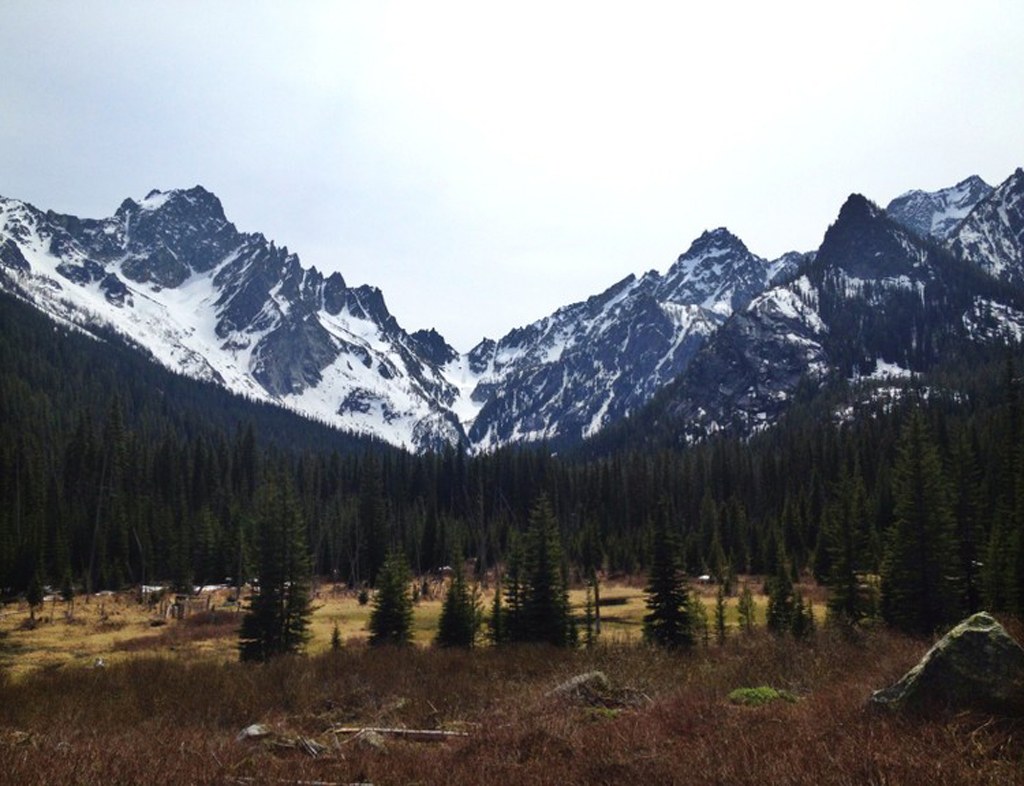
Lake Stuart
Last modified
Jul 19, 2010 05:17 PM
Lake Stuart is an inviting lake beneath the fearsome north face of one of Washington's highest and most imposing peaks. Though not as dramatic as nearby Colchuck Lake, Stuart still serves up plenty of nice scenery, including a close-up of the 9415-foot peak that shares its name. The journey is longer than to Colchuck, but much easier due to Stuart's lower elevation and the gentler topography on the way. Stuart is smaller and shallower than Colchuck, too, but warmer-by late summer, warm enough to even splash in. Try that in nearby Colchuck, whose name means "cold water!"
The Lake Stuart Trail starts easy, kicks up a little dust, settles down, then makes one last push, albeit moderate, before emerging in the forested basin housing the aquatic object of your desire. Begin your hike in cool forest, soon entering the Alpine Lakes Wilderness. Follow alongside the tumbling and chattering Mountaineer Creek and enjoy an air-conditioning effect thanks to flows of heavy cool air constantly funneling down this tight valley. At about 1.75 miles (elev. 4000 ft) cross Mountaineer Creek on an attractive log bridge. Then begin a short but grueling grunt up sun-kissed slopes of open forest interspersed with slabs of granite. At 2.5 miles the grade relaxes and a junction is reached (elev. 4500 ft). The trail left leads to Colchuck Lake and is where the majority of hikers heading up this valley end up. Good. Now, you can enjoy your trip to Stuart even more. The way continues up the Mountaineer Creek valley on a near-level course. Soon break out of the cool forest into a brushy meadow, affording a splendid view of an almost-dead-ringer for Mount Stuart, its smaller twin, 8453-foot Argonaut Peak. Cross the base of a boulder field, returning to forest, this time of the lodgepole pine persuasion. The trail pulls away from the creek, continuing up the wide valley, undulating between forest and meadow, gaining very little elevation en route. Meeting up again with Mountaineer Creek at about 4.5 miles, the way commences a short climb via a series of short switchbacks. With the creek now tumbling beside you, pass through groves of aspen that warrant a return trip in autumn for a golden showing. At 5 miles reach Lake Stuart (elev. 5065), surrounded by tall timber and tall peaks. Much of the shoreline is rocky and forested, but you can find grassy and sandy spots perfect for sunning and wading. Find a nice spot on the north shore for staring out across the placid waters to imposing Mount Stuart with its hanging glaciers. Consider bringing your fishing pole-the cutthroat are jumping. Recent Trip Reports
Hiked here recently?
Submit a trip report!
There are
93
trip reports for this hike.
See all trip reports for this hike.
Day hike
Features:
Wildflowers blooming
Issues:
Overgrown | Bugs
Expand report text
Hide report text
Read full report
with photos
With the temperature forecast to soar into the 90s later in the week, I decided to take a cool but...
With the temperature forecast to soar into the 90s later in the week, I decided to take a cool but dry Tuesday visiting the Stuart Range from the north. The unpaved road portion was bumpy but not too long. The parking lot at the Lake Stuart TH was just over half full at 9:30am.
The trail is in good shape going to Colchuck Lake with the last 1.5 miles rocky, rooty, steeper, but w/ firm footings - nothing that cannot be handled w/ slower pace. There were no significant bugs on a cool morning. Once the Lake was reached, the lingering sweeping clouds tried to hide the toothy peaks of Dragontail and Colchuck from time to time. But they could not diminish the sapphire shining of the clear alpine lake. There were quite a few people on the trail. Most of them are backpackers and climbers (w/ ice ax). Aasgard Pass was truly waiting patiently for the lucky few! On my way back, I decided to take a side trip to Lake Stuart w/ its easy grade (600 vertical feet in 2.5 miles). There were a lot more wildflowers blooming there in the valley. Naturally the bugs were also buzzing constantly in the warmer and breeze-less afternoon. With the trail less traveled, the vegetation was a little overgrown but in no way prevented me from following the trail. From a different perspective, the peaks of Argonaut, Sherpa, and Stuart were clearly in view in front of the lush meadow and the pyramid-like namesake ridges of the nearby Mountaineer Creek. Even after dipping my toes in the cool and sandy Lake Stuart, my feet were getting sore towards the end of the 14-mile hike pushing the limit of my day-hike boots. But the soothing sound of the rapids and cascades fading in and out from the accompanying Mountaineer Creek seemed to be urging me on. Slowly, surely, and safely the TH came into view and a wonderful hike was finished. Multi-night backpack
Features:
Wildflowers blooming | Ripe berries
Issues:
Blowdowns | Bugs
Expand report text
Hide report text
Read full report
with photos
Perfect backpacking weather on the hike in to Stuart Lake with high 70s. Slightly buggy in the expect areas (near...
Perfect backpacking weather on the hike in to Stuart Lake with high 70s. Slightly buggy in the expect areas (near boggy, marshy areas and streambeds) - quite a bit better than in '09. Perhaps the mosquitos had already had their fill of weekend hikers!
Enjoyed scenic view break near the far end of Stuart Lake. Campsite (near the 'big rock') seemed less buggy to us, but hikers heading out from their weekend appeared bugged-out. Continued through the lake-end marsh and anticipated blowdowns (should've counted these, as they're plentiful and at times difficult to pick the trail back up after clamoring over multiple trees at the same time). Great note for those seeking the Horseshoe Lake trail is to keep to the LEFT after the stream on the far side of Stuart Lake (thru the woods) towards the marsh. We noticed many dead-end trails off to the right from hikers seeking the trail last year and didn't make the same mistake this time. You'll be rewarded when finding the rusted horseshoe (I'd suspect this is just after most hikers give up). Trail heads up severely - indeed a scramble at least a quarter of a time. Quite challenging if you've heavy packs (ours were 25-50 lbs). Elevation profile shows it's about 3/4 of a mile up to the lake with steep, often difficult-to-track trail. The reward is in the lake. Yes, some bugs (this is August, after all!), but worthy of a few nights' stay and more day-hiking up the scramble to the ridge overlooking Ingall's Lake on the western slope. An abundance of frisky mountain goats are sure to keep you entertained. Be prepared for thundering hooves and little ones calling out for mom's in the wee hours of the morning. (Some might find this annoying - we found it delightful!). Plethora of huckleberries found between the trailhead and halfway hill. Keep an eye out for a little brown bear tucked within the bushes!
Lake Stuart
— Jul 26, 2010
— CatLeGrand
Day hike
Features:
Wildflowers blooming
Issues:
Bugs
Expand report text
Hide report text
Read full report
Got to Stuart Lake at around 2:30pm, boy were the bugs in FULL FORCE that day! We got eaten alive...
Got to Stuart Lake at around 2:30pm, boy were the bugs in FULL FORCE that day! We got eaten alive even with the bug spray. Perhaps it was because it was pushing the upper 90's that day?? Lake was beautiful, lots of solitude, not even a lot of cars at the trailhead. Trail was in excellent condition. Will wait to hike again (anywhere) until the flies and mosquitos have died down a bit. It was a great hike, but the bugs made it awful at times.
Day hike
Expand report text
Hide report text
Read full report
with photos
Mt. Stuart is the tallest peak in the Alpine Lakes Wilderness area. The Mt. Stuart...
Mt. Stuart is the tallest peak in the Alpine Lakes Wilderness area. The Mt. Stuart batholith is a hotly debated topic in geologic circles. A microplate tectonic model proposes in what is called the Baja-BC hypothesis that the granite of Stuart had its origins at latitude ~31 degrees in the Baja region. The rock was driven on a subterranean plate and surfaced as an accreted terrane at it present location. The only movement of rock we experienced was the occasional rockfall in our Cascadian Couloir route. Randy Busch and Craig Beaver were my partners for this ambitious day-trip.
We drove I-90 east and turned north toward Wenatchee at Route 970. We were on this for 5 miles and turned left at the sign for Teanaway River road. At 13 1/2 miles is a road junction at 29 Pines Campground. At this "Y" take the right fork (Forest Road 9737) and drive the dirt road until it ends at the trailhead, elevation 4243 feet. This trail also accesses Ingall's Lake but the signage is good for the turnoffs to reach Long's Pass at 6250 ft. Once at Long's Pass the descending trail toward Ingall's Creek is 50 ft to the left. It starts out with tricky footing but gets better as you descend. There is a log crossing at Ingall's Creek but it is not for the faint-hearted. You may want to bring wading shoes for the ford. We then took the Ingall's Creek trail downhill east for ~1/4 mile. The start of the trail toward the Cascadian Couloir is just past a large stream with a broken bridge at ~4900 ft. The trail is on the left and is well-used. When you get out of the trees and see the mountain the route continues up broken rock to the left of a black-rock buttress seen on your right. The route continues up and dropped us at a snowfield where we finally changed into our boots and removed our ice-axes from the packs. The snow was easy to kick steps into and our crampons remained stowed away. We crossed the ridge at ~9,000. It is important to remember the landmarks for where you crossed this ridge as it will be a challenge to locate on the downclimb. Once across the ridge we lost ~30 feet of elevation before following the cairned route to the top. There is a fair amount of traversing left and don't be tempted to gain elevation quickly or you will be on unfriendly rock. If you are on Class 4 rock then you are off-route. The true summit only grants use of one person at a time. The summit register is in an attache size box placed by the Cascadians of Yakima. Our descent varied from the ascent route. We wanted to avoid the slabby rock and with climbers above us the risk of rockfall in the Cascadian Couloir. We took the next gully drainage to the east. Where the gully steepened through a rock course we angled right and teased our way through trees and talus to reconnect with the Cascadian Couloir trail. The sun had thankfully dropped below the ridgelines and gave us a shadowed route for the grind back up to Long's Pass. Distance travelled; 13 miles Elevation gain; 8,200 ft Car-to-car; 13 hrs
Lake Stuart
— Jul 03, 2010
— jjdebord
Day hike
Features:
Wildflowers blooming
Issues:
Snow on trail | Bugs
Expand report text
Hide report text
Read full report
Jennifer,Matt,and I decided to brave the crowds and hike to Stuart lake. The trail is in good shape the first...
Jennifer,Matt,and I decided to brave the crowds and hike to Stuart lake. The trail is in good shape the first little log crossing is a bit shaky and there were a few patches of snow near the lake. We were blessed with beautiful weather and a nice breeze at the lake. I was surprisingly unsuccessful at catching any fish, but it did not spoil the day. The mosquitoes were pretty fierce after the junction with the Colchuck Lake trail, but we battled back with the bug dope. All in all a good hike and not that crowded at the lake.
|
Driving Directions
From milepost 99 on US 2, on the western edge of Leavenworth, follow the paved Icicle Creek Road (Forest Road 76) for 8.4 miles, turning left onto Eightmile Road (FR 7601). Continue on this washboarded dirt road for 3.8 miles to a large parking lot and the trailhead (elev. 3400 ft). Privy available.
|
Document Actions
- Email this page
- Print this
- Share