


How to prepare for a WTA backcountry trip
WTA's backcountry volunteer trips can be fun and rewarding, but they do require a little extra prep. Luckily, we've got you covered.
Here's everything you need to be fully prepared for a volunteer vacation or a backcountry response trip with WTA.
- Training for your trip
- Packing lists
- Sample daily schedules
- After your trip
Get ready
2026 backcountry trip preview is Feb.13.
Registration is Feb.21.
Before you go: Training for your trip
Get into your peak condition
Backcountry trips involve doing trail maintenance for multiple days in a row, and often feature long hikes to camp or the worksite.
As you sign up for trips, read the descriptions carefully to see how long the hike to camp and the project are and choose a trip that is the right amount of challenge for you. Everyone works (and hikes!) at their own pace on WTA work parties. We want to make sure you set yourself and the crew up for success at every work party.
It's a good idea to work on your flexibility and strength leading up to your trip. You might want to work on some endurance training, too. Hiking with your loaded pack plus 3-5 pound weights in one or both hands is a great way to get in shape for carrying gear and tools for BCRTs. Here are some resources to help you physically prepare for your next backcountry trip.
- Train so you can move mountains today and feel good tomorrow
- Get into your peak condition
- Training hikes: Try these to build endurance
- Alternately, filter through the hikes in our Hiking Guide to find the perfect trail near you to train on.
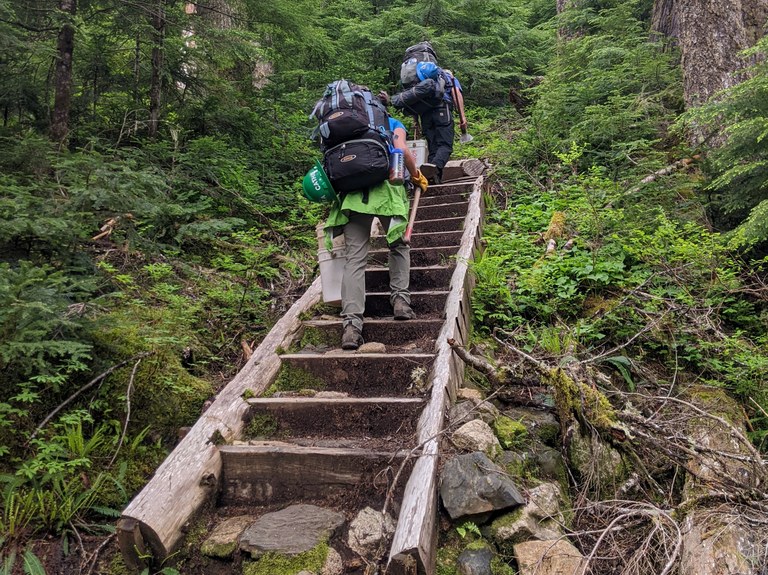
Even seasoned volunteers and experienced backpackers can benefit from training before summer kicks off. Photo by Anna Roth
Pack everything you need (& some things you want)
It's most important that you're warm, dry, and well-fed on these trips, but sometimes a couple extra items in your pack go a long way towards making camp feel like home for a few days. We've got recommendations to make that happen, too.
*We provide packing lists in the registration email you receive after signing up. Please check your gear at least four weeks in advance of your trip so you can make any needed repairs or replacements.
Backcountry Response Teams
In the field: Daily schedules
Volunteer Vacations and Backcountry Response Teams have similar day-to-day structures with some key differences. Here's a schedule outline to give you an idea of what your trip will be like, plus testimonials from past volunteers about what their first backcountry trip with WTA was like.
Backcountry Response Teams
Day 1
In the morning, meet the crew at the trailhead for introductions and a safety briefing. Pick up tools and begin the hike to camp. (Specific meeting time and location will be confirmed in advance by your crew leader).
Once we arrive at camp, we set up camp and eat lunch. If it's still early in the day, we may work on Day 1.
Around 4:00 or 5:00, we're back at camp to unwind, prepare our own dinners and eat together, then socialize before heading to our tents for the night.
Day 2 and beyond
The crew usually wakes between 6 and 7 a.m., and sits together to make breakfasts before we pack up our individual bags and lunches for the day. By 8:30 a.m., we start our hike to the project and work as a crew until noon when we break for lunch.
After lunch, we continue trail work, stopping periodically for breaks. Depending on the project and the weather, work may end at different times each day, but usually we are back in camp no later than 5:00 p.m.
At camp, we take some personal time or make dinners together as we wind down for a cozy night at camp.
Final day
Depending on how long a hike out we have, we may work for a half day (until noon), or we may pack up camp and simply hike back to the trailhead. (Your crew leader will have the specifics for this and will tell you in the lead up to your trip.)
Volunteer Vacations
Day 1
Meet the crew at the campsite or trailhead for introductions and a safety briefing. Most volunteer vacations don’t require a hike to camp, so you’ll meet your crew at the campsite in the afternoon and spend some time getting to know each other, setting up camp, and cooking dinner on the first night. If it is a backcountry volunteer vacation, you will meet at the trailhead in the morning and spend the day hiking together before setting up camp.Specific meeting time and location will be confirmed in advance by your crew leader.
Once the communal kitchen tent, water filtration system, and camp toilet are set up, you’ll set up your personal tent or vehicle camp.. If it's still early in the day, we may work a bit on the project.
Around 4:00 or 5:00, we're back at camp to relax and prepare dinner together. We try to serve dinner by 6:00 p.m., then everyone helps clean up camp and socializes before heading to our tents for the night. Check out a sample menu for the week here.
Day 2 and beyond
The crew usually wakes between 6 and 7:30 a.m.. We make and eat breakfast together, then you make your own lunch before heading out to work. We have lunch at the project site around noon.
After lunch, we continue working, stopping periodically for breaks. Depending on the project and the weather, work may end at different times each day, but usually no later than 3:30 p.m.
On most volunteer vacations, there is a day off mid-week for participants to rest or explore the area. Food is provided on days off.
Final day
Usually, the final morning is spent cleaning and packing up camp. Depending on the project, we may work for a half day (until noon) before packing. If there is a hike back to the trailhead, your crew will prepare all gear to be packed out before hiking out together. Usually, you are on the road by early afternoon. Your crew leader will give you more details about what to expect on the last day of your specific trip.
Back at home
Once you're home, kick back and write a trip report outlining what you accomplished on your trip. You'll get an email from the crew leader wrapping up the trip and sharing photos. If you have pictures you want to share with the crew (like this great one below), you can! Just look for the photos link in the summary report email.

Clean Your Gear
Gear can be pricey. We've got tips to help you keep it in excellent condition for years to come.
Write a Trip Report
Trip reports are a chance for you to brag about the work you and your crew did while informing hikers of what condition the trail is in.
Fill out our post-trip survey
We want to hear about your experience. When you get the summary email from your crew leader, you can tell us what you liked and what we can do better next time in the survey link there.