


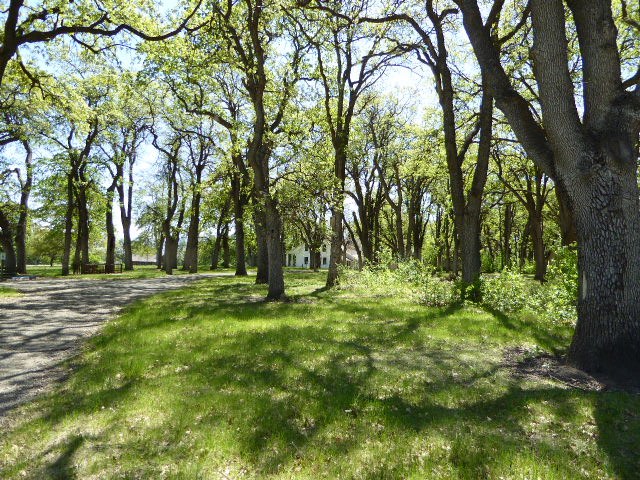
Fort Simcoe State Park, located in the middle of the Yakama Indian Reservation, is not on the road to anywhere; it is a worthy destination on its own. It’s a day use park, and though I long to camp there, I’m glad it’s not a camping park… because if it were, it would be packed full of people, especially on a perfect Saturday in May. Instead, we saw only a handful of others and were surrounded by peace.
The State Park website gives the following background:
“Once a Yakama Nation camping area, the rich, fertile region sparked discord between the tribes and Euro-American settlers, prompting the U.S Army to construct a fort there in 1856. Fort Simcoe’s military history was short-lived, however. Closed as a fort in 1859, the site was handed to the Bureau of Indian Affairs, under which it became a boarding school for Yakama children.”
If you feel some unease when you read “boarding school for Yakama children,” you’re not alone. A Yakima Herald article I found online states, “From 1860 to 1922, the former U.S. Army installation was home to a government-run boarding school for Native children. The school was part of a program government officials claimed was an attempt to “civilize” Indians.” (Donald Meyers, “It Happened Here: Indian boarding school established at Fort Simcoe,” in Yakima Herald, February 17, 2019). The article goes on to describe some examples of that “civilizing” education, but let’s turn our gaze to the serenity of today’s Fort Simcoe.
The landscape is an intriguing juxtaposition of arid shrub steppe and shady oak grove. Flowing springs give the area enough water to support trees and greenery. With the sun shining through the leaves, creating dappled shade, it there was no trace of the conflicts that once defined Fort Simcoe.
The Yakama Nation granted a 99-year lease to the State in 1956 for historic preservation of the park. Given the dark history of the military fort and the boarding school, it strikes me as generous of the Yakama Nation to share the park with the public.
The interpretive center and historical buildings are only open by special appointment (which we did not have), but we were able to peek through the wavy glass windows and see inside some of the buildings.
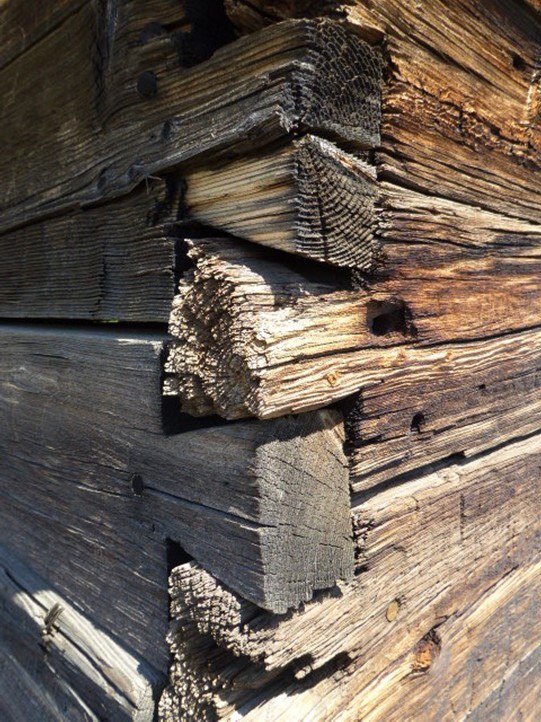
There are several reproduction blockhouses (i.e., sturdy building where the soldiers could be protected while fending off Indians). One original blockhouse is still standing, and the weathered dovetail joints speak of its age.
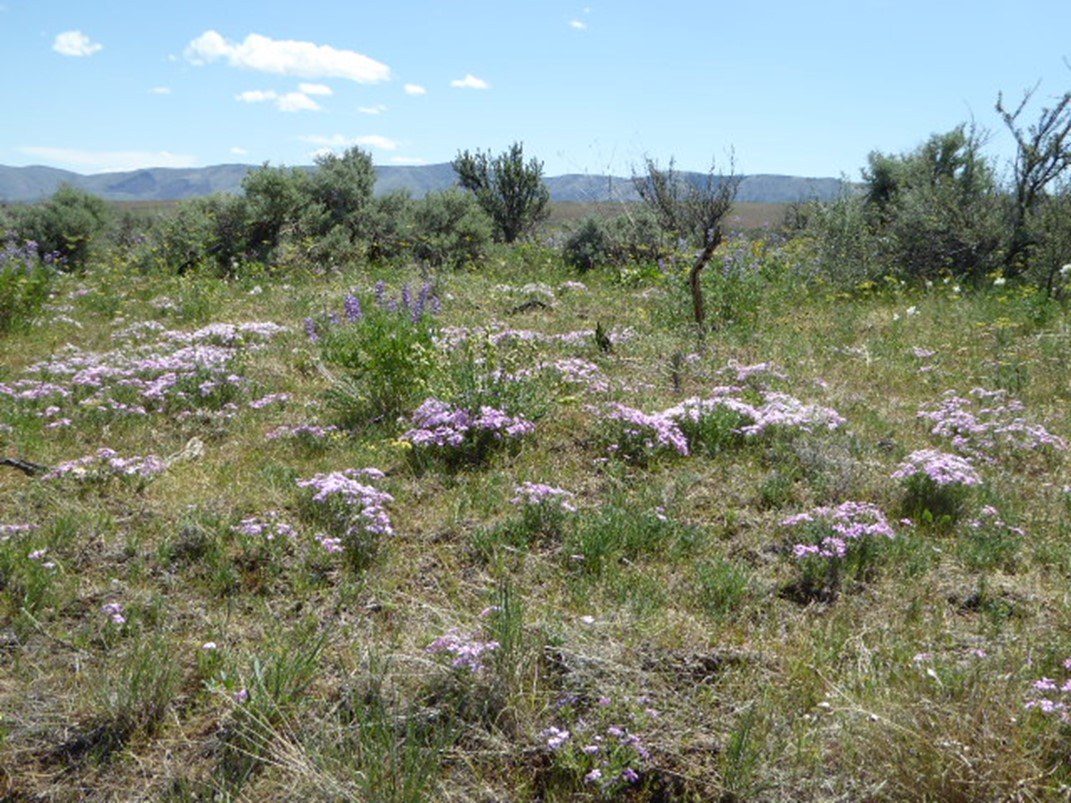
We walked a trail from the blockhouse around the park and were treated to plenty of wildflowers. I’m thinking this must be open range because we also saw cow pies (nothing too fresh). The trail then wound through an oak grove, where we spotted a lizard, a woodpecker, an owl, and elk tracks. Signs around the park warned of bears, but we saw no sign of them. The air was filled with birdsong.
After eating my sandwich in the shady picnic area, I wandered down another short trail that led to a couple of military graves. Ruffin Thompson served in the Confederate Army during the Civil War. He came to Fort Simcoe in 1888 (after it was a boarding school) to work as a clerk. He fell fatally ill just a month after he arrived and requested burial in the oak grove, “…where the sun shines brightly from heaven and the birds sing over my grave.”
While I was pondering Ruffin Thompson’s resting place, I heard/felt a heavy thud from a short distance away through the trees. My view was somewhat obscured, but I soon discovered it was a horse. It had no rider and wore no halter. After looking at me for a minute, it wandered off and I realized I had just seen one of the Yakama’s wild horses. I have read that the Reservation is home to thousands of wild horses. Information found at www.ynwildlife.org explains that the horses are highly valued, but overpopulation presents a problem. In any case, the horse-mad little girl tucked away in this 60-year-old woman was delighted to see a wild horse in a State Park!
We had hoped to drive a loop around the Reservation after leaving the park -- our Gazetteer shows a very inviting route. However, just a mile or so west of the State Park, the paved road abruptly turns to a very rough primitive track (not remotely accessible to our sedan) and a sign clearly stated the road is not open to non-Tribal visitors. So now we know.

Comments