


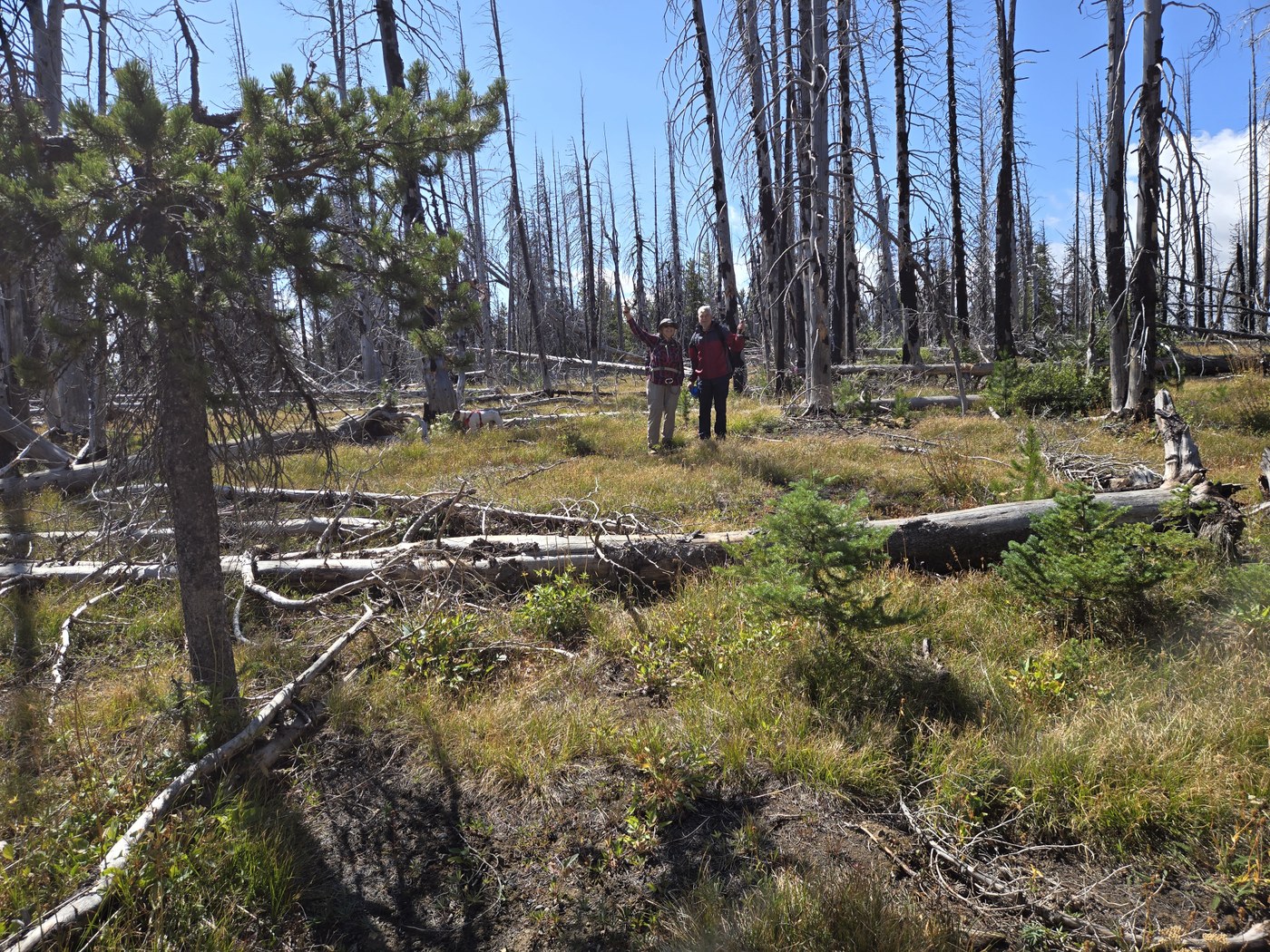
We started this hike on a cool, partly cloudy day. But the cold wind early in the morning warmed up nicely into the afternoon. The eleven miles of Forest Service Roads 9716 and 9712 from Bluet Pass were generally in good condition, readily navigated by our Honda CRV SUV. The trailhead is easily found and lies at about 5,400 feet elevation. It lies at a nearly 180-degree bend in the road about one mile past the well-signed Ken Wilcox Horse Camp. The trail starts off as a poor jeep road that heads up a gentle incline. It eventually leads to the Tronsen Ridge Trail 1264. It should be noted that the entire trail lies within an area that was burned over in 2012. Although charred tree trunks predominate along much of the route, young trees are prevalent throughout, and the resurrection of the future forest is well underway.
After perhaps a third of a mile on the jeep trail, a well-defined trail leads off to the right. This is the beginning of the Mt. Lillian Loop. The grade of the trail is moderate and steadily gains elevation. After about one mile the ridge is attained. A brief stroll off of the trail yields expansive views and the historic landslide scarp.. The Columbia Valley lies in the middle distance with the vast Columbia Plateau beyond, to the east. The steep drop-off from the ridge plunges perhaps 3,000 feet, emphasizing the high elevation of the ridge itself. As one approaches Mt. Lillian you get a fantastic view of the nearly vertical east face of the mountain. The lowly weathered, bare rock is evidence of a massive rockslide that occurred in the recent past. The peak, itself is almost an afterthought. It consists of nothing more than gently rounded terrain extending across a few acres. Our group had trouble agreeing where the high point lay, the local topography was so gentle. And with a thicket of burnt tree trunks there was no view from the top, whatsoever.
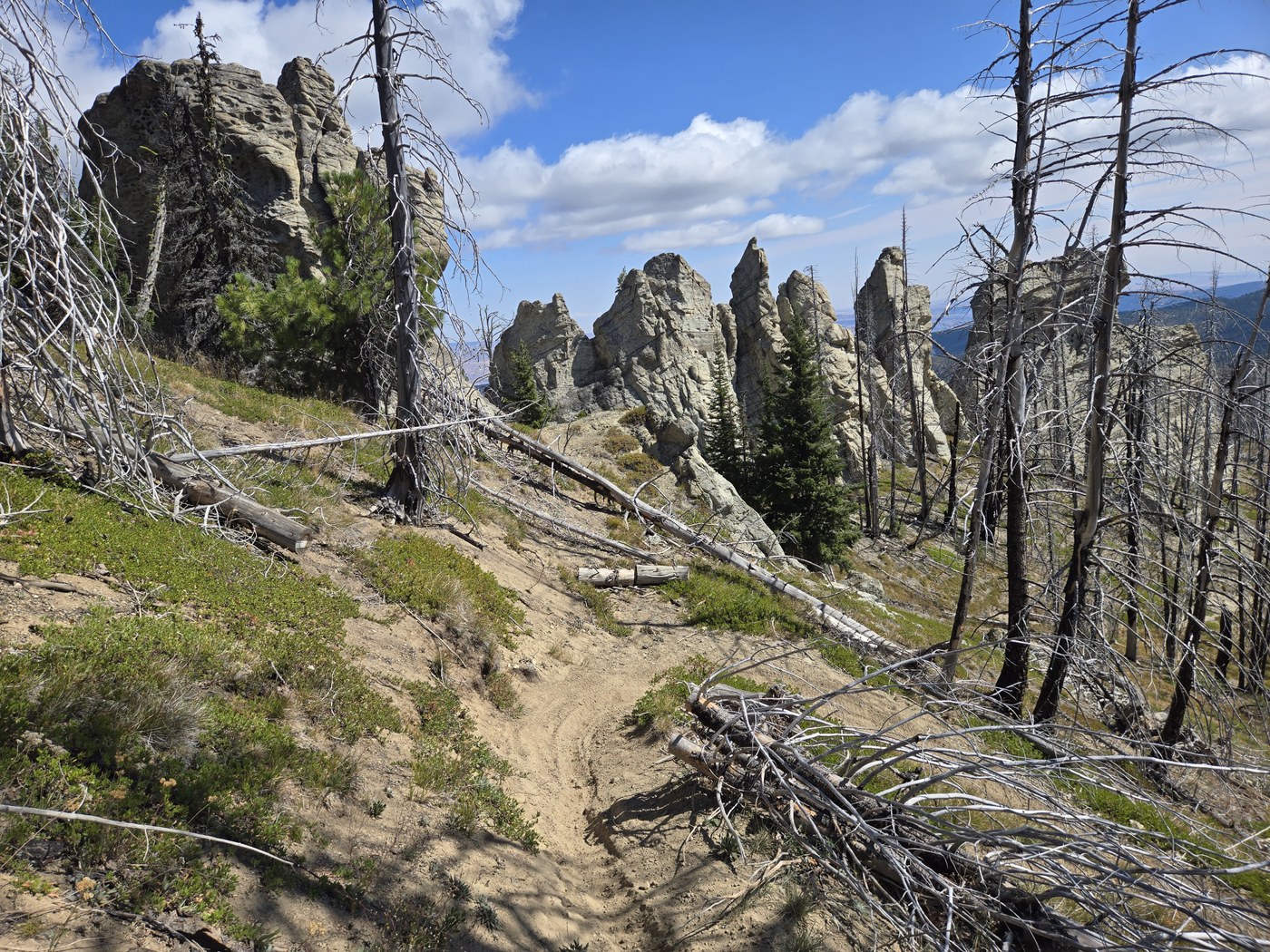
As we continued another quarter mile past the “peak”, the view to the east and south did open up. A prominent, narrow sandstone and siltstone outcrop, probably part of the Ellensburg Formation stood below us, extending a half mile down the steep ridge. Eroded to a series of sharp craigs with narrow spaces in between, this formation was reminiscent of the famous sandstone fins of Arches National Park. The trail switch-backs past this spectacle down to a saddle. One badly eroded section of sandy silt along this portion of the trail made for some treacherous footing. It would probably be tough coming up the trail too and when wet. Otherwise, the trail presented no problems other than the pervasive dust stirred up from treading over the fine loose soil. At the saddle we turned right, onto the main Forest Service Road 9712 which runs between Ellensburg and Wenatchee, over the high Mission Ridge. We ended up walking about four miles along this rather boring road, finally reaching the trailhead where we started.

Comments
seabeav on Tronsen Ridge, Mount Lillian
Good trip report and photos!
Posted by:
seabeav on Aug 31, 2024 08:31 AM