


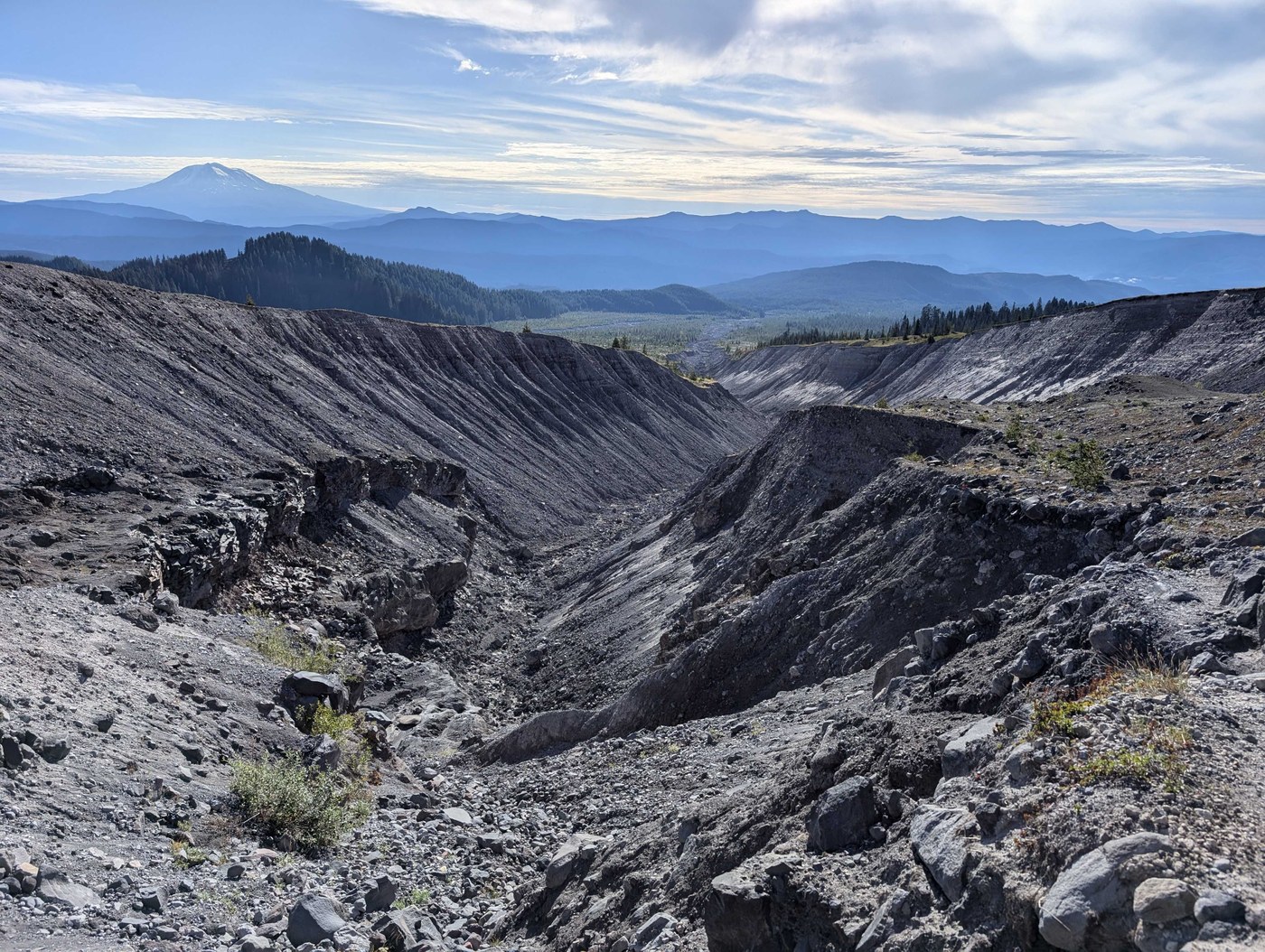
We spent a long weekend at the Mount St. Helens National Volcanic Monument this weekend, and what a lovely long weekend it was! We were slightly concerned about how a somewhat later-season loop would go, so I wanted to share as much about the conditions as I could. Get ready for a long report...
ITINERARY
Starting from Climber’s Bivouac and going clockwise on the Loowit, our itinerary was:
Day 0: Camped at Climber’s Bivouac
Day 1: 9.9 miles to South Fork Toutle River
Day 2: 12.1 miles to Pumice Butte/Ape Canyon trail junction
Day 3: 9.7 miles back to Climber’s Bivouac
Total: 31.7 miles
THE ROAD / PARKING
We got to Climber’s Bivouac after 8 on Friday night. The gravel road in was mostly fine, although we were in a very high-clearance truck — some lower-clearance vehicles would probably have to take some parts pretty slowly.
There were plenty of folks around the trailhead, but we had no issues finding a parking spot as there are places to park all over.
Trailhead note: We had originally planned to start at June Lake, but pivoted last-minute when we found out the June Lake trailhead parking lot is now day-use only.
THE TRAIL: DAY 1
Climber's Bivouac to South Fork Toutle River
(Trail note: I put that the trail is in good condition overall above because it was doable by 2 hikers who hike regularly and are in generally good shape. The trail is iffy in some places, especially when dropping into and climbing out of some ravines, but we were able to make it through just fine with poles. There were some spots on those drops/climbs we came across that seemed like they could collapse at any point, and alternative boot paths will have to be made then.)
The Ptarmigan Trail from Climber’s Bivouac to the junction with the Loowit Trail is in great shape. There are some rocky parts, but overall, it’s a super well-maintained, well-graded trail.
Soon after turning left onto the Loowit Trail, the trail becomes a boulder field, and it becomes a fun game of “find the next post marker,” particularly fun for us because it was so foggy that it was pretty hard to find the next one sometimes! I was glad we did this part on our first day, when we were still fresh.
Much of the day consisted of alternating between lightly-forested meadows and dipping in/out of rocky ravines. One of these ravines was 1 of 2 roped sections we had to climb up/down. For what it’s worth, I’m terrified of heights, and this honestly wasn’t too bad at all for me, even with a big backpack on.
Overall, where the trail was, it was in really good shape. Where it wasn’t (like with the boulder fields or the rope climb), it was clearly marked where you should be going, so we never got lost.
THE TRAIL: DAY 2
South Fork Toutle River to Pumice Butte/Ape Canyon trail junction
We had a slow start to the morning because we had to fill up on water at the South Fork Toutle River, and it was cold! And then we went looking for a good way to cross (I ended up just putting on my sandals and walking across). The river was the second of the 2 roped gullies to cross, but neither going down to the river nor climbing out of the river was very difficult (even with a pack on).
The climb out of the river looked significantly worse in its elevation profile than it felt — the climb was well-graded and consistent. The only thing was that my severe fear of heights was triggered near the top, where you’ve got a couple of big switchbacks on scree/small gravel. It wasn’t too bad/debilitating, but I was glad when we made it to the top. From there, the trail was in beautiful shape for quite some time, weaving through the meadows.
The trail was relatively easy hiking compared to either of the other days, mainly because there was very little climbing over things (boulder fields, huge ravines). The trail across the blast zone was overall easy hiking, and very beautiful even though we were sitting under a huge cloud for most of it, and the top of the mountain was hidden.
The climb over/around Alpine Butte was pretty tiring, but the trail was easy to follow and not too terrifying, and the trail afterward is super nice, all the way to Pumice Butte.
THE TRAIL: DAY 3
Pumice Butte/Ape Canyon trail junction to Climber's Bivouac
This was a tough day! The first part out of camp was pretty simple — relatively easy trail, followed by our usual dips into and climbs out of ravines. But these became some big ravines.
One of those ravines, the one through old Muddy River, was — pardon my dramaticism — the only part on the whole loop I thought I could severely injure myself. There was one small section on our descent into the ravine where the “trail” had eroded away, and the boot path that had replaced it was pretty sketchy, with a 20-foot drop if it fell.
But we both made it through all of them, and all the while, we had great views of Hood, Adams, and Rainier (though we’d lose views of the 3 of them throughout the day, until we’d lose them all in the forest).
After this section, the trail was easy to follow for a while, but eventually we ended up back in the boulder field, following posts to our destination. There actually was a trail for a decent part of this, but we lost it regularly because of how rocky the terrain was (it was always very exciting to find it again!). Keeping track of the posts was easy enough though, so we still weren’t getting off course, even when we lost the trail. This part, like many parts, was very exposed, but this day was warmer than the others, so we were getting our energy sapped fast, especially with all the heat radiating off of the dark rocks.
Once we were out of the boulder field, we ended up back in the forest. The trail had several blowdowns between the June Lake junction and the Ptarmigan Trail junction, but they were all easy enough to climb over, even with a pack on. I got many spider webs in the face here!
The last climb back up to the Ptarmigan Trail junction is pretty brutal, especially when the sun is beating down on you — we were very excited to see the trail sign at the junction that let us know all we had left to do was descend back to the car.
WATER
Water was our main concern while planning this trip, but it wasn’t as bad as we expected because it was so cool. The water situation would have been much more difficult if our whole trip was as warm as day 3 got later in the morning.
Between us, my hiking partner and I had about 9L capacity for water. We also cached a decent amount of water in the car at the parking lot.
3 water sources were flowing freely.
- South Fork Toutle River. We camped here night 1 because we knew this was a reliable source. The river was rushing, and the water was clear and incredibly easy to collect.
- Step Creek. This was the only of the 3 sources we saw that we didn’t expect. The water was very silty and cloudy, but I am sure you could use this as a water source if you wanted to because it was flowing great. (You might need to backflush your filter a few times because of all the sediment, or you could consider pre-filtering with a bandana.)
- The spring near Windy Ridge. The spring between the junctions to the Loowit Falls and Windy Ridge trails (it is marked as a spring in Gaia) is flowing beautifully, and the water is clear! This was the last water source for us until we got back to Climber’s Bivouac — because we reached this source halfway through day 2, we packed out all our water capacity. We were nearly empty when we got back to the car on day 3, which was much warmer than we expected.
Other than these 3 water sources, we saw some puddles from the rain we endured during the trip and one small stream near the Windy Ridge trail that we figured would be gone within a few days if it didn’t keep raining. The rest of the trail was dry.
CAMP
We camped at Climber’s Bivouac on Friday night, and, as mentioned, we weren’t alone! We assumed many of the campers were around to get an early start to their climb on Saturday. We got there after it was dark, so didn’t get to do a great tour of the sites, but it was easy enough to find a campsite in the center of the lot where there are plenty of sites in the trees. We were woken up around 5 from everyone getting ready for their big climb (so we were able to get an early start too!).
We camped 2 nights on the Loowit.
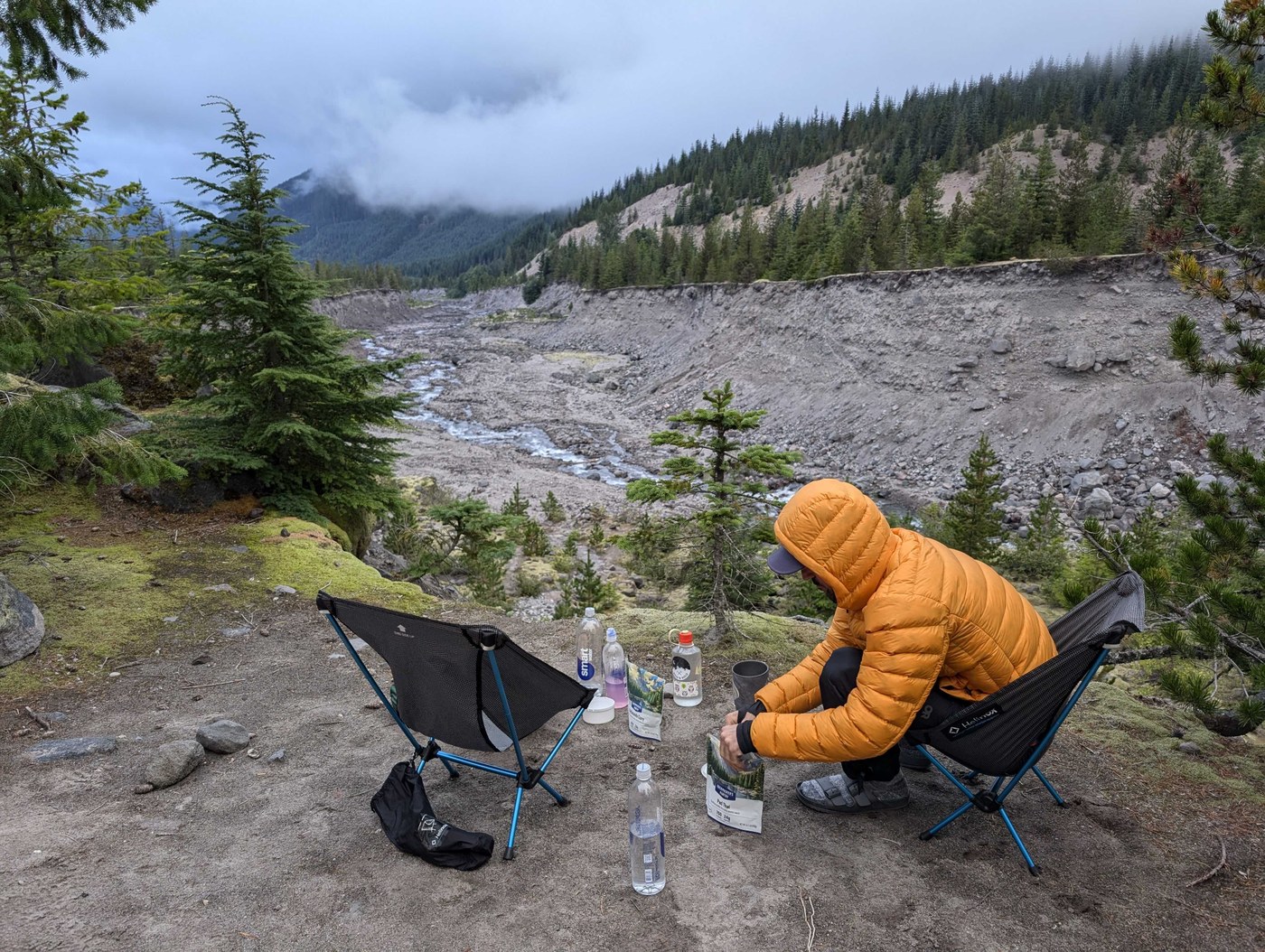
- South Fork Toutle River. There are a ton of campsites on the south side of the river, up the bluff. It’s kind of annoying to get water because you have to climb down the bluff to the river, but given the water situation of the whole trail, it felt very luxurious to even camp that close to a water source. And they’ve got great views of the river! Some sites have more privacy (with fewer views) too, if you’re willing to look around.
- South side of Pumice Butte/at Ape Canyon trail junction. There are camps on both the north and south sides of Pumice Butte and we hiked around to the south side (where the Loowit trail meets the Ape Canyon trail) to camp there. The sites are beautiful! Not a lot of wind protection (and we had a breezy night, so lots of tent-shaking), but incredible views of the mountain, and of Adams, Hood, and even Rainier when the skies are clear. We counted at least 4 campsites with some space between them — you might be able to find more if you looked around.
A few other good campsites we passed I took note of included the aforementioned sites north of Pumice Butte (there were plenty of them and in a beautiful place).
SOME HIGHLIGHTS
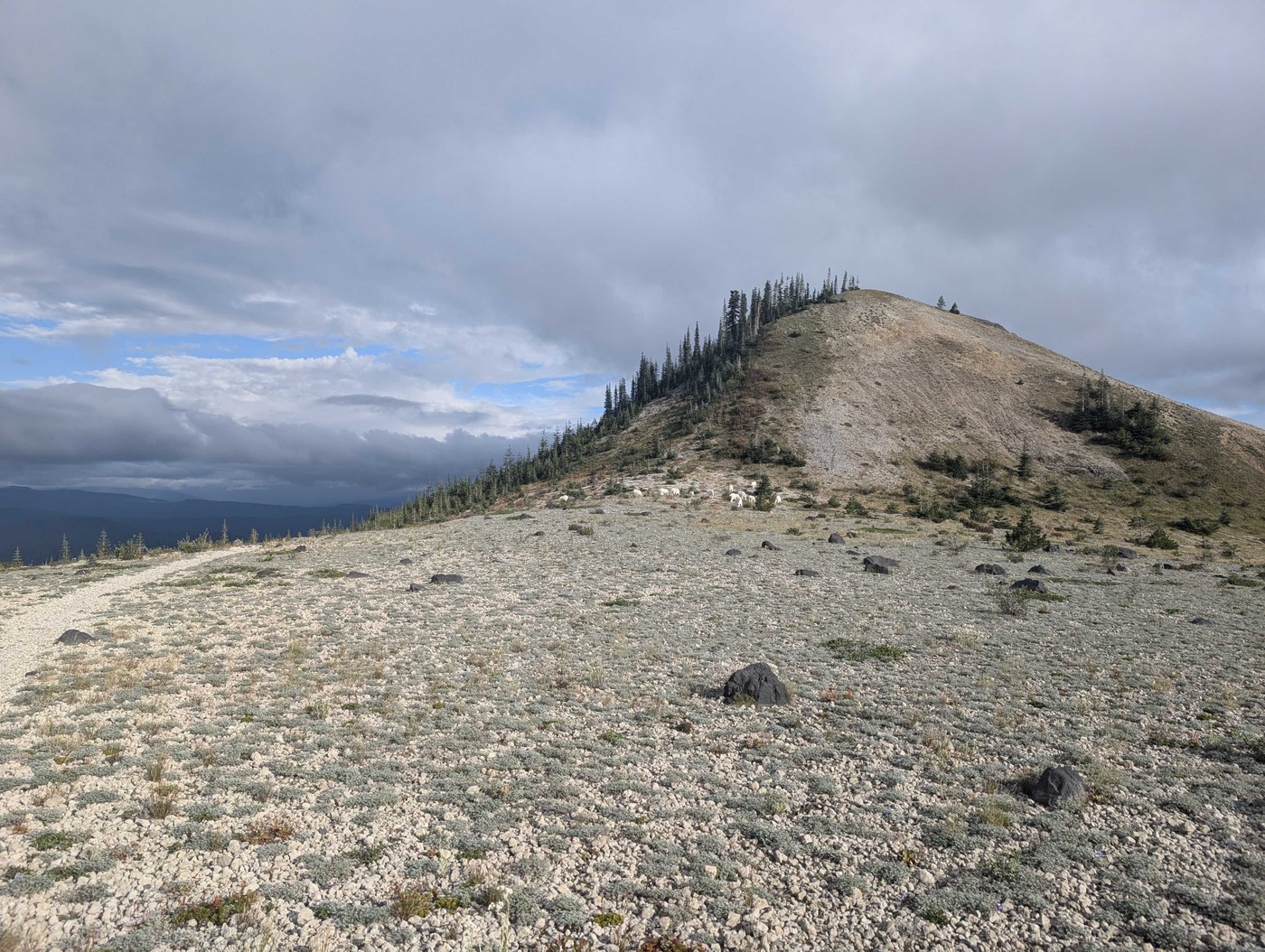
The Plains of Abraham and Pumice Butte were probably my favorite part of the actual hike. That may have been slightly weather-dependent — it was almost a totally cloudy day until we got to this part near the end of the day. But I loved the striking flatness of the plains next to the huge mountain — a really unique landscape due to the pyroclastic surges from the eruption.
We got to see a herd of elk on day 2 in the blast zone, close to the South Fork Toutle River. There were at least a dozen of them running around, and we eventually lost sight of them after a while. I had never seen elk in person before, so I was very excited!
We also got to see a bunch of mountain goats at Pumice Butte! We could see them from far away, just as flecks of white on the butte. When we got close enough, they had mostly descended to the bottom of the butte and watched us as we hiked past.
Many huckleberries about, although whether they were sweet or tart was a little hit-or-miss. And the vegetation colors really made it feel like autumn was here.
SOME LOWLIGHTS
Be aware of food-seeking mice at the camps at the South Fork Toutle River! My critter-proof food bag did a great job keeping the critters out, but was covered in mouse poop in the morning — ew.
Fortunately for us, the cool and cloudy weather meant that low water wasn’t a huge problem because we just weren’t losing/drinking as much during our hike. Unfortunately, it also meant we didn’t get views of the crater in the blast zone. Oh well! Just a reason to come back someday.
NOTE ON DIFFICULTY
I hike a lot for someone who works a typical 40-hour-week desk job — usually at least a few miles of moderate to steep hiking every weekend day, often with my training pack. This hike kicked my butt.
It never got to a point where I felt broken or unable to continue, but I saw many reports that these 30 miles feel like more than 30 miles, and I can agree with that! Our moving pace was slower than our usual pace on steady terrain, even if that terrain is steep and breaks a sweat. On our typical hikes, we can get in an average moving speed of between 2.5-3 mph. On the Loowit, we were averaging more like 1.5-2 mph across the day while we were moving. We also took breaks more frequently than usual because of how mentally taxing it was on some terrain like the large boulder fields.
For the record, none of this is a complaint! Just a note that this definitely felt more difficult than the stats would have you think at first glance.
MISC.
Even though the parking lot and Ptarmigan Trail were pretty lively, it was a very quiet hike overall. We only saw a handful of people once we left Ptarmigan Trail until we returned to it, mostly trail runners who we lost track of quickly. We assumed many of the hikers we saw at the start were doing the climb.
The terrain on this trail changed like the weather did on our trip — it was unpredictable and quite the adventure! We saw so many different types of trail/"trail" (traversing through meadows, meandering through the forest, boulder hopping, etc.) and it was fun to see it change so much on a single hike.
I would highly recommend ankle gaiters to keep gravel/rocks out of your shoes and poles. I would have been miserable without either, and probably would have injured myself without the latter.
Stopped by the Cascadia Grill in Olympia for some great comfort vegan food — perfect after a long weekend of intense hiking!
I took over 400 pictures during this trip. Was just about impossible for pick 4 to share here, but I might end up adding more to an album to share more.

Comments
Goats and pumice, name a more iconic duo
Posted by:
Joseph Gonzalez on Sep 30, 2024 11:24 AM