


Trip Report
North Fork Skykomish River, Pacific Crest Trail (PCT) Section K - Stevens Pass to Rainy Pass & West Cady Ridge to Benchmark Mountain — Wednesday, Oct. 7, 2009
 Central Cascades > Stevens Pass - West
Type of Hike
OvernightTrail Conditions
Obstacles on trail:Overgrown in places.
Snow
Snowfields to cross - could be difficult

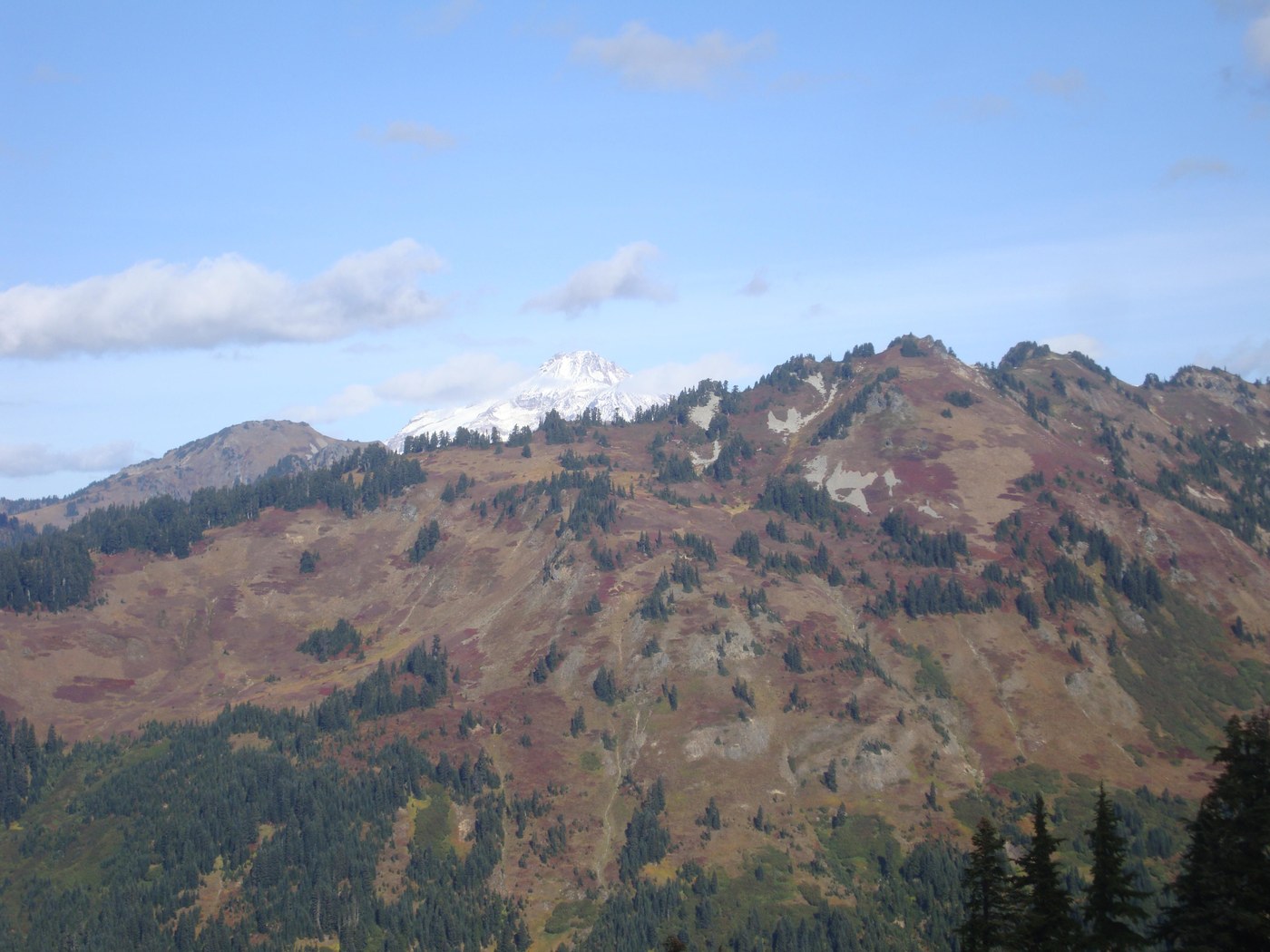
According to the reknown poet, philospher, and thinker of deep thoughts, Ringo Starr, you "got to pay your dues if your want to sing the blues, and you know it don't come easy." I'd like to go on record as saying that the same thing goes if you want to enjoy some of the most scenic wilderness bursting with fall color in October.
I had spent Saturday through Tuesday on top of my garage replacing the roof. This ensured that I'd be sufficiently tired when I embarked on Wednesday on what "100 Hikes in Washington's Glacier Peak Region" dubs the "Benchmark Mountain Loop." Starting a 25 mile overnight hike tired is not preferable, but during the fall you have the take any opportunity the weather gives. Got to pay your dues.
I arrived at the trailhead at 11:00am and proceeded up the N. Fork Skykomish River Trail. The trail got a little brushy after the junction with the Pass Creek Trail, and whether the result of the recent rain or just dew, the brush was wet, and consequently before long my trousers were soaked and the inside of my boots were sloshy. Got to pay your dues.
I made it to the dreaded "ford" of the Skykomish at about 1:30. The guidebook made a big deal out of this river crossing, applying adjectives such a "difficult," "dangerous," and "life threatening." This time of year, however, the water level was pretty low, and the crossing was very much a non-event. I ate lunch and changed into dry socks. The insides of my boots were still a little wet, but the dry socks helped.
From the crossing the N. Fork trail, which previously had been gently gaining altitude, begins to climb the final 2000' to Dishpan Gap in earnest. My legs, already tired at the beginning of the hike, and further fatigued by the first 5+ miles, complained loudly, though some salve was found as the huckleberry fields and occasional views increased. Still, with tired legs and wet shoes, those 2000', which normally wouldn't be a big deal, were a trial. It don't come easy...got to pay your dues.
I don't often stop for breaks when hiking, but I promised myself a nice long sitdown break once I reached Dishpan Gap. However, upon reaching Dispan Gap and dropping my pack, I became so enthused with snapping pictures of the jaw-dropping scenery that my anticipated break fell off the agenda. With renewed spirits and the knowledge that Lake Sally Ann, my destination for the night, was not far off, I hoisted my pack, turned south on the Pacific Crest Trail, and resumed my journey.
I arrived at Lake Sally Ann at 5:45, exhausted but happy. As I began to set up camp, I heard voices approaching...people! Soon, the only two people I saw on the whole trip came rambling though on their way back from extensive roaming to the north to their camp at top of the Pass Creek Trail. We chatted for a few minutes as they filled their water bottles, and then they were gone and I was alone again. After getting my tent set up and food ready to be hung, I cooked dinner. It was getting pretty cold up there, and though my dinner was warm, it did little to keep me warm against the rising breeze. I soon finished eating, hung my food, and changed for bed. I knew the night was going to be cold, and I came super-prepared. All the long-underware and fleece layers that are part of my snowshoeing kit came along, along with gloves, wool socks and the other cold weather accoutrements. These kept me plenty warm as the sun set, the temperatures dropped, and the winds generated from the cooling world below whipped up the valleys. Before long I clambered into my down sleeping bag, where I remained toasty and warm through the night. Of course, that warmth and comfort was paid for by lugging all that extra gear, but sometimes accepting that it don't come easy saves you from having to pay some of your dues.
I awoke just before sunrise and watched the sun rouse itself from beyond Cady Ridge to the east. Soon the bag of food was retrieved from it's tree, and hot cocoa and ham and eggs were soon warming my belly as I soaked in the splendors of Lake Sally Ann and the eastern Casades in the morning sunlight. It is amazing how much a night's sleep in the wilderness and the simple breakfast that follows will reenergize a person, both physically and spiritually.
By 9:00am, the dishes were clean, camp was broken down, my pack was on my back, and I was off down the trail. A good night's rest and the glory of my surroundings consipred to cause me to forget the 14 mile march ahead of me. The world in which I found myself was a symphony of colors and textures...the reds and yellows of the fall foliage, the ever-present green of the trees, the white occasional patches of snow, the palette of greys and browns on the steep peaks surrounding... Your eyes open so wide in awe that you have to be careful that they don't pop out entirely.
Miles later, yet all too soon, the trail plunged down into the forest to Cady Pass, and shortly thereafter, Pass Creek where I paused to fill my water. At this point, I had covered a little over four miles, and was still feeling pretty good. Still, I had a decision to make. I could cut my trip short and drop down Pass creek to the Skykomish, and arrive at the car in a mere six miles all-downhill. Or, I could add another 4 miles to that (making it 14 total for th day) start climbing the 1300' back up to West Cady Ridge and then follow the ups and downs of the ridge back home. My legs were feeling good, and my taste of heaven left me hungry for more, so up I went.
The climb to the junction with the West Cady Ridge trail was easy enough, and the views began to open up again as I left the Pacific Crest Trail behind. Soon, however, the feedback from my legs began to make me wonder if I had mad the right choice. The stats said that this should be a relatively quick and painless climb, but I slowed down more and more as the climb towards the ridge became seemingly interminable. This was supposed to be easy...haven't I paid my dues?Finally the grade moderated and things became easier. "100 Hikes" says that there is a steep snowfield that might not melt out until late-July...well that had not only melted out, but had already started to accumulate new snow. Crossing it was no problem, however as the fall progresses this will become increasingly challenging, even if the rest of the trail is passable.
After an eternity (in leg-years) I reached the side trail up to Benchmark Mountian. With seven miles still ahead of me, I debated whether it was worth making the ascent. The winning arguement boiled down to "I've come this far, how can I miss this?" I dropped my pack, grabbed my lunch and minutes later was at the summit, where I sat and ate. The views were very nice, with Glacier, Baker, Rainier, the Monte Cristo group, Sloan and a gazillion other peaks in view.
Lunch did little to refresh me, however, and despite the comforting knowledge that the trend would be downhill from here on out, there still 7 miles to go. The rest of the hike assumed a dream-like quality. On I went. On, on,on, winding up and down through endless meadows filled with huckleberries, views of peaks to the east, views of peaks to the west, sections of ridge so broad that you could spend hours exploring, on, on, on...
Finally, to my great relief, the trail started plunging down. The trees got thicker and taller and the red huckleberries gave way to green ferns. Soon the roar of the Skykomish filled the ears, and moments before 5:00pm, shortly after crossing the bridge over the river, came the trailhead, the car, the awesome Sultan Bakery, and home.
For an overnighter, this makes a long and relatively strenuous hike. Best to spend two nights...take the pressure off and allow yourself time to roam and explore this Eden. Hikers owe a debt of gratitul to the late(s) Harvey Manning and Ira Spring for their "100 Hikes" guidebooks. But ol' Harvey must have hiked this on a cloud day, because his description does not do it justice, and Ira Spring must have come in early summer, because a color photo of this place in the fall would have had a place of honor in "100 Hikes".
So, Go! Explore! And take your time up there. But either go soon or wait a year. The temperatures will get colder, the snow more likely, and any snow that falls will be staying until next year.


Comments