


Type of Hike
Day hike
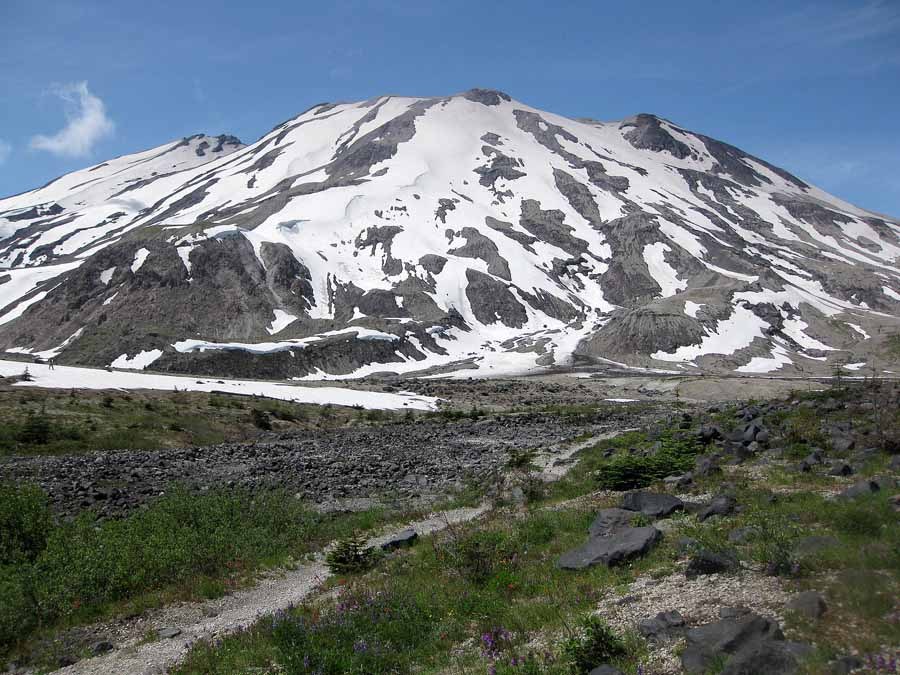
Despite a weather forecast for 30% chance of rain showers and a cloudy day, I decided to hike the Ape Canyon Trail to the Loowit Trail and onward to the Plains of Abraham on the east side of Mount St. Helens.
What an excellent decision! We were in a clearing trend with the clouds melting away as we hiked upward towards the mountain.
This is one of my favorite hikes around Mount St. Helens. The trail starts in an old (40-50 years ago) clearcut, now regrowing, and goes through it for about 1.2 miles. The trail then enters oldgrowth forest with lots of big Douglas-firs and begins serious climbing up the ridge through well-engineered switchbacks.
At about 4 miles, the trail emerges from the forest as it reaches Ape Canyon. A lot of hikers turn around here, but more wonders still await so I always continue on. The Ape Canyon Trail junctions with the Loowit Trail at 4.5 miles. We turn north and continue another mile to the Plains of Abraham and our favorite lunch site at a viewpoint.
As we walked beneath the slope of Pumice Butte, I pointed out a lot of mountain goat fur snagged in the slide alders beside the trail. Goats must be nearby.
Sure enough, we soon spotted the mountain goats themselves: a nanny with a kid and two other adults. Although I have heard reports for years, this was the first time I have seen mountain goats on Mount St. Helens myself.
The goats moved off but focused on the main business of eating. Obviously, they have seen a lot of hikers and were not very concerned.
The cloud layer obscured most of Mount Adams to the east, and we could not see the Goat Rocks, Mount Rainier or Mount Hood due to the heavy marine layer, but directly to our west, Mount St. Helens was totally clear.
The diversity of habitats on this hiking route produced a high list of wildflower species in bloom. Over the total 11 mile hike, I counted 57 species blooming:
Achillea millifolium Yarrow
Achlys triphylla Vanilla leaf
Actaea rubra Baneberry
Agoseris aurantiaca Orange agoseris
Anaphalis margaritacea Pearly everlasting
Arctostaphylos nevadensis Pinemat manzanita
Arenaria macrophylla Big-leaf sandwort
Arnica cordifolia Heart-leaf arnica
Aruncus sylvester Goatsbeard
Castilleja miniata Scarlet paintbrush
Chimaphila umbellata Pipsissewa
Claytonia siberica Siberian miner's lettuce
Clintonia uniflora Queen's cup
Corallorrhiza maculate Spotted coralroot
Corallorrhiza mertensiana Merten’s coralroot
Cornus canadensis Bunchberry
Dicentra formosa Bleeding heart
Disporum hookeri Hooker’s fairybell
Eriogonum pyrolifolium Alpine buckwheat
Eriophyllum lanatum Oregon sunshine
Fragaria virginiana Woods strawberry
Hieracium albiflorum White-flowered hawkweed
Hydrophyllum fendleri Fendler's waterleaf
Leucanthemum vulgare* Oxeye daisy
Lilium columbianum Tiger lily
Listera caurina Northwestern twayblade
Lomatium martindalei Martindale’s desert parsley
Luetkea pectinata Partridge foot
Lupinus latifolius Broad-leaf lupine
Lupinus lepidus var. lobbii Dwarf lupine
Maianthemum dilatatum False lily-of-the-valley
Maianthemum racemosa False Solomon's seal
Maianthemum stellata Star-flowered Solomon's seal
Nothochelone nemerosa Woodland beard-tongue
Penstemon cardwellii Cardwell's penstemon
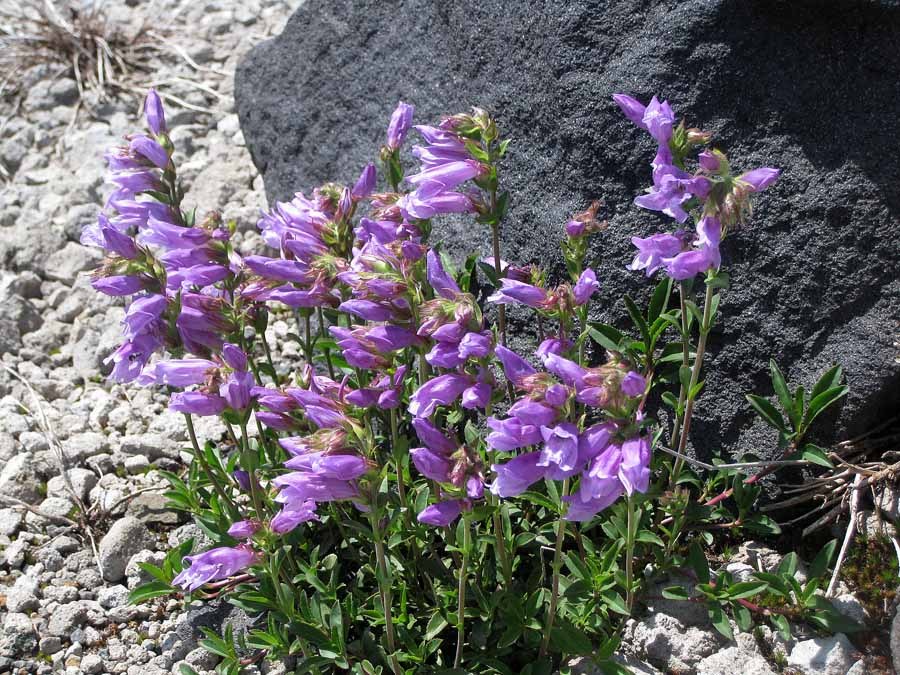
Penstemon rupicola Cliff penstemon
Penstemon serrulatus Cascade penstemon
Phlox diffusa Spreading phlox
Phyllodoce empetriformis Red mountain heather
Polygonum newberryi Newberry's knotweed
Pyrola picta White-veined pyrola
Rosa nutkana Nootka rose
Rubus lasiococcus Dwarf bramble Rubus parviflorus Thimbleberry
Rubus spectabilus Salmonberry
Sambucus racemosa Red elderberry
Saxifraga ferruginea Rusty saxifrage
Sedum oreganum Oregon stonecrop
Sorbus scopulina Cascade mountain-ash
Spraguea umbellata Pussypaws
Taraxacum officinale* Dandelion
Tellima grandiflora Fringecup
Tiarella trifoliata Foamflower
Trillium ovatum White trillium
Valeriana sitchensis Sitka valerian
Vancouveria hexandra Inside-out-flower
Viola glabella Stream violet
*non-native
There were a few blowdowns across the trail and two snowbanks, but they were easily negotiated. The snow will be gone soon. Another excellent day on the trail.


Comments