


This post was written originally for the Ice Creek/Ice Lakes trail, but much of it is relevant for the first eight miles of the Entiat River Trail.
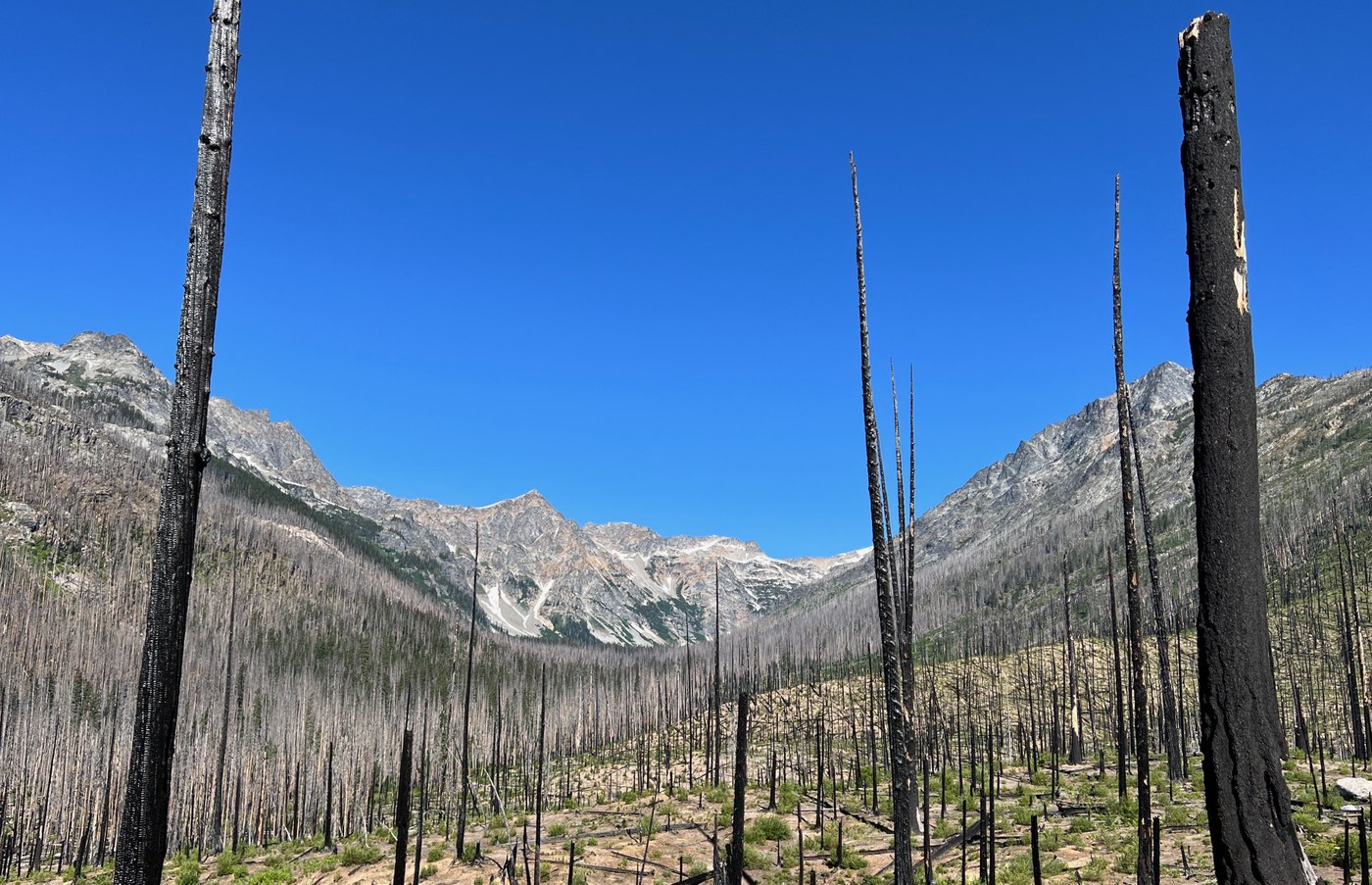
I had not been up the Entiat River for about 10 years - however, my first trip was about a year after the first forest fire up the valley about 14 years ago. But this time, I was NOT prepared for the Scorched Earth scene. Everything about this hike got hard, especially as a couple of 60(mumbled number)-somethings who aren't in as good of shape as we should be.
The Entiat River trail reports from some WTA crew are helpful here. Please be sure to read those.
A few small streams still have some water running in them, but a couple smaller ones are starting to dry up. We had enough water along the way that we could make sure our dogs could water up and cool off as we went, but they had to dig deep on this trip too.
With the forest so utterly burned, virtually no real shade is left. That means that when the car thermometer read 88 in the parking lot, it stayed that temperature on the trail. Very little relief remains for a cool spot to stand. While some vegetation is recovering, other places have years to go. (Beta from a 20-something couple is that past the Ice Creek turn off, the washouts and route finding just get worse the farther up the Mt. Maude basin the traveler goes).
Water is still running pretty swift in a couple of the smaller streams that cross the trail. About 1.5 miles from the meadow [~about 6 miles in] (which also survived and has camping spots) is a bigger crossing that is manageable by some rock hopping, and the old log is still across the original main channel. The log is getting old, so be careful when using it. A little farther up from the the log is some debris that might not feel so scary, but you have to bushwhack to come and go from there.
One significant washout is described by a WTA crew member: "At mile 6.5 there is a major mud slide which wiped out the trail about 100 yards across. Avoid the cracks on top of the old trail where the water is now trying to flow as those are 3-4 feet deep and could easily collapse. Keep going mostly straight and you will eventually climb up and down into the slide (across a newly established 3 foot creek). Look for a cairn next to a short climb up to where the trail reconnects. After that it is easy hiking for the next few miles."
Just remember to stay high - go straight across from the cairn on your way back to the parking lot. It's really easy to lose the trail in the aftermath of the washout here. It honestly looks like a lahar flowed through here.
We saw no formal campsites carved out along the burn. We found a fairly flat spot by one creek, [~mi 5] and on exit, stayed near the Pomas Pass marker [~mi 5.5 or so] on the way out - we could see it used to be a campsite before the fires.
The campsites on the east side of the river survived. It's still as idyllic as before, but the changes upstream have allowed more water into the river, and the original log jam no longer spans the entire river here as the river eroded the far side away from the edge, so the river splits around a now mini-island; a log does *nearly* span the new channel, but I am not big and strong enough to cross it and try my luck hopping to the edge. We opted to change into Crocs and Keens, and I picked up my friend's 13 pound Pomeranian (yes, she is an intrepid hiker!), strapped my dog's pack onto my pack, and tromped across the river to head up the Ice Creek trail.
The water is still pretty swift here, and the path we chose came up to my knees in places (I am almost 5'6" with my boots on). I used the tripod method of always having two points of contact so the water wouldn't pull me off of my feet.
The fire also essentially burned down to the river on the west side. The west campsite did survive, but many lodgepole pine fell like jack straws for about 300' feet past the campsite. Crossing them was a real PITA. They are so criss crossed that finding a way through them without getting stabbed or hung up in them like a briar patch is frustrating. I am not sure a horse could get through here - maybe by picking its way through the blow down closer to the hillside would work, but I didn't look that hard.
It was obvious very quickly that the Ice Creek trail hadn't been used much this year. At times finding the very faint trail became a bit of a challenge in the aftermath of the last fire. The trail was continues to be exposed, thus hot even though we were gaining elevation, but fortunately the wind coming down the canyon helped cool the climb. We crossed one small stream at about 1.5 miles that had enough water for the dogs and to refill water bottles. No other reliable water is available until crossing Ice Creek in about 3.5 miles. The trail also had 4 downed trees. Two downs were especially challenging for a couple of shorter, older ladies. Horses can pick their way around these downs more easily than around the river campsite.
About 200 yards from a nice campsite at the Ice Creek crossing, the fire veered up the mountain side. From there to the valley, the forest survived. (but note many trees are dying because of the beetle infestation.) Crossing Ice Creek there requires a change of shoes or slogging through and subsequently hiking in soaked boots as the water comes up mid calf or higher. The trail continues to slowly climb as it approaches the valley. The trail crosses the creek twice more. The first time, the log jam is still intact, so it's a simple crossing. The second, the water is still running so high that we couldn't rock hop across 5 or 6 feet breadth, so we had to ford it.
Thus, the beautiful campsite at the base of the incline is intact. It was relatively buggy here as it's still damp everywhere, even though virtually all the snow is gone, and even the mountainsides are remarkably void of snow so early in the summer.
The trail too has changed heading up to Ice Lakes. Before, the trail wended through the boulder field that runs up the mountainside. Now, the trail is *simpler*, but not necessarily *easier*. The trail crosses the creek twice more on the way up. The morning crossing was a little easier as the flow had slowed down during the night. But we had to be careful finding our crossings coming and going as because nothing about this climb was "easy" for our "middle aged" skill set and small dog. Watch for cairns, especially higher up when the pitch steepens, since the trail is not necessarily obvious. {The 20 somethings we met on descent skipped down the mess like Legolas on the heads of orcs, but not us old fogies}.
Two climbers working on the Grand Slam told us that they bushwhacked through a bear path as they descended Spectacle Butte - very fresh scat was along this trail. When we hiked up to the lakes, I had my dog carry his dog food, since the alpine trees in the valley don't lend themselves well to hanging a bear bag.
The valley and mountains were shockingly void of snow for late June/first of July. We only crossed one tiny patch of snow getting into the valley, and we saw almost no other snow patches anywhere - including none going up the trail, and remarkably little at Ice Lake.
The "new" path follows small drainage trails, so the trail is filled with scree - which is like hiking on marbles, especially on descent. Just when our lungs were ready to walk on flat, the pitch got worse. For my aging body, the angle is almost too steep for me to be comfortable to navigate.
But the reward! We couldn't have asked for a more blue bird day - literally not a cloud in the sky! The sky was a magnificent deep blue, and the valley below was an emerald joy, punctuated with Alps-like peaks, and dotted with waterfalls. We watched ravens soar in the updrafts, an eagle fish in the lower lake, pan-sized rainbow trout flip clear out of the water, marmots scurry, and pika stand guard. After the punishing climb for us, we decided against making the 1.5 mile trip to the upper lake and shoulder of Mt. Maude for the breathtaking view of Glacier Peak and her friends.
Pros of the burn: Beautiful, open views of jagged mountaintops, some recovering vegetation, and a eyepopping view of the Entiat River.
Cons of the burn: Scorched earth in places, burned tree skeletons for miles, no shade, no temperature modulation- sun up - very warm, quickly! Sun down - cools off FAST!
Comments