You are here: Home » Find a Hike » Hiking Guide » Quinault National Recreation Trails

Quinault National Recreation Trails

Last modified Jan 28, 2010 05:31 PM
The Quinault National Recreation Trail system offers a melange of hiking options to choose from. With nearly 10 miles of well-maintained interconnecting trails, your choices are as varied as spring wildflowers on these popular paths. Trails lead from campgrounds and a historic lodge to waterfalls, cedar bogs, monster trees, and along crystal-clear creeks and a scenic lakeshore. Spend a half day or half a week exploring this delightful area. The Rainforest Lake Loop is one suggestion. Feel free to expand, contract, or combine it with other trails.

Step into the Quinault rain forest and immediately be propelled into a world of primeval beauty. Start your journey under a canopy of towering, emerald giants: ancient Sitka spruce, western red cedar, and western hemlocks that were mere saplings when Christopher Columbus set sail for the Americas.

The Quinault Valley left a deep impression on president Franklin D. Roosevelt when he visited here in 1937. It inspired him to protect a good chunk of the adjacent lands within a new national park. The Quinault rain forest, however, has remained within the national forest. But it's managed for recreation and wildlife, not timber production.

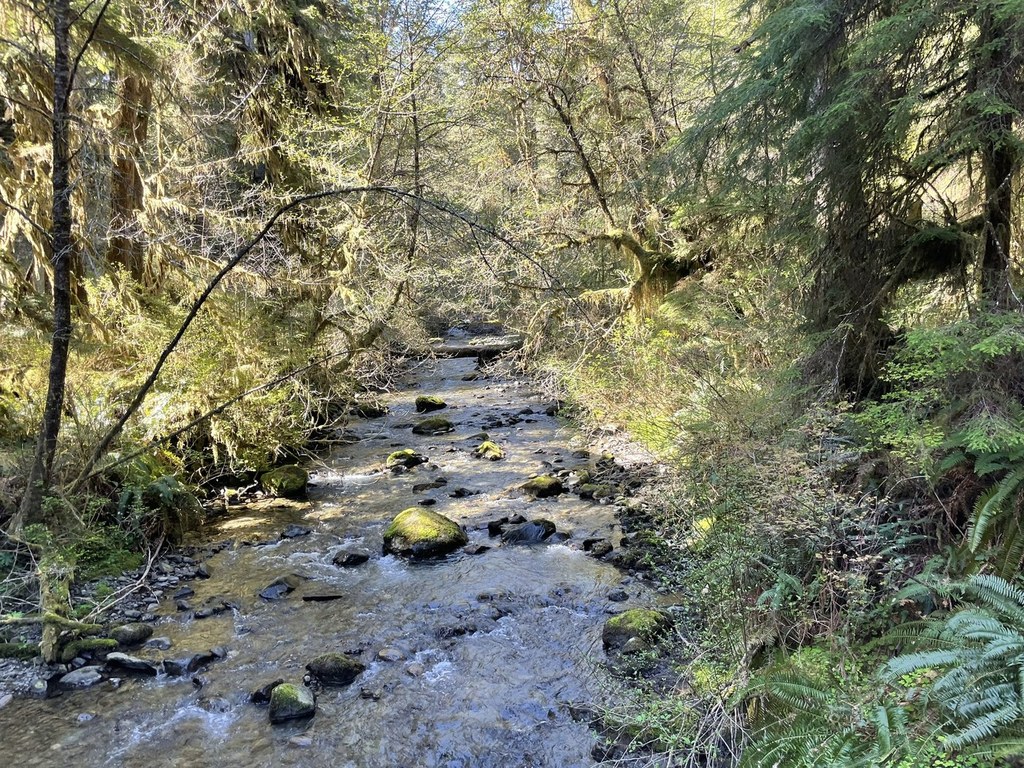
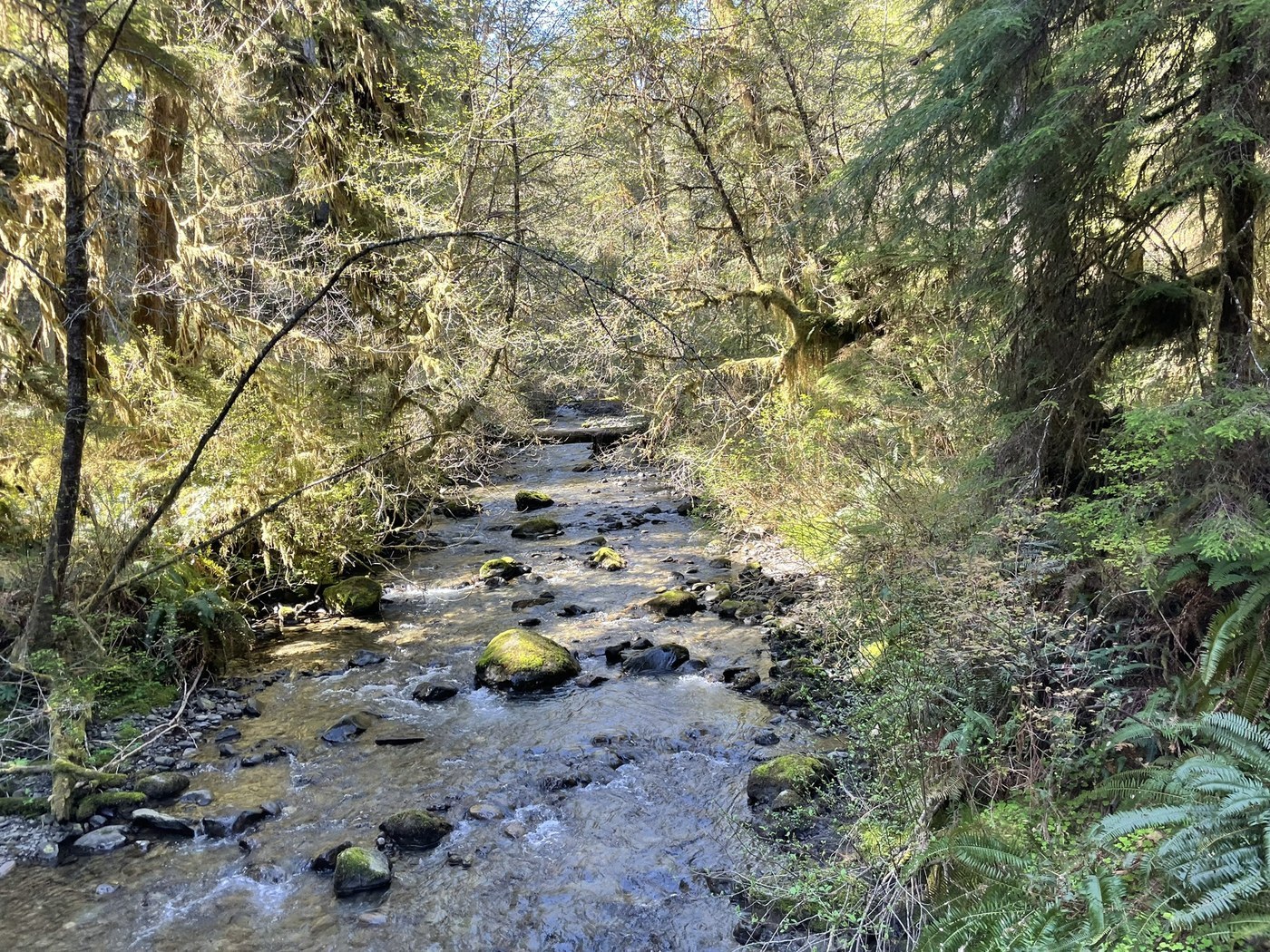
From the trailhead the well-groomed path passes a colossal Doug-fir to emerge on a high bank above Willaby Creek. Search the sparkling creek waters for salmon. Gaze up at the towering forest canopy for eagle nests. Then turn right and begin your journey into the past. At 0.25 mile is a junction; a short nature trail heads right, returning to the parking lot.

Continue on the main path, crossing Willaby Creek at about 0.5 mile. A half mile farther you'll reach another junction. The trail to your right travels 1.7 miles and climbs over 1000 feet to the Willaby Creek giant cedar. A ford over Willaby Creek is necessary and can be difficult in high water.

The loop continues forward to a cedar bog bursting with pungent patches of skunk cabbage. Traverse this saturated landscape via a boardwalk and come to another junction at 1.8 miles. The trail to your left heads 0.6 mile to the Quinault Lodge; proceed right instead. Cross Falls Creek, and after 0.5 mile of gentle climbing, cross Cascade Creek at lovely Cascade Falls. Admire the tumbling waters and then carry on. At 2.4 miles turn left at a junction (the right trail goes to Gatton Creek). Span Falls Creek again, climb a little, and then drop back down to reach the South Shore Road at 2.8 miles.

Cross the road, stop to admire Falls Creek Falls, skirt a campground, and then come to Lake Quinault, one of the largest bodies of water on the Olympic Peninsula. Close the loop by following the lakeshore for 1 mile, passing quiet coves, humble cabins, and the majestic 1926 Lake Quinault Lodge. In times of heavy rainfall, this section of trail is prone to inundation. If that's the case, return via the South Shore Road, or head up the Lodge Trail and retrace some of your route. The forest may be ancient, but this hike never gets old.
Improve or add to this guidebook entry

Recent Trip Reports

Hiked here recently? Submit a trip report!
There are 4 trip reports for this hike.
Quinault Rain Forest Loop, Quinault Rain Forest Nature — Jun 23, 2009 — Bob & Alex
Day hike
Features: Wildflowers blooming | Ripe berries
Issues: Overgrown | Bugs
Expand report text Hide report text
Great Hike, these trails all loop around the small town of Quinalt. We started at the far end where one...
Great Hike, these trails all loop around the small town of Quinalt. We started at the far end where one direction takes you down to a 900 ft tall Spruce tree. Traveling in the oppisite direction takes you up into the wind ravaged hills. The trail is a little over grown at this end so wear long pants. The Forrest service appears to be clearing it back out though. Nice trail that meanders through the hills crossing multiple foot bridges and a boardwalk over a cedar bog. Meets up with the Nature trail, a nice interpritave trail under towering giants.

We crossed under the road and walked the trail along the lake most of the way back to the car. Along this portion as well as the Nature trail there are great storyboards that not only explain the forrest ecosystem but share Quinalt fokelore as well. Our 10 year old daughter loved it.

A great display of the changing forrest from the waters egde, to devasted foothills to lush rain forrest. A nice treat that can easily go from a quick "lets stop and see the worlds largest spruce tree" to a enjoyable 3 hour hike.
 
And there is no shortage of salmon berries, should you be up for them.
Read full report
Quinault Rain Forest Loop #854 — Jan 06, 2007 — meganerd
Day hike
Expand report text Hide report text
Although the Quinault area is quite a drive for me (from Bellingham), it is somewhat surprizingly quick because I was...

Although the Quinault area is quite a drive for me (from Bellingham), it is somewhat surprizingly quick because I was on freeway all the way to Aberdeen. For Seattle area residents, the drive wouldn't be too bad at all. Taking the ferry and driving around the north side of penninsula wouldn't be quicker for anyone, more scenic though.

Recently I bought Robert Van Pelt's ""Forest Giants of the Pacific Coast,"" and renewed an old interest in giant trees. Although most go to the Hoh River for a rainforest experience, the Quinault actually consistently contains the larger trees. I guess this is because the area right around the lake is basically a lowland or foothill environment rather than the mountain valley which is all that's left of the preserved old growth in the Hoh. Also interestingly, the South Shore area which contains the biggest trees is not in the national park, and also contains a significant number of houses and a golf course, which was especially a surprize to me.

Anyway, although the winter might seem like a good time of year to make a soggy pilgrimage to the forest giants, I really wouldn't recommend it right now. First off, the storm damage is very extensive. The western trails (nature trail, Quinault loop) are reasonably passable although there are quite a few downed trees. Not really out of the ordinary for this time of year. The eastern trails though (Graves Creek) have been completely devastated. Drive up the Wright's Canyon road a little ways to see what I mean. The Graves Creek area trails actually have signs at the trailheads saying ""closed to public use."" ""Yeah right,"" I thought, being used to burly abandoned trails and whatnot. I turned back within a couple hundred yards... I have never seen a blowdown this extensive before. The only thing in my experience that compares is the avalanche path coming down into Bachelor Creek on the Ptarmigan Traverse. Fortunately, I guess, the decimated area seems to be one of younger forest. I guess the largest trees at the end of trail are still standing. It's just going to take a lot of work to get a trail pushed back there.

I also tried to hike up the Willaby Creek trail which leads to a very large cedar tree. I was really enjoying this trail as the rain forest seemed to become deeper and more primeval as I hiked towards the valley wall. Unfortunately though, a significant portion of the trail has become a creek/swamp type thing. After about a half hour of trying to get around the area, I finally gave up. Definetely a trail for a dryer time of year. There's also a sign which says there's no bridge across Willaby Creek which seems quite large.

So, I mostly had to be content with seeing and photographing the more accessable large trees in the area: the big spruce right near the lake, and the Quinault Lake Cedar. This tree is the largest known tree in the world outside California. It is indeed enormous and anyone familiar with the Ents from Tolkien will immediately be reminded. It's a little unfortunate though because this tree is right at the end of its life cycle. Almost all of the bark and branches are dead and the bottom of the trunk is rotted out, allowing access to several ""rooms"" at the base. I'd really like to know how old this tree is, though I guess that would be impossible because the trunk is so rotted through.

After all this I drove up to Kalaloch to see the big cedar just off the road there. This one is ridiculously gnarled and imposing, but much shorter than the Quinault tree. Worth the stop though for anybody in the area.

Anyway, I'll be back when it dries out a bit and the trails are repaired, which could definetely be a while.

Read full report
Quinault Rain Forest Loop #854 — Mar 17, 2001 — mcaver
Day hike
Expand report text Hide report text
This hike is clearly marked and mostly dry the entire 4 mile loop. There are signs warning that there...

This hike is clearly marked and mostly dry the entire 4 mile loop. There are signs warning that there may be water on the trail as you walk the lake, but there were no problems. The boardwalk through the cedar bog was a little slippery due to the recent rain. Yellow flowers are starting to come out in the boggy areas, and the mosquitos are starting to wake up.

Read full report
Quinault Rain Forest Loop #854 — Dec 07, 1999 — Flora
Day hike
Expand report text Hide report text
We discovered these excellent trails near the Lake Quinault Lodge. There is a series of connecting loops which travel...

We discovered these excellent trails near the Lake Quinault Lodge. There is a series of connecting loops which travel through rainforest, some of which is old growth and other bits which have had some minor cutting.

There are creeks, ferns and lots of huge trees to admire. The trails are in excellent shape and the bridges sturdy and in good repair. It is a great place to take children and/or beginner hikers since you don't have to make a great commitment of time or distance. If you're in the area, make the effort to visit this trail system known as the Quinault National Scenic Trail System. Maps are available at the local ranger station.

The trees were magnificent and tall, bigger than most I've seen anywhere in the Olympics or Cascades.

Read full report
Location
Quinault Rain Forest Loop (#854)
Olympics -- West
Olympic National Forest
1.67 out of 5
Based on 3 votes
Featured In...

Day Hiking: Olympic Peninsula
by Craig Romano

To buy the full book, including maps, elevation profiles, photos, and more, visit:

A portion of all book sales from the links above benefits WTA and helps protect and maintain our trails.

Information about this hike provided in partnership with Mountaineers Books. Copyright © Craig Romano/The Mountaineers Books

Roundtrip 3.9 miles
Elevation Gain 300 ft
Highest Point 450 ft
Guidebooks & Maps
Day Hiking: Olympic Peninsula (Romano - Mountaineers Books)
Green Trails Lake Quinault No. 197
Custom Correct Quinault-Colonel Bob

Improve or add to this guidebook entry

Driving Directions
(47.4599, -123.8621) Open in new window
Red Marker Quinault National Recreation Trails
47.4599 -123.862133333
From Hoquiam travel north on US 101 for 35 miles. Turn right (east) onto the South Shore Road, located 1 mile south of Amanda Park. Proceed on this road for 1.3 miles to a large parking area signed "Rainforest Nature Trail Loop."Water and restrooms available.
Document Actions
  • Email this page
  • Print this
  • Share
Email Newsletter
Monthly trail news, hiking trips and advocacy.
Log in


Forgot your login name or password?
New user?
Sales Support WTA!
Footer


powered by Plone | site by Groundwire and served with clean energy