


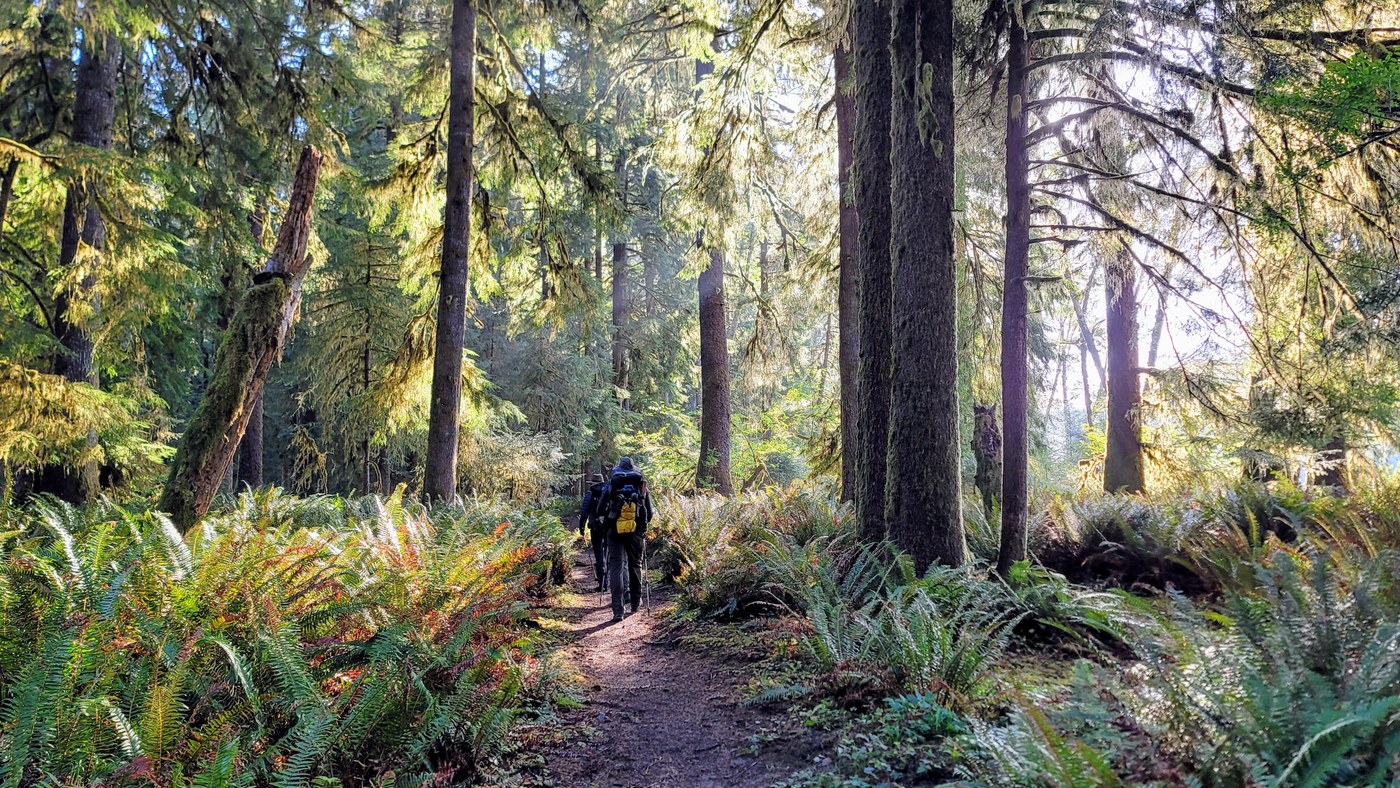
We hiked for eight days across the Olympics, from the rainforest to the rainshadow, following four of the great rivers of the Peninsula: The Bogachiel, the Sol Duc, the Elwha, and the Dosewallips. We circled the Seven Lakes Basin on the High Divide, climbed Appleton Pass and dropped down to Olympic Hot Springs for a soak, and visited the site of the Glines Canyon Dam, the demolition of which set the Elwha free. We ascended the Elwha, climbed Hayden Pass, and descended the Dosewallips. Our route totaled 112 miles, and we climbed over 18,000 feet. Along the way, we saw 13 bears and one marmot. We had clear skies the whole way (except for wildfire haze the last 3 days), and encountered hardly any bugs.
Day 1: Bogachiel trailhead to Fifteenmile Camp. 15 miles. The trail was in great shape, almost entirely clear of blowdowns. About 7.5 miles in, we took the advice from previous trip reports and took the stock ford across the Bogachiel and hiked up the south bank for a couple of miles before crossing again at Flapjack Camp. Both fords were easy, no more than shin-deep. Hiking on the south bank was flat. Reportedly, if we'd stayed on the hiker trail on the north side, we would have encountered much more up and down. We saw few other hikers beyond Flapjack. Fifteenmile Camp is just a small shelter right up against the trail on a steep slope. It was undergoing restoration at the time, with a new shake roof being installed. A new dirt platform had been built in front, and between that and the dirt floor of the shelter, there was just enough room for the four of us. There's no privy or bear wire at this camp. Water was available from a rivulet a hundred yards up the trail.
Day 2. Fifteenmile to Deer Lake. 15 miles. The Bogachiel Trail was in good shape as far as Twentyone Mile Camp (room for one, maybe two tents there). At Hyak Shelter, two park workers were replacing the shake roof. Hyak is a nicer place than Fifteenmile. The shelter faces a meadow, and there are plenty of tent sites. Above Twentyone Mile, there were maybe a half-dozen big blowdowns to the junction with the Mink Lake Trail. The trail looked much less traveled in this stretch, often mossed-over, brushy, or muddy. There was lots of puncheon, some rotten, but much in solid shape. We saw no other hikers on this section. The trail along Little Divide from the Mink Lake junction to Deer Lake was in good shape. We camped on the west side of Deer Lake in the group site, convenient to a privy.
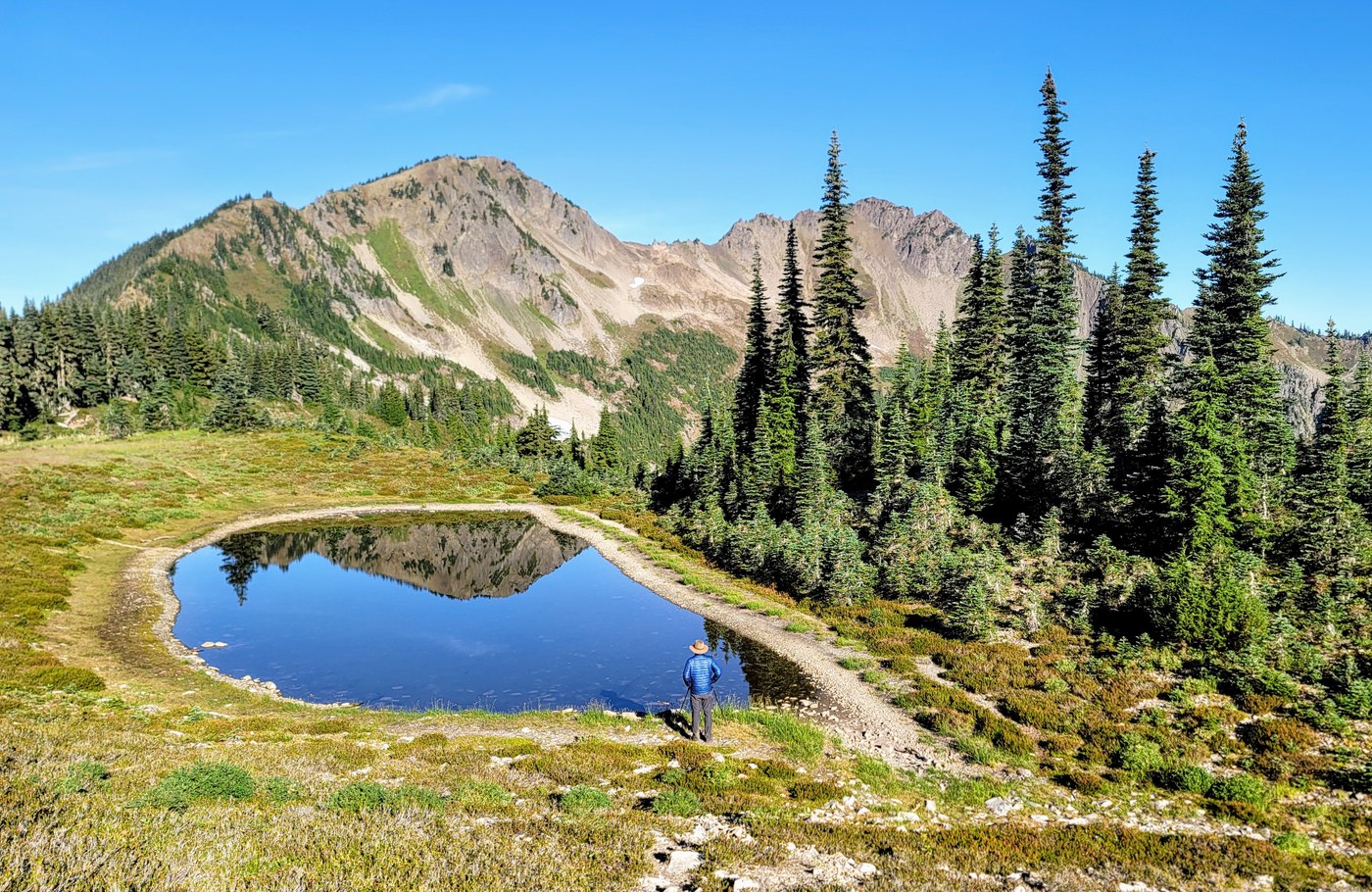
Day 3. Deer Lake to Appleton Pass. 13 miles. We had clear skies for the hike along the High Divide, with spectacular views of Mt Olympus and the Seven Lakes Basin. We saw a mother bear and two cubs right by the trail. We encountered a number of other hikers on the High Divide Trail and the Sol Duc Trail, but had the trail to ourselves once we turned up the Appleton Pass Trail. That trail climbs steeply to the pass, 2200 feet in a bit over 2 miles. But it was clear of blowdowns and the tread was in good shape. At the pass, there were a number of tent sites available, sheltered among trees, and nobody else was camped there. There was also a bear wire. The views were lovely. Because we were unsure of the water situation on the pass, we'd tanked up on water far below, but that turned out to be unnecessary. Oyster Lake, while shallow, was clear and could have supplied all we needed.
Day 4. Appleton Pass to Boulder Creek Campground (by Olympic Hot Springs). 5 miles. This was our day of relative leisure. It was a short hike, all downhill, to the campground. The trail wasn't in great shape, though. It was quite brushy, often steep and rough, and there were several blowdowns to contend with. But Boulder Creek Campground was a great place to camp. There was only one other party camped there, and there was lots of room to spread out. Plus there's a privy and bear wire. We made camp and dropped down to the creek to cross the footlog to the other side, where we found the hot springs. There's a series of pools that have been dammed with rocks. Most were small and unappealing, but we found a nice one on the downhill side of the trail. The water temperature probably wasn't more than 90 F., but it still made for a nice soak.
Day 5. Boulder Creek Campground to Humes Ranch. 17 miles. It was an easy walk down the closed Olympic Hot Springs Rd (stopping at the Glines Canyon Dam site) to the junction with Whiskey Bend Rd. There, we met a friend who had graciously hiked in our resupply for the last three days of the trip. From the Madison Falls trailhead, it's a 2-mile hike to the junction. At this point, by prearrangement, one of our party departed, leaving three of us to complete the hike. From the junction, we walked 5 miles up the gravel Whiskey Bend Rd to the Elwha Trailhead and continued up the Elwha Trail, which was in good shape. We passed Michael's Cabin and Humes Cabin before dropping to the lovely meadow at the Humes Ranch campsite, where there's a bear wire and privy. We camped under a pair of grand old Doug firs in the meadow. One other party was camped far across the meadow. The easiest place to get water was not the river, which was far beyond thick willows, but from a stream a hundred yards up the trail from the bear wire.
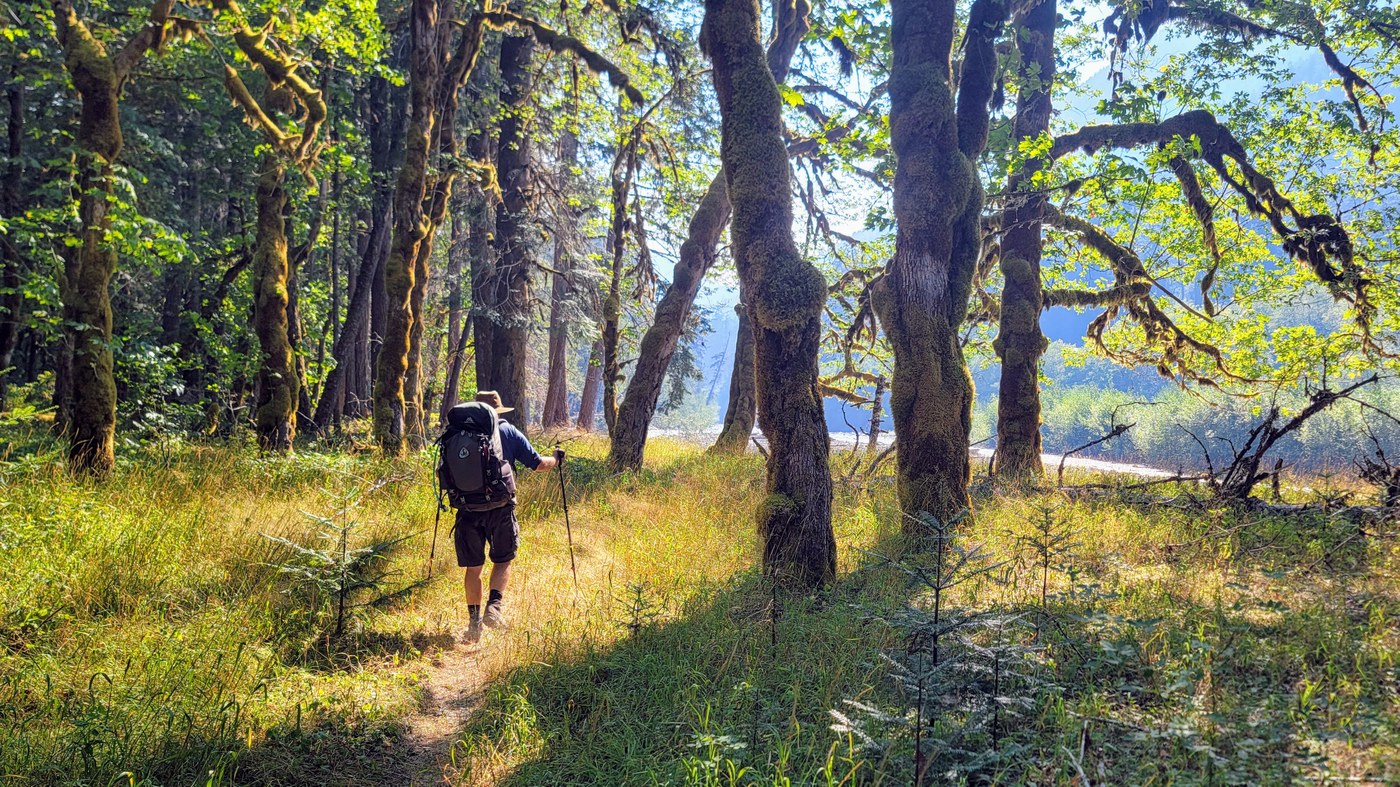
Day 6. Humes Ranch to Hayes River. 16 miles. The mountainsides above the Elwha Valley were draped in haze from wildfires far away in Oregon, but the forests along the river were lovely. Lots of moss-draped rocks and bigleaf maples. The trail was in generally good shape, with a few blowdowns. We stopped for lunch at pretty Elkhorn Camp, which has two shelters, a ranger cabin (closed), and lots of open meadows. Not far after that, we passed Remann's Cabin. This is where you find the ford across the Elwha to the primitive trail headed up to Dodger Point. The river looked easily fordable here. By 5:30, we reached Hayes River Camp, where there's a ranger station, all closed up for the season. There's a bear wire and privy. We found a campsite by the river.
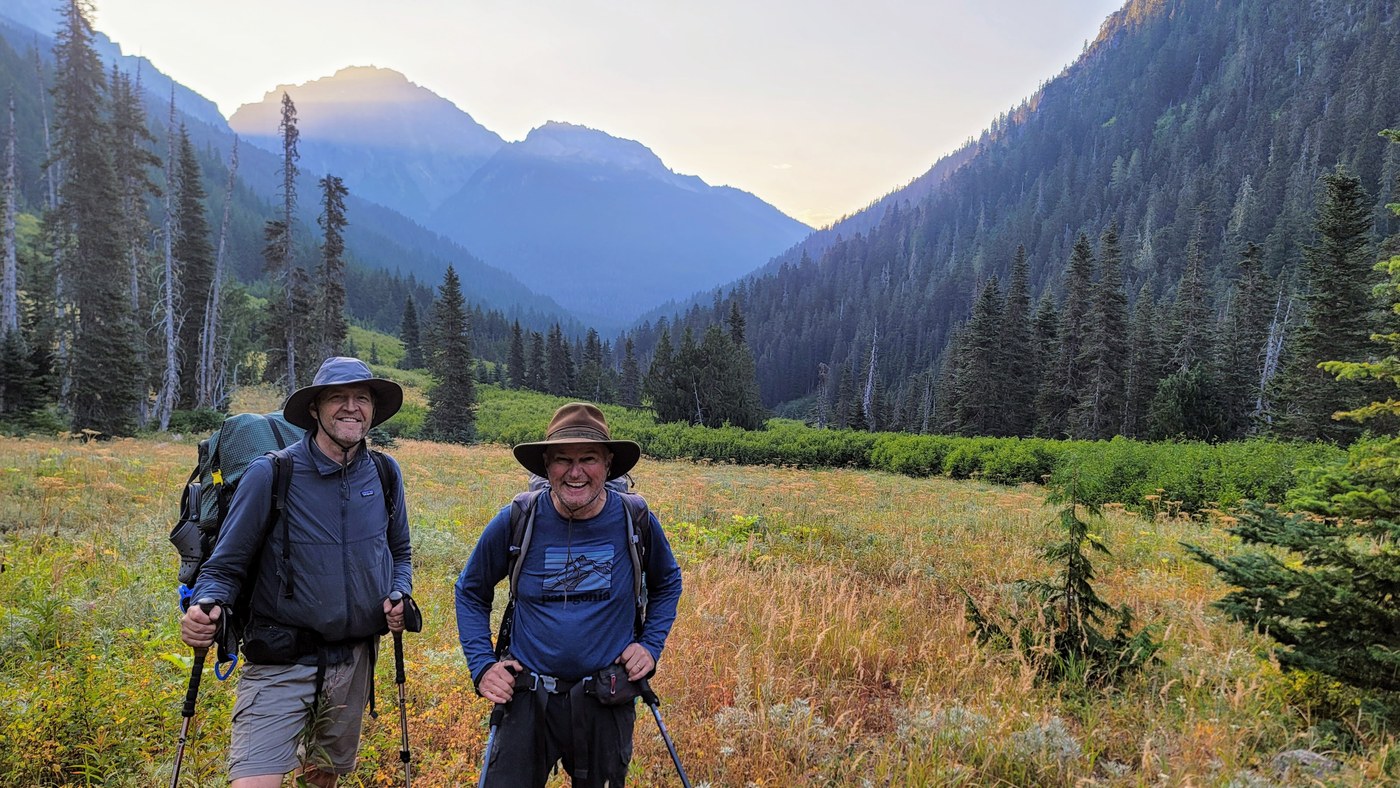
Day 7. Hayes River Camp to Bear Camp. 13 miles. From camp, it was a 4000 foot climb over 8.3 miles to the top of Hayden Pass. The trail was in very good shape most of the way, with a reasonable gradient and good tread. But about halfway up, the trail entered a large burn (left by the 2016 Hayes Fire, which consumed more than 3000 acres) and a number of blowdowns blocked the trail. And of course, the burn was shadeless, making for hot hiking. The combination of the scorched forest and the wildfire haze gave the land an apocalyptic feeing. But from the top, the view to the east down the Dosewallips valley was spectacular. The burn had not crossed the ridge, and all was green below. As we dropped into the high alpine basin, we spotted three bears in quick succession. It was nearly a 2000-foot descent through Dose Meadows to Bear Camp, where we spent our last night. There's a small shelter there, with a couple of tent sites nearby. It's not a particularly scenic place. Two of us slept on bunks in the shelter, while the third opted for his tent. There was no bear wire, and the privy had been flattened by a falling tree.
Day 8: Bear Camp to Dosewallips trailhead. 18 miles. The trail below Bear Camp had a number of blowdowns, some requiring real gymnastics to get past. The trail was also quite brushy in places, since it passes through a series of meadows. The trail improved after we passed the junction for the Constance Pass Trail. After 12 miles, we reached Dosewallips Campground, which was a nice place to stop for lunch. Then, it was 6 miles of easy walking on the closed Dosewallips Road to meet our pickup at the trailhead.
Comments
Awesome, epic trip! Too bad about the burned section of Hayes - Robert L. Wood once described that as an exemplary stretch of ancient forest. Also, very brave to drink from Oyster Lake. :)
Posted by:
SpruceMoose on Sep 14, 2022 08:54 AM