


Here is a trip report for a two-day loop, going in at Phelps Creek, coming out Trinity. I’ll try to focus on aspects that were not accounted for in previous trip reports. If you like the Mt. Rainier NP Northern Loop, you’ll love this hike. There are so many highlights, including long stretches of solitude, but I will just focus on information not available in recent reports.
First off I can give more information for the unpaved section of road for those in low clearance vehicles. Skip below if that’s not pertinent. The road was passable in my little low clearance subcompact hatchback but it was a bit nerve-wracking, due to rockiness, mainly in the last half mile before the fork to the two trailheads. I only hit the undercarriage once or twice but I was more concerned about tire damage. Anyway, I made it both ways. Higher clearance with beefy tires definitely preferred but take what you’ve got, ideally with fully inflated tires and plenty of tread. Note: the section of road to Trinity after the fork didn’t seem to be any worse than the previous section of road. The road to Phelps Creek was eroded at points but not as rocky as the previous section. I went 10-20 mph heading in but had to slow to a crawl numerous times. I parked at the fork and was thankful for it when hiking out and not having to hike another 2 road miles in the sun. Be warned that there is only space for about 6 cars to park at the fork. When I arrived midweek, for example, there was only 1 spot left. Thanks to the folks who gave me a partial lift up to the trailhead!
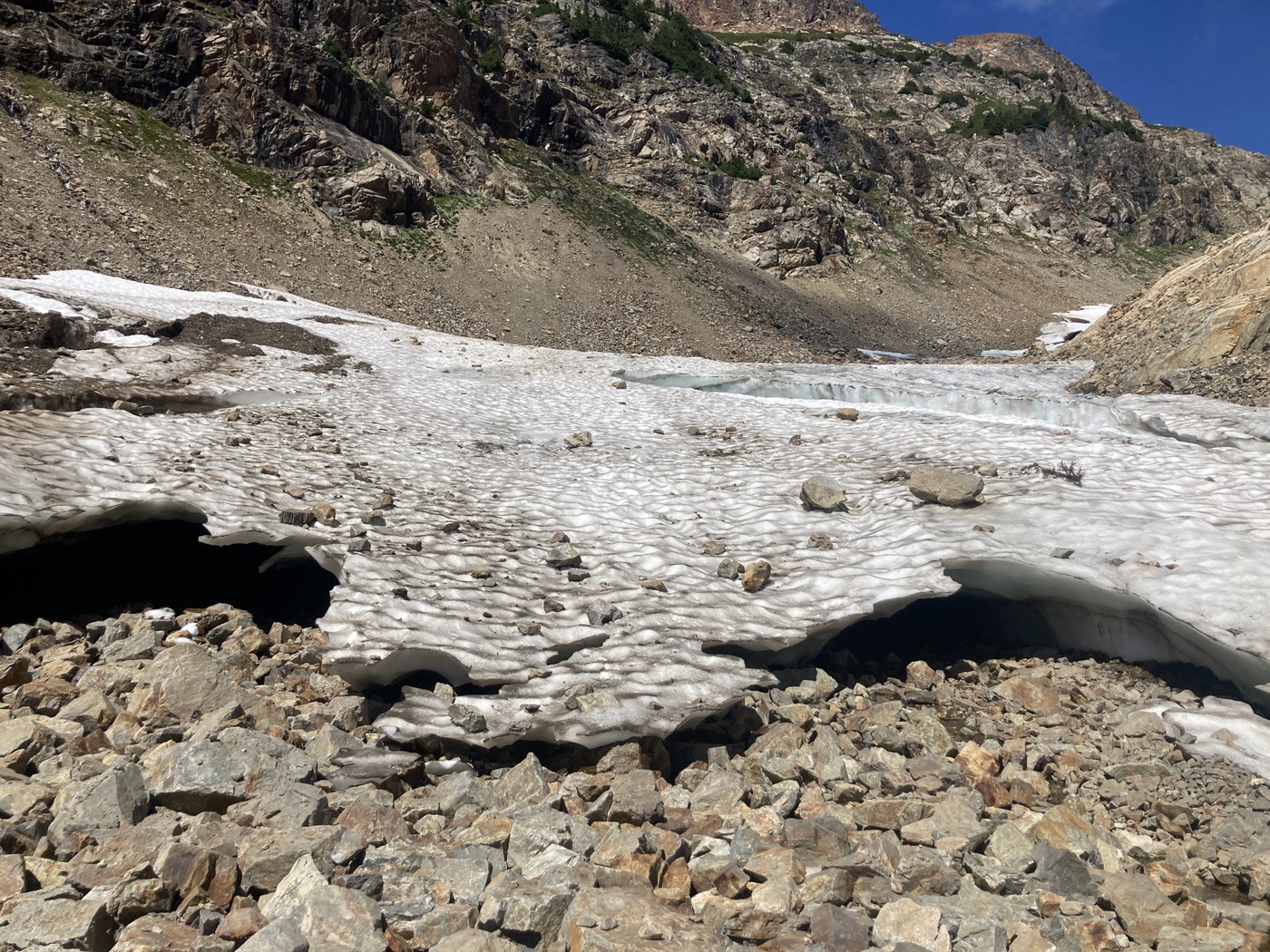
Spider Glacier. I realized that I forgot sunglasses but the snow was dirty enough and the snowfields short enough that it was ok. But you'll want shades. The glacier / snowfields needed some care to traverse but the safer routes seemed obvious (especially after consulting and watching others) and not technical. Near the top I was honored to meet the spider of spider gap. I think I enjoyed the trip up the gap much more than the switchbacks to get to it. It’s reminiscent of the valley from Melakwa Lake to Melakwa Pass but with snowfields.
From Spider Gap down to Lyman Lakes was also uneventful. (I’m not doing justice to the stunning setting in this report but just trying to give new information.) It was helpful to watch someone head off on an obvious trail (edit: it isn't the one labeled Spider Gap / 1256.4 on Gaia) that heads sharply and then after a minute turn left downhill sharply and pick up a fainter trail that switchbacks straight down to the snowfields. Maybe you could stay on that more obvious trail. Just don't take 1256.4. I managed to pick up a faint trail on the scree at the base of the second snowfield , then lost it, then regained it. But you can also just pick your own way down the scree, trying to avoid some of the steeper terrain below you. I found the Gaia app useful- except for the misnamed Spider Gap Trail that I mentioned above. I took an hour to cross all the snow on both sides of the gap, going at a steady but not fast pace and moving more or less the entire time.
Not much to report between Lyman Lakes and Buck Creek Pass trail that hasn’t been reported recently. The PCT thru hikers are out and about and they look determined! It was awesome to chat with them briefly as I yielded to the ones traveling uphill.
Buck Creek Pass trail is a slog but the blowdowns are easy to navigate up to the pass. (Like most of the trails, the tread was good and not eroded like more popular trails and you do get peek-a-boo views of the surrounding peaks and valleys.) Pay attention to the topo: you climb to gain a ridge and lose a fair bit of elevation to Small Creek before climbing up to Buck Creek Pass. I got water at Small Creek because I wanted to snag one of the waterless campsites at the pass with a view before the marked campground that has water. I managed to get one of those sites when rolling in at 7pm (midweek) but at first it wasn’t clear where those were. Glacier Peak stayed out of the clouds until after sunset. I hiked from about 930 am until 7pm that day and I felt great watching the sun set next to Glacier Peak, even if extreme soreness set in once I got back to my car the next day. Note: berries are starting to ripen at the pass and then intermittently down the trail.
At night a cloud settled over the pass and made it damp and chilly. That wasn’t forecast, so be prepared. I was pushing it with a sleeping bag rated to 46 degrees but with a liner and a waterproof bivy I was comfortable enough. It only took ten minutes of a descent to get to blue skies in the morning. It was good to hit the burned out area earlier in the day, otherwise it would be blazing in the sun. Even that area was beautiful in its own way, thanks to the prolific fireweed. Pretty sure that there was a bear down there, not far off the trail, which I spooked. Didn’t see it but heard it snorting as it caught its breath.
BTW I didn’t pick up any signal on my mobile phone (ATT carrier) at any point on the hike, and took nearly an hour of driving back toward the 2 to get enough signal to send a text message.
Also, I encountered virtually no biting bugs, likely due to the decent wind, especially in Lyman Valley, but which also meant that the mountaintops and some passes were clouded over at times throughout the day.
Comments