


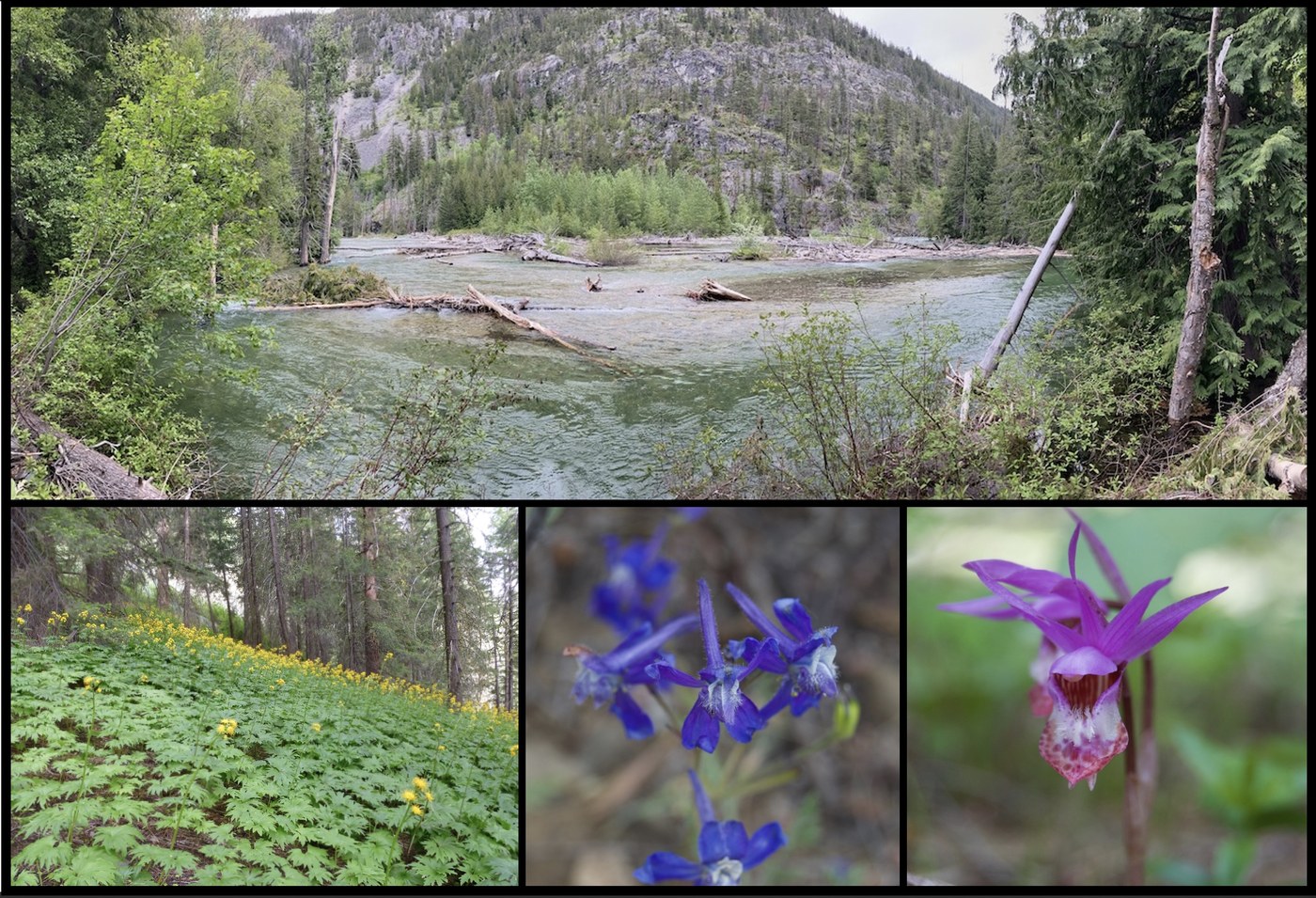
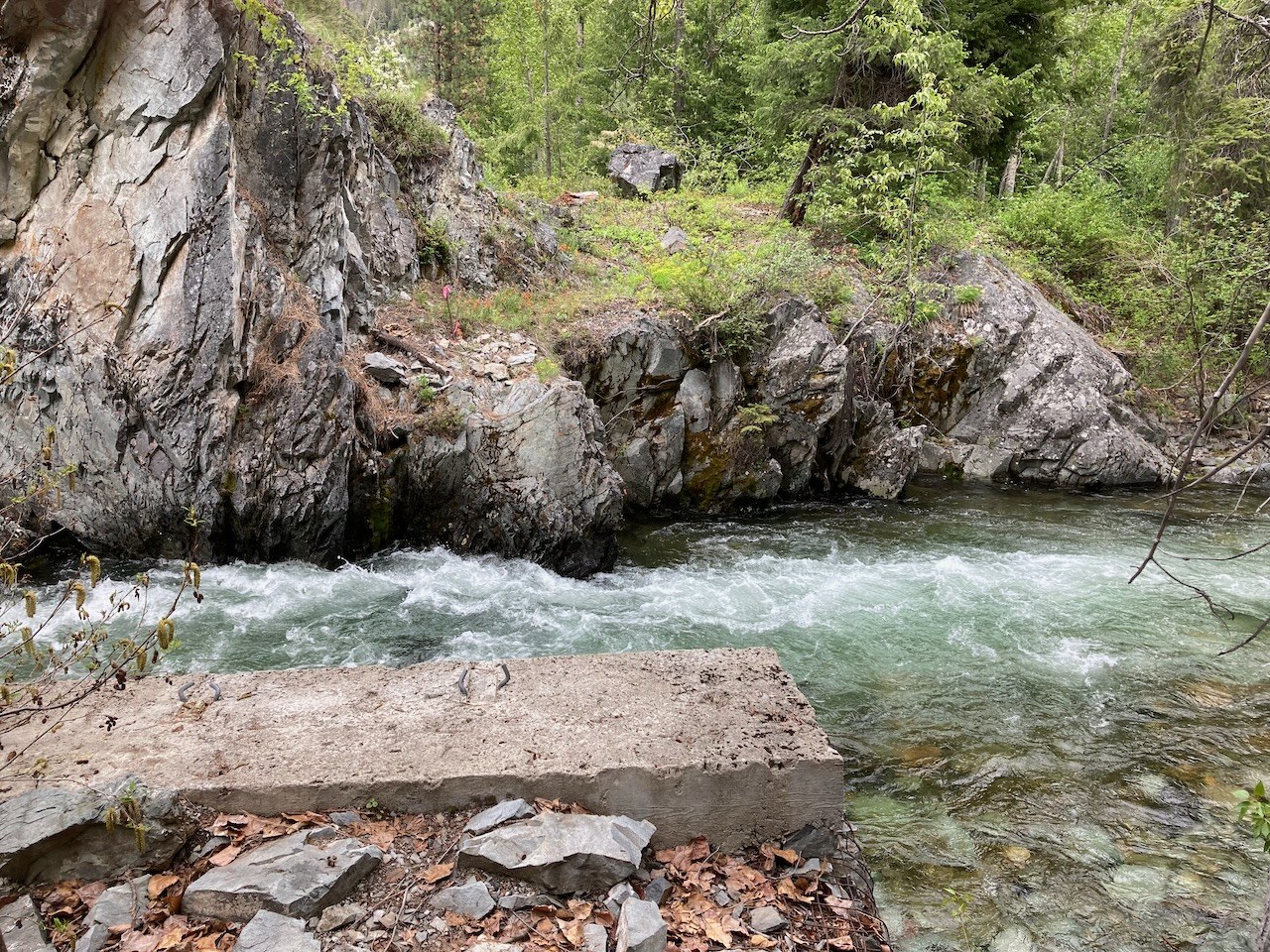
It’s spring, a cloudy day, and it threatens to rain. Historically, I might have gone to Cedar Creek or Wolf Creek, but both trails are closed because of last year’s Cedar Creek fire. I opted for the Monument Creek Trail, which goes along the Lost River, a major tributary to the Methow, for about 4 miles, ending at Eureka Creek, where the anchors for the bridge that washed out in 2006 can be seen (Figure 4). A small load of treated lumber was located at the Pasayten Wilderness boundary—perhaps indicative of a bridge soon. I highly recommend this trail for several reasons that I will detail below.
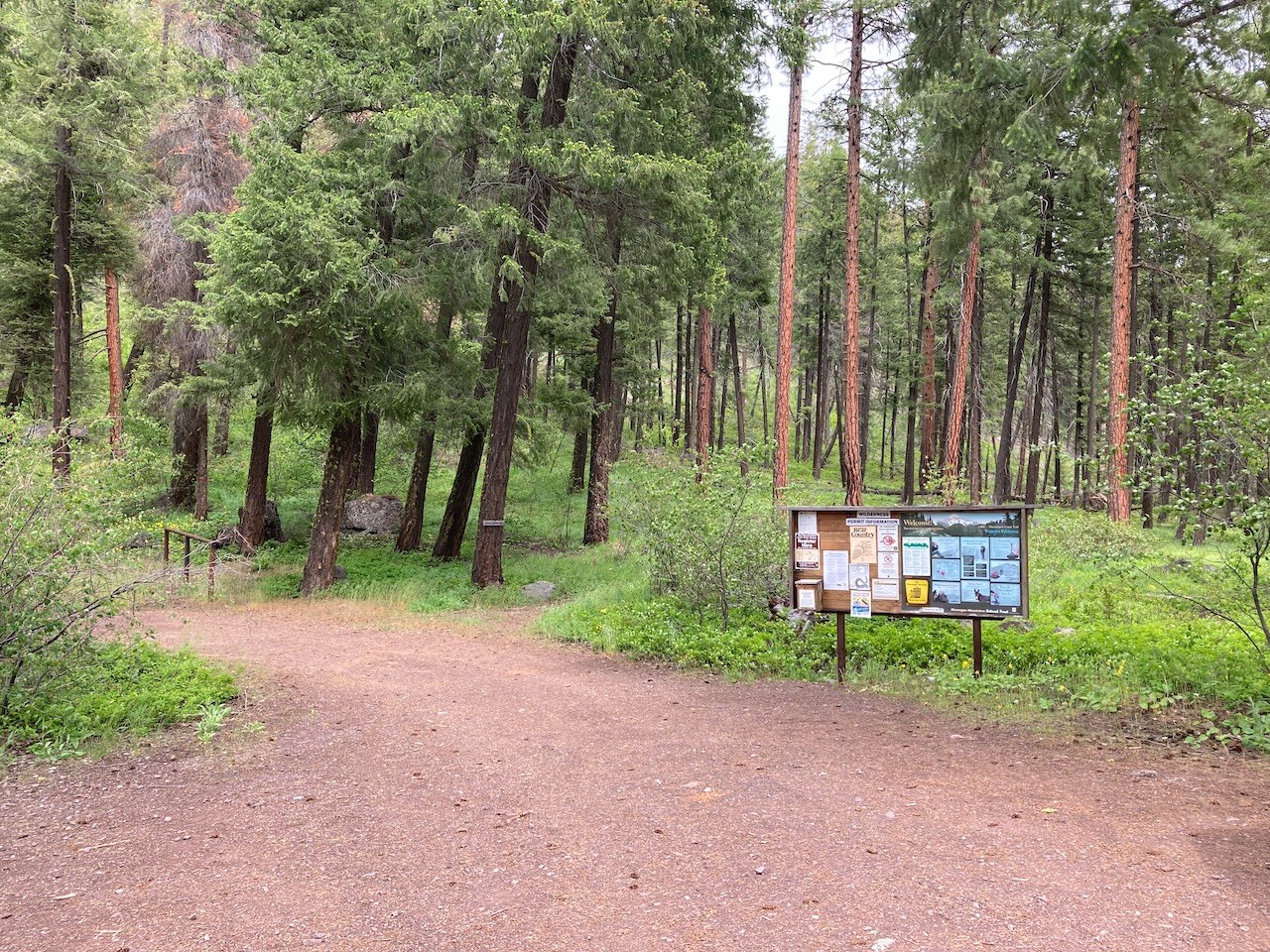
Access: From the Mazama Store, it is about 7.5 miles NNE on the Lost River Road to the bridge over Lost River and the end of pavement. Another quarter of a mile on a pothole deep and plentiful dirt road to a sign that says 'Monument Trail' and road to the right that leads after a short uphill to the trailhead. Forest Service Pass not required. Other than a bulletin board and a place to hitch your horses, there are no other facilities in this relatively small trailhead parking area (Figure 2).
Trail Condition: There has been recent work on this trail including the removal of all obstacles! Trail is in excellent condition (Figure 3). It rises and falls as it heads toward the washed-out bridge at Eureka Creek (Figure 4).
Important Note: There was fresh, but not steaming, and older bear scat in the last 0.5 miles of the trail.
The Names Monument Creek and Lost River: For over 30 years, the trail beyond Eureka Creek has not been maintained and plus the bridge across Eureka Creek accessing the remaining 25 miles of this trail washed out in 2006. The trail historically reached Pistol Pass (~7,100 ft) and then dropped in the Monument Creek valley reaching it at 4,700 feet and then leaving that valley at either Butte Pass (~6,900 ft), which leads into Ptarmigan Creek and Lost Lakes, one of the tributaries of Lost River, or Shellrock Pass (~7,500 ft), which leads back into the headwaters of Eureka Creek. Monument Creek is also a tributary of Lost River. All this activity in a remote and a spectacular region of the Pasayten Wilderness! Plus, thanks to some changes following the last Ice Age, Lost River is now a huge watershed – as you walk the trail in what seems a desolate, steep, and restricted valley, the volume of water and the noise of Lost River seem so disconnected from the surrounding landscape.
As WTA member ‘austineats’ notes, the name Lost River itself is a bit curious. Seasonally, during periods of low flow when the Lost River reaches its confluence with the Methow River, it disappears into glacial outwash deposits that are between 200 to 1,000 feet deep between this confluence and the Weeman Bridge further down the Methow Valley (Konrad 2006 Water Resources Research 42:1). During spring runoff, it is difficult to imagine any volume of water disappearing.
Escaping the Anthropocene (except the trail, of course): Soon after leaving the trailhead, especially on a cloudy day, other than birds, the noise of the river, and the sound of your feet, noise disappears (think of silencing I-90 and the shoot range near Issaquah). Except on major holidays, there are few encounters with people. In the spring, the river roars except for a few locations along the trail.
Botanical Diversity: Water and topography drives what you see and both change often along this biologically interesting trail. Tree species: Very common: Ponderosa pine and Douglas-fir, frequent: black cottonwood, western red cedar, less frequent: grand fir, infrequent: Engelmann spruce, Pacific silver fir, subalpine fir, water birch. Shrub Species: bearberry (in flower), chokecherry (in flower), oceanspray, Oregon boxwood (a few in flower, Oregon grape (in flower), red osier dogwood, Rocky Mountain maple, serviceberry (in flower), snowberry, snowbrush, spirea, thimbleberry. Rare were blue elderberry, mountain ash, and prickly currant. Flowering plants: Arnica, balsamroot arrowleaf, corn lily, chocolate drops, fairy slipper (see Figure 1 bottom right), false salmonseal, Hooker’s fairybells, Indian paintbrush, larkspur, meadow death camas, penstemon, prince’s pine (not in flower), purple lupine, and tall silvercrown (see Figure 1 bottom left).
Learn about the plans for the bridge and the future: https://www.wta.org/go-hiking/trip-reports/trip_report-2021-10-14-4430768027

Comments
Muledeer on Lost River, Monument Creek
Thanks for the report! I've done that trail twice after the bridge washed out, it will be nice to have that bridge back. What I remember is all the white ceanothus in bloom (sneeze) and a flock of Western tanagers hanging around the river, so colorful!
Posted by:
Muledeer on May 30, 2022 12:14 PM